
Contact Fumei
No.20 Jiuqiao Road, Shijiang Industrial Area, Jiujiang Town, Nanhai District, Foshan City, China.
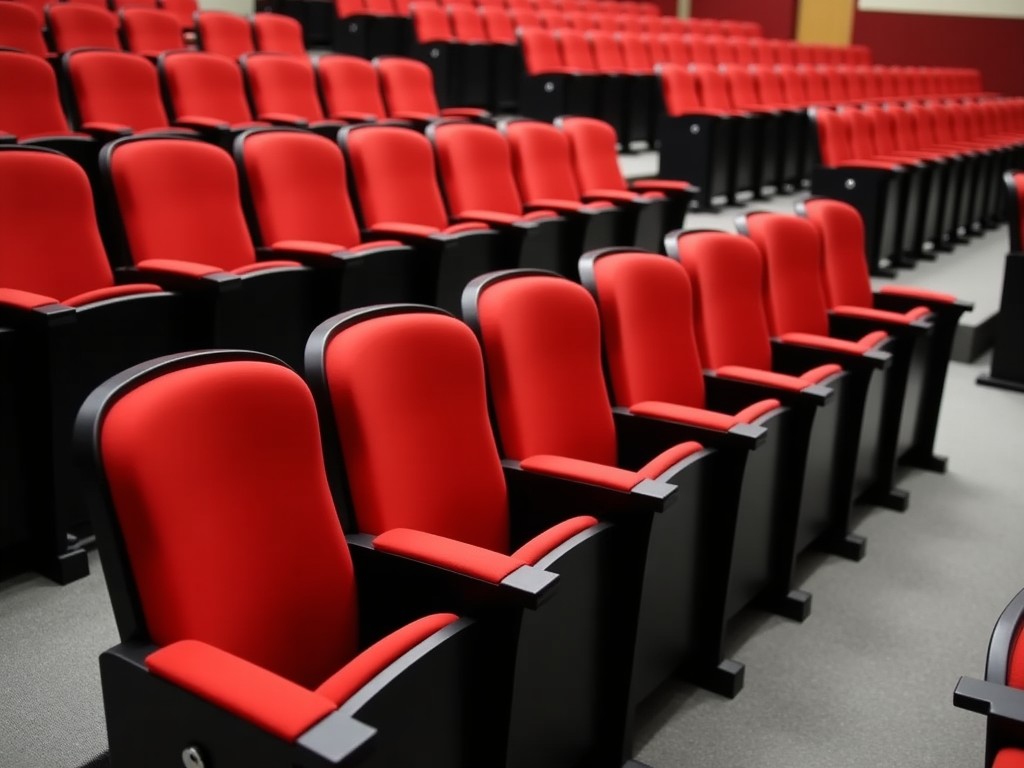
AF-820 classroom seating furniture. Featuring cold-rolled steel, CAL 117 fire-retardant fabric, and 20,000-cycle hinges. Ideal for universities. B2B wholesale.
Selecting auditorium folding chair suppliers requires evaluating engineering specifications that impact long-term usability, safety compliance, and lifecycle cost. This guide outlines key technical parameters procurement teams should verify during supplier assessment, focusing on measurable characteristics rather than subjective claims.
Frame integrity determines safety margins under dynamic loading. Reputable suppliers provide chairs tested to withstand 150 kg static load per seat with a 2:1 safety factor, verified through cyclic testing per EN 12520 or ANSI/BIFMA X5.1 standards. Frame materials typically use 1.2–1.5 mm cold-rolled steel with powder coating thickness ≥80 μm for corrosion resistance in humid environments.
Ergonomic design reduces fatigue during extended use. Seat depth should range 400–450 mm to accommodate 5th–95th percentile users, with a 100–120 mm front waterfall edge to reduce thigh pressure. Backrest height between 300–350 mm supports lumbar alignment, while a 5°–8° recline angle balances posture support with egress efficiency in tight row spacing.
Folding mechanisms endure repetitive stress; high-cycle applications demand rated life of 20,000+ cycles without degradation. Suppliers should disclose pivot point materials—hardened steel pins or self-lubricating bushings—and specify lubrication maintenance intervals. Quiet operation (<45 db="" during="" deployment="">
Fabric selection affects cleanability, fire safety, and wear resistance. Common options include:
Polyester blends with ≥50,000 Martindale abrasion resistance for high-traffic venues
Vinyl-coated textiles meeting CAL 117-2013 fire retardancy with wipe-clean surface
Trevira CS®-treated fibers for inherent flame resistance in theaters and auditoriums
Storage density impacts facility planning. Standard folded chair depth ranges 200–250 mm, allowing 18–22 units per linear meter of storage rail. Overall deployed width (including armrests) typically measures 520–580 mm; verify interlocking tolerances to prevent gapping or binding when rows are fully deployed.
Reliable suppliers implement incoming material inspection (steel thickness, coating adhesion), in-process weld integrity checks (6σ visual + spot ultrasonic), and final function testing (load, fold/unfold cycles, noise). Request batch-level traceability for critical components and documentation of compliance with ISO 9001:2015 or equivalent QMS.
Beyond standard models, suppliers may offer:
Integrated tablet arms (300×200 mm working surface, 15 kg load capacity)
Numbered backplates for seat management systems
End-of-row restraint brackets to meet local egress codes
Custom fabric colors via Pantone matching with lab-dip approval
| Parameter | Tier 1 (Basic) | Tier 2 (Mid-Range) | Tier 3 (Premium) |
|---|---|---|---|
| Frame Material Thickness | 1.0 mm | 1.2 mm | 1.5 mm |
| Cycle Life Rating | 10,000 cycles | 20,000 cycles | 50,000 cycles |
| Upholstery Abrasion Resistance | 30,000 Martindale | 50,000 Martindale | 100,000 Martindale |
| Fire Retardancy Standard | CAL 117 | CAL 117 + BS 5852 | CAL 117 + BS 5852 + EN 1021-1/2 |
Before finalizing supplier selection, verify:
Test reports for load capacity and cycle life from accredited labs
Material safety data sheets (MSDS) for upholstery and coatings
Warranty terms covering frame (min. 5 years) and mechanism (min. 3 years)
Packaging method for damage prevention (corrugated corners, stretch wrap, palletization)
Lead time for standard vs. customized orders (typically 4–8 weeks)








