
Contact Fumei
No.20 Jiuqiao Road, Shijiang Industrial Area, Jiujiang Town, Nanhai District, Foshan City, China.
AF-8025 auditorium seating chair. Featuring cold-rolled steel frame, fire-retardant fabric, and durable molded foam. Ideal for Theater, Lecture Hall. OEM factory wholesale.
Selecting auditorium seating requires balancing initial cost with long-term performance, compliance, and user experience. This page outlines the factors influencing auditorium seating chair pricing, including material choices, mechanical systems, customization levels, and volume-based pricing tiers. Understanding these elements enables procurement teams to evaluate total cost of ownership and make informed decisions aligned with project budgets and technical requirements.
Auditorium seating chair prices vary significantly based on structural design, upholstery materials, mechanism type, and compliance standards. Base models typically start at lower price points but may lack features essential for high-usage environments such as theaters, lecture halls, or conference centers. Premium configurations incorporate reinforced frames, fire-retardant fabrics, and automated folding mechanisms, which increase unit cost but reduce maintenance frequency and extend service life.
Volume pricing applies uniformly across all tiers: orders exceeding 100 units typically receive a 5–15% discount, while projects over 500 seats may qualify for negotiated rates based on logistics efficiency and simplified installation. Custom branding, embroidery, or special stitching adds a fixed surcharge per seat regardless of volume.
| Configuration Tier | Frame Material | Upholstery Type | Mechanism | Typical Unit Price (USD) |
|---|---|---|---|---|
| Economy | Steel frame, powder-coated | Standard polyester fabric | Manual fold-up, gravity-assisted | $85 – $110 |
| Standard | Steel frame, reinforced joints | Fire-retardant fabric (FR rating) | Spring-assisted fold-up | $120 – $160 |
| Premium | Steel frame, welded construction | FR fabric, stain-resistant coating | Dampened fold-up, noise-reducing | $180 – $240 |
| Custom/Luxury | Steel or aluminum alloy, custom finish | FR fabric, vinyl, or leatherette options | Motorized or manual with tablet arm | $260 – $400+ |
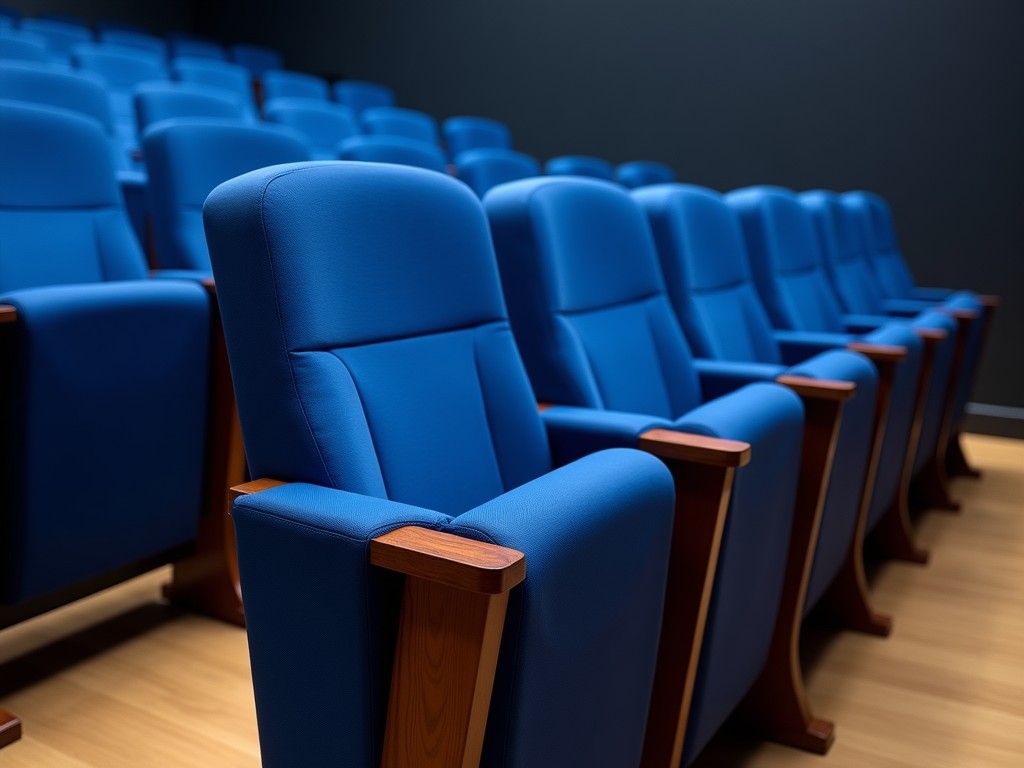
Upholstery selection directly affects both price and lifecycle performance. Standard polyester fabric is the most economical but offers limited stain resistance and flame retardancy. Fire-retardant (FR) treated fabrics meet international safety codes (e.g., BS 5852, CAL 117) and add approximately 15–20% to the base cost. Vinyl and leatherette alternatives provide superior durability and ease of cleaning, increasing unit price by 25–40% but reducing long-term maintenance in high-traffic or food-service-adjacent auditoriums.
Frame materials influence both structural integrity and cost. Standard cold-rolled steel with powder coating is sufficient for most installations. In environments requiring corrosion resistance (e.g., coastal venues), galvanized or stainless steel frames are available at a 30–50% premium. Aluminum alloy frames reduce weight for easier handling but require thicker cross-sections to match steel strength, resulting in comparable or slightly higher costs.
The folding mechanism is a critical cost driver and reliability factor. Gravity-assisted manual systems are simplest and least expensive but rely on user action to return the seat to upright position, which can lead to uneven wear and misalignment over time. Spring-assisted mechanisms ensure consistent return behavior and add approximately 10–15% to the unit cost. Dampened systems, which use hydraulic or pneumatic controls to slow the fold-down motion, reduce impact noise and frame stress, justifying a 20–30% increase in price for theaters and performance halls where acoustics matter.
Optional features such as tablet arms, cup holders, or under-seat storage add fixed costs per unit. A standard flip-tablet arm increases price by $25–$40, while integrated cup holders add $10–$15. These accessories are priced independently of volume discounts and should be specified early in the quotation process to avoid redesign delays.
Unit pricing decreases with order volume due to economies of scale in material procurement, frame stamping, and assembly line efficiency. The following tiers reflect typical discount structures applied to the base price of each configuration level:
1–50 units: base price (no discount)
51–100 units: 5% discount
101–300 units: 8–12% discount
301–500 units: 12–15% discount
500+ units: negotiable; often 15%+ with logistics optimization
Additional cost factors include shipping method (flat-pack vs. pre-assembled), installation requirements, and site-specific conditions such as floor slope or fixed mounting needs. Pre-assembled shipping increases freight volume but reduces on-site labor; flat-pack reduces transportation cost but requires skilled assembly. Projects requiring custom row curvature, aisle lighting integration, or ADA-compliant spacing should budget for engineering review and potential tooling adjustments.
While initial purchase price is a primary concern, industrial buyers should evaluate total cost of ownership over a 10–15 year lifespan. Chairs with higher upfront costs due to superior materials and mechanisms often exhibit lower annual maintenance, fewer replacements, and better compliance with safety inspections. For example, a premium-tier chair priced at $220 may incur less than $15/year in maintenance over 12 years, whereas an economy model at $95 might require $40/year in repairs, reupholstering, or mechanism adjustments, narrowing the long-term cost gap significantly.
Warranty terms also influence value perception. Standard warranties cover frame defects for 5–10 years and mechanism operation for 2–3 years. Extended warranties are available upon request and may be factored into negotiated pricing for large projects. Buyers should request detailed maintenance schedules and spare parts availability as part of the procurement package.
To receive an accurate auditorium seating chairs price list tailored to your project, provide the following technical details: total seat count, required configuration tier, preferred upholstery material and color, mechanism type, any required accessories (tablet arms, cup holders), flooring type (concrete, wood, tiered), and delivery timeline. Including venue drawings or seating plans enables precise pricing for custom row layouts, aisle cuts, and ADA-compliant sections.
Quotations are typically valid for 30 days and include itemized pricing, volume discounts, estimated lead time (usually 4–8 weeks after design approval), and shipping terms. For projects exceeding 200 seats, we recommend a technical consultation to validate load requirements, egress compliance, and installation logistics.








