
Contact Fumei
No.20 Jiuqiao Road, Shijiang Industrial Area, Jiujiang Town, Nanhai District, Foshan City, China.
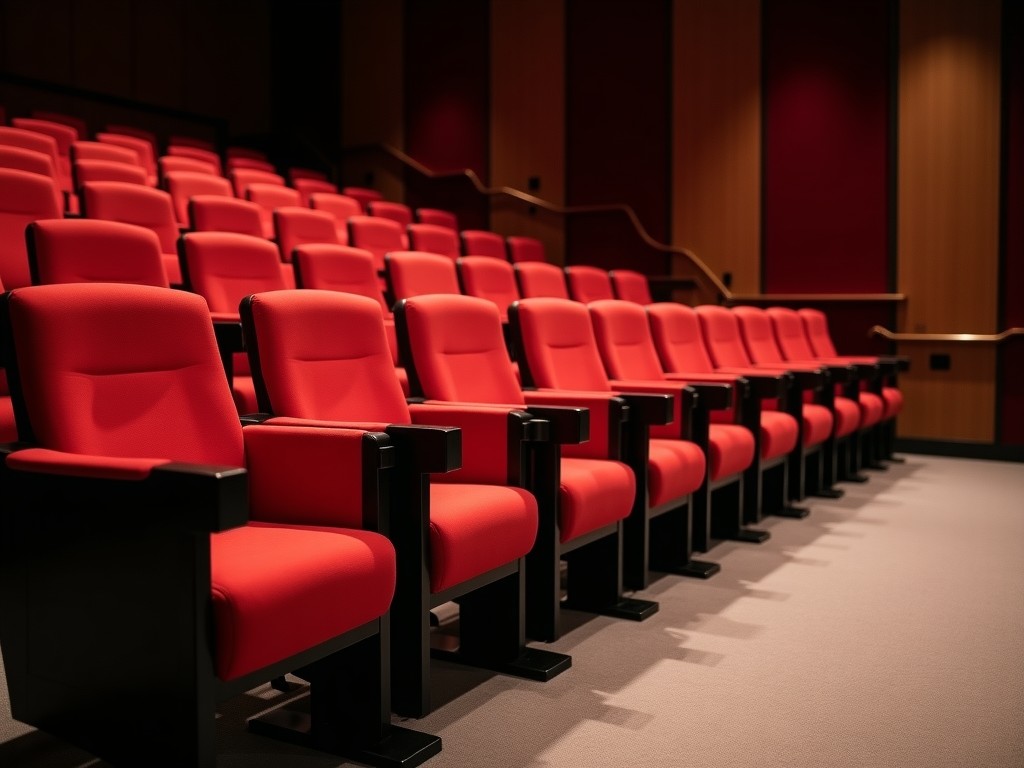
FM-2019 training room chair. Featuring foldable writing tablet, cup holder, and slim 180mm profile. Ideal for training room, university, auditorium.OEM.
Each auditorium seat frame is constructed from cold-rolled steel with a minimum thickness of 1.8mm, formed through precision stamping and robotic welding to ensure dimensional tolerance within ±0.5mm. The frame undergoes finite element analysis to distribute dynamic loads from occupants weighing up to 120kg per seat, with safety factors exceeding 3:1 under cyclic loading conditions equivalent to 100,000 use cycles. Armrests and backrest brackets are reinforced with gussets at stress concentration points, reducing deflection under lateral forces by 40% compared to standard designs.
Seat shells are manufactured from high-density polypropylene copolymer with UV stabilizers, tested to retain 90% of impact strength after 1,500 hours of accelerated weathering per ASTM G154. Upholstery options include solution-dyed polyester with a Martindale abrasion resistance rating of 50,000 cycles, meeting ISO 12947-2 standards for heavy contract use. Frame finishes undergo a three-stage pretreatment followed by electrostatic powder coating with epoxy-polyester hybrid, achieving 500-hour salt spray resistance per ASTM B117 without blistering or adhesion loss.
Seat depth is adjustable between 480mm and 520mm via sliding mechanisms on the frame, accommodating varying anthropometric data while maintaining consistent row spacing. The backrest angle offers 5-position recline from 95° to 110° in 3.75° increments, locked by a friction-based mechanism requiring no tools for adjustment. When folded, the seat protrusion into the aisle is reduced to 180mm, allowing minimum clear width of 1,050mm between rows per NFPA 101 life safety code for egress.
Customization begins with thermal modeling of the venue to determine optimal seat pitch based on HVAC load and sightline calculations. Clients provide CAD files of the space, which are used to generate seat numbering logic, aisle lighting integration points, and wheelchair-accessible module placements per ADA and ISO 21542 standards. Armrests can be specified with integrated tablet arms, cup holders, or power outlets, each adding no more than 25mm to the overall seat width and requiring separate circuit routing plans.
Every production batch undergoes incoming material verification with spectrometer analysis for steel composition and melt flow index testing for polymers. Weld joints are inspected via 100% ultrasonic scanning, with acceptance criteria based on ISO 5817 Level B for porosity and crack detection. Final assembly includes functional testing of folding mechanisms over 50 cycles, with torque validation of fastening points using calibrated digital wrenches; all data is logged in a traceability system linked to serial numbers for field service tracking.
Price competitiveness is achieved through high-volume tooling amortization, where stamping dies for frame components are designed for 500,000+ cycles, reducing per-unit tooling cost below $0.80 at annual volumes exceeding 20,000 seats. Material sourcing leverages regional supply chains for steel and polymers, minimizing logistics variance and enabling fixed-price quotes for 6-month periods. Labor efficiency is improved through cellular manufacturing layouts, reducing assembly time per seat to 8.5 minutes via standardized work instructions and poka-yoke error proofing.
Seats are packaged in knockdown configuration with frame components nested in corrugated cardboard dividers rated for 200 lbs burst strength, preventing metal-to-metal contact during transit. Upholstered elements are wrapped in low-density polyethylene film with anti-static additives, then placed in double-wall cartons with corner protectors rated for 15J impact absorption. Each palletized unit includes shock indicators and tilt sensors, with acceptance criteria requiring less than 5g peak acceleration and no tilt beyond 15° from vertical during shipment.
| Parameter | Typical Value | Customizable Range |
|---|---|---|
| Seat Width | 520mm | 480mm – 580mm |
| Backrest Height | 900mm | 800mm – 1,000mm |
| Seat Height (Folded) | 580mm | 550mm – 620mm |
| Frame Material | Cold-rolled steel SPCC | Stainless steel 304, Galvanized |
| Upholstery Abrasion Resistance | 50,000 Martindale cycles | 30,000 – 100,000 cycles |
| Weight Capacity | 120kg per seat | 100kg – 150kg |
In concert halls, the seating system supports acoustic integrity by minimizing internal cavities that could cause resonant frequencies between 63Hz and 125Hz, achieved through solid back panels and sealed undersides. For multi-purpose auditoriums hosting lectures and theatrical performances, the quick-fold mechanism allows reconfiguration of floor space within 15 minutes per 100 seats, enabling rapid conversion to flat-floor layouts for exhibitions or dining events. The low seat profile (580mm folded height) ensures unobstructed sightlines over preceding rows when occupied, maintaining a minimum vertical clearance of 1,100mm from eye level to the top of the seat in front, calculated using seated eye height of 1,050mm for 95th percentile male.
Production line balancing ensures takt time of 90 seconds per seat across stamping, welding, painting, and assembly stations, monitored via real-time OEE tracking with target availability above 85%. Tool wear is managed through predictive maintenance schedules based on stroke count, with die inspections conducted every 25,000 cycles to maintain dimensional stability. Paint thickness is verified using dry-film thickness gauges at three points per frame, targeting 80–120μm for corrosion protection, with automatic rejection if outside tolerance.
To initiate a quotation, provide the venue’s floor plan in DWG or PDF format, specifying required seat count, aisle layout, and any accessibility requirements. Our technical team will return a detailed seating layout drawing with load calculations, material data sheets, and installation instructions within two business days. For export projects, we offer packaging compliance documentation including ISPM 15 wood treatment certificates and container loading plans to minimize port handling risks.
Contact our engineering team to discuss your auditorium seating requirements and receive a project-specific cost analysis.








