
Contact Fumei
No.20 Jiuqiao Road, Shijiang Industrial Area, Jiujiang Town, Nanhai District, Foshan City, China.
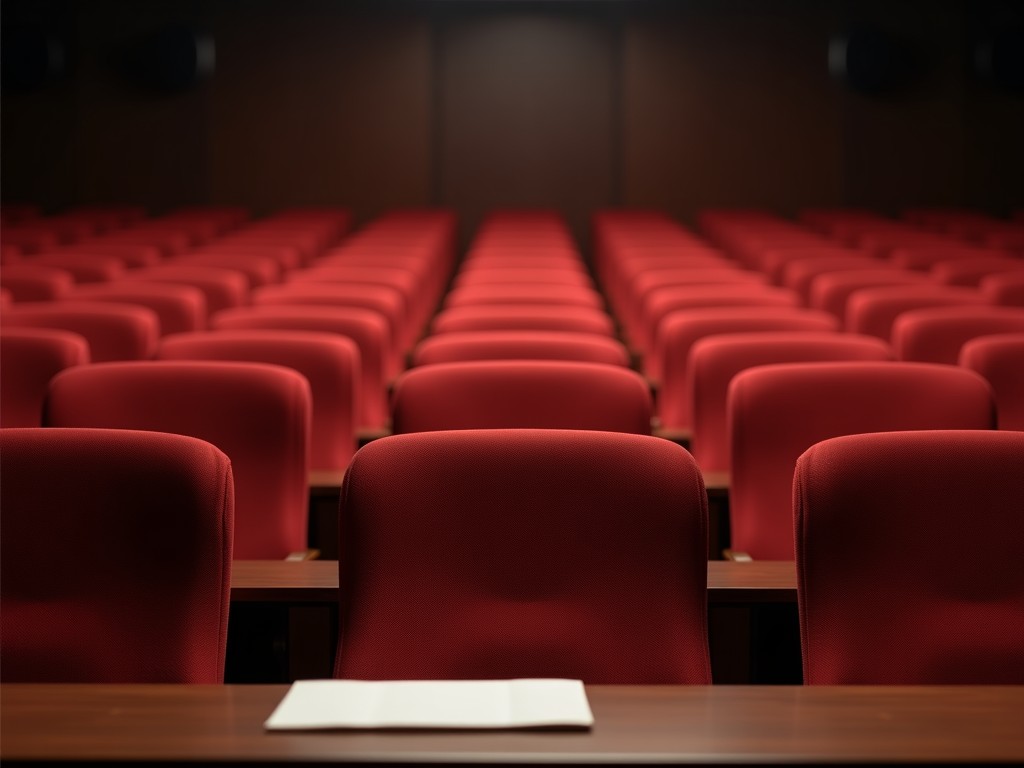
FM-2019 multi-functional training seating. Featuring integrated fold-down writing tablets, robust pivot mechanisms, and floor-mounted frames. Global bulk supplier.
Fixed auditorium seating with integrated writing tables addresses specific ergonomic and spatial requirements in lecture halls, conference centers, and performance venues where note-taking or device use occurs during seated events.
This page explains the technical considerations, material choices, dimensional relationships, and customization options that influence long-term functionality and user comfort in such systems.
The seating unit typically combines a steel or aluminum frame with a molded seat and backrest, to which a writing table is attached via a pivot or slide mechanism. The frame transfers user and table loads to the floor through anchor points, often designed to meet DIN EN 12727 or BIFMA X5.1 standards for public seating.
Writing tables are commonly cantilevered from the seat riser or attached to the seat frame, requiring sufficient moment resistance to prevent deflection under lateral loads (e.g., elbow pressure, laptop weight). Frame tubing diameter and wall thickness are selected based on span and expected load, with 1.5–2.0 mm cold-rolled steel being typical for 450 mm table extensions.
Finite element analysis is often used to validate stiffness, ensuring table deflection remains under 2 mm under a 150 N lateral load at the front edge, maintaining usability for writing or tablet use.
Two primary mechanisms exist: fold-down tables that store vertically when not in use, and slide-out tables that retract horizontally beneath the seat. Fold-down designs use gas springs or torsion bars to control motion and prevent sudden drop; slide-out systems rely on low-friction nylon rollers or ball bearings within guided channels.
Table surface height relative to the seat is critical for ergonomics. A range of 250–280 mm above the compressed seat surface accommodates 90th percentile forearm clearance when using a laptop or notebook, based on ISO 9241-5 anthropometric data.
Surface materials include high-pressure laminate (HPL), melamine-faced chipboard, or molded polypropylene, chosen for wear resistance, ease of cleaning, and impact strength. Edge treatments—such as 2 mm PVC or polyurethane—reduce chipping and improve durability in high-use environments.
The retracted depth of the writing table directly affects minimum row spacing. Fold-down tables typically add 60–80 mm to the seat depth when stored, while slide-out tables may require only 20–40 mm of additional clearance if fully nested beneath the seat.
Aisle access and egress compliance (e.g., NFPA 101) influences whether tables are permitted to overlap the aisle when deployed. In many jurisdictions, tables must not reduce required aisle width below 1100 mm when in use, necessitating careful calculation of table extension angle and seat rake.
Row curvature and sightline requirements further complicate layout; radial seating often requires tapered table designs or variable extension lengths to maintain consistent user access to the writing surface across curved rows.
Frame materials are selected based on corrosion resistance, weight, and finish durability. Powder-coated steel is common for indoor venues; anodized aluminum or stainless steel may be specified for humid environments or coastal installations to prevent staining and reduce maintenance.
Seat and backrest components often use injection-molded polypropylene with UV stabilizers or flame-retardant additives (meeting CAL 117 or EN 1021-1/2) for fire safety compliance. Upholstered options, when used, incorporate foam with specified indentation load deflection (ILD) values and fabric abrasion resistance (e.g., >50,000 Martindale cycles) for heavy-duty use.
Writing table surfaces resist common cleaners (isopropyl alcohol, diluted bleach) and staining from beverages or markers, with surface energy and porosity specified to ensure long-term hygiene and appearance retention.
Beyond standard configurations, options include integrated power outlets, USB charging ports, or data ports mounted on the table surface or underside, requiring coordination with venue electrical planning and cable management systems.
Number holders, cup holders, or document clips can be added as molded accessories or aftermarket attachments, with placement studied to avoid interference with writing motion or leg clearance.
Seat numbering, row identifiers, or accessibility markers (e.g., for wheelchair companion seats) are often laser-etched or applied via durable decals, with contrast ratios designed to meet ADA or local accessibility guidelines for visibility.
Manufacturing quality focuses on consistent mechanism operation, surface finish adhesion, and dimensional repeatability. Automated torque tools ensure fasteners are tightened to spec (e.g., M6 bolts at 8–10 Nm) to prevent loosening under cyclic loading.
Accelerated life testing may simulate 10,000+ fold cycles for tables or 50,000+ impact cycles for seats to validate durability. Warranty terms often reflect these tests, with frame components covered for 5–10 years and moving parts for 2–5 years, depending on usage classification.
End-of-life disassembly is facilitated by mechanical fasteners over adhesives, allowing material separation for recycling—steel frames, aluminum components, and polypropylene parts are commonly recovered in municipal or industrial streams.
| Parameter | Typical Range / Option |
|---|---|
| Seat Width | 480–550 mm |
| Seat Depth (compressed) | 400–450 mm |
| Backrest Height | 350–400 mm |
| Writing Table Depth (extended) | 300–350 mm |
| Writing Table Width | 400–480 mm |
| Table Height Above Seat | 250–280 mm |
| Frame Material | Cold-rolled steel (1.5–2.0 mm), aluminum, or stainless steel |
| Table Surface | HPL, melamine, or polypropylene |
| Weight Capacity (seat) | 120–150 kg static load |
| Table Load Capacity | 15–20 kg (distributed) |
In technical training centers or product demonstration auditoriums, attendees frequently reference schematics, take notes, or use tablets during presentations. Fixed writing tables eliminate the need for clipboards or lap desks, improving note legibility and reducing physical strain over sessions lasting 60–90 minutes.
In legislative chambers or municipal council halls, where members reference documents or electronic devices during debates, the writing table provides a stable surface that supports consistent posture and minimizes distractions caused by adjusting materials on the lap.
The fixed nature of the attachment also prevents loss or misplacement of auxiliary accessories, ensuring every seat provides identical functionality—a key factor in environments where equitable access to tools is expected.
For project-specific configurations, including custom dimensions, material selections, or integration of power/data ports, contact our engineering team to discuss requirements and receive a detailed quotation.








