
Contact Fumei
No.20 Jiuqiao Road, Shijiang Industrial Area, Jiujiang Town, Nanhai District, Foshan City, China.
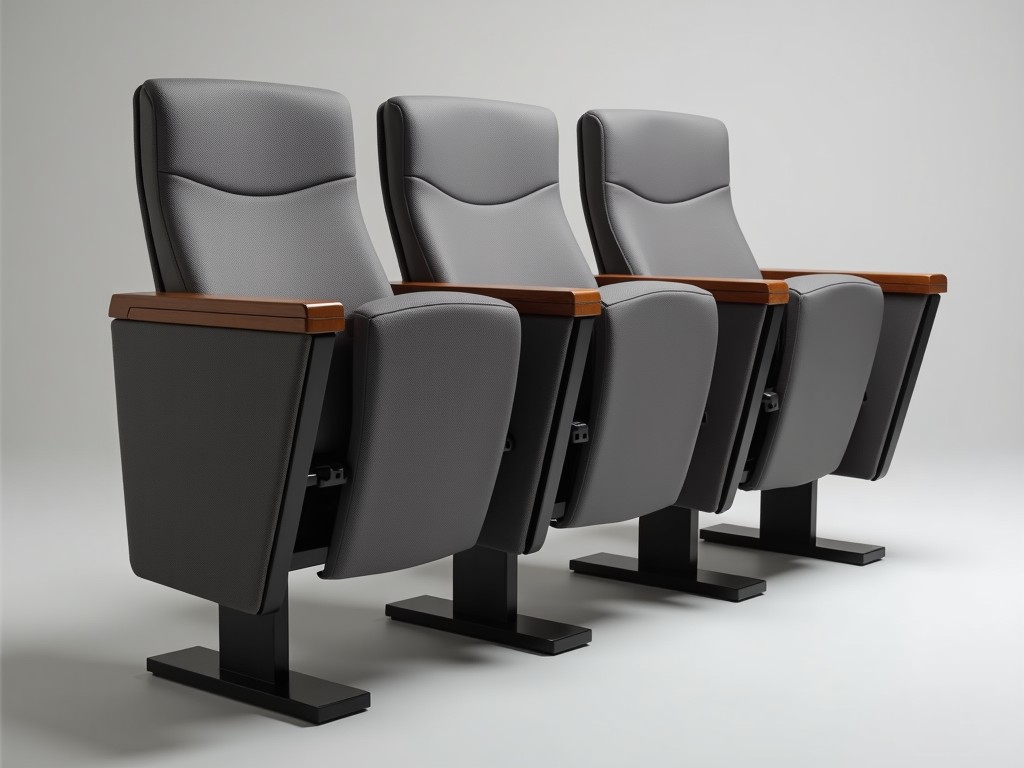
HD-201 learning furniture. Featuring high-density HR foam, spring-return mechanism, and quiet pivot. Ideal for higher education classroom furniture. OEM supply.
Heavy duty auditorium chairs are engineered for permanent installation in venues requiring high-cycle usage, structural integrity under sustained loads, and compliance with public assembly safety standards. This page details the technical specifications, material selection criteria, and design considerations that define industrial-grade auditorium seating for institutional and commercial applications.
The load-bearing frame determines long-term performance in high-traffic environments. Industrial auditorium chairs typically use cold-rolled steel profiles with minimum thickness of 2.0mm for seat standards and 2.5mm for back supports, formed through precision stamping and robotic welding to ensure dimensional tolerance under ±0.5mm. Frame geometry incorporates tapered leg designs to distribute dynamic loads across four-point contact zones, reducing point stress concentrations by approximately 30% compared to uniform cross-sections.
Corrosion resistance is achieved through multi-stage pretreatment followed by electrostatic powder coating with epoxy-polyester hybrid resins, achieving salt spray test endurance exceeding 500 hours per ASTM B117. Frame joints utilize gusset reinforcements at stress nodes, with weld penetration verified via ultrasonic testing on 10% of production samples per batch. All load paths are analyzed using finite element modeling to ensure safety factors of at least 4:1 under dynamic load simulations of 400kg concentrated force.
The seating mechanism must balance ergonomic support with operational durability. Heavy duty models incorporate spring-assisted return systems using torsion bars made from 5160 alloy steel, heat-treated to HRC 42-45, rated for 100,000 cycles without sag exceeding 2mm. Pivot points use self-lubricating PTFE-lined bronze bushings with wear rates below 0.01mm per 10,000 cycles under dry conditions.
Seat and backrest shells are formed from virgin polypropylene copolymer with 20% talc filler, providing flexural modulus of 1800 MPa and izod impact strength of 45 J/m at -20°C. Upholstery options include flame-retardant polyester fabrics compliant with California Technical Bulletin 117-2013, with abrasion resistance exceeding 100,000 Martindale cycles. Foam density in cushions ranges from 45-55 kg/m³ with 25% ILD between 180-220N, maintaining compression set below 5% after 22 hours at 70°C.
| Component | Standard Material | Optional Upgrade | Key Performance Metric |
|---|---|---|---|
| Frame | Cold-rolled steel Q235 | Galvanized steel or stainless 304 | Salt spray resistance: 500h (std), 1200h (galv), 2000h (SS304) |
| Seat/Back Shell | PP copolymer + 20% talc | UV-stabilized PP or recycled content | Flexural modulus: 1800 MPa (std), 2100 MPa (UV-stab) |
| Upholstery | FR polyester fabric | Vinyl or wool blend | Abrasion: 100k+ Martindale (fabric), 200k+ (vinyl) |
| Cushion Foam | HR polyurethane 45-55 kg/m³ | High-resilience or fire-block | Compression set:<5%> |
| Glides | Nylon 6 | Felt or polyurethane | Wear resistance: 50k cycles (nylon), 20k (felt) |
Auditorium seating layouts require precise row-to-row spacing to satisfy egress codes and sightline requirements. Standard center-to-center spacing ranges from 900mm to 1050mm, with 1000mm being common for general-purpose venues. Back-to-back clearance must maintain minimum 600mm for knee room, increasing to 650mm for accessible seating zones per ISO 13567-2. Chair width at shoulder level typically measures 520-560mm, influencing maximum occupancy per row.
Mounting methods vary by substrate: concrete floors use M10 chemical anchors with embedment depth ≥90mm; raised floors employ through-bolting with load-spreading plates; retractable systems integrate with floor-mounted tracks using hardened steel rollers. Row continuity is maintained via interlocking standards that prevent lateral drift, with alignment tolerances held to ±3mm over 10-meter spans using laser-guided installation jigs.
Industrial procurement requires verifiable quality assurance beyond visual inspection. Each production batch undergoes dimensional auditing on critical interfaces using coordinate measuring machines (CMM), with first-article inspection reports available upon request. Load testing validates ultimate strength through static application of 1200kg force distributed across seat and back, held for 60 seconds without permanent deformation exceeding 3mm.
Material certifications include mill test reports for steel grades and UL 94 HB flame ratings for polymers. Packaging incorporates corner protectors and stretch wrapping to prevent transit damage, with drop testing performed per ISTA 3A standards. Traceability is maintained via laser-etched batch codes on frame interiors, linking to raw material lot numbers and process parameters for 10-year recall capability.
Heavy duty auditorium chairs serve environments where failure consequences include public safety risks and operational disruption. In educational institutions, these chairs support daily use over decades, withstanding dynamic loads from student movement and frequent reconfiguration for multi-purpose halls. Theatres and concert venues require consistent dimensions to maintain sightline integrity, making dimensional stability under thermal cycling a critical selection factor.
Government facilities such as council chambers and conference centers demand compliance with accessibility standards, necessitating models with removable arms or integrated wheelchair companion seats. Religious institutions benefit from low-maintenance surfaces resistant to staining from prolonged exposure to sunlight and humidity. Transportation hubs utilize these chairs in waiting areas where abrasion resistance and ease of cleaning directly impact lifecycle cost.
Customization begins with functional requirements rather than aesthetic preferences. Clients must specify: expected usage frequency (cycles/day), environmental conditions (temperature/humidity range), loading patterns (static vs. dynamic), and regulatory frameworks (local fire codes, accessibility laws). These inputs drive selections in frame gauge, upholstery grade, and mechanism type.
Dimensional adjustments include seat height (400-480mm), backrest angle (95°-105°), and row pitch (850mm-1100mm), all achievable through standard tooling without custom dies. Color matching uses Pantone references for fabric and powder coat, with lab-dipped samples provided for approval. Branding options include laser-etched logos on armrests or woven labels on upholstery, requiring vector files at 300dpi minimum resolution.
For phased installations, modular design allows future expansion with guaranteed dimensional compatibility. Lead times for standard configurations average 4-6 weeks; customized orders add 2-3 weeks for sample approval and tooling verification. All quotations include detailed breakdowns of material costs, labor rates, and packaging specifications to support accurate budgeting.
Industrial buyers prioritize total cost of ownership over initial price. Heavy duty auditorium chairs reduce lifecycle costs through extended service intervals—typically 8-10 years before major refurbishment is needed—compared to consumer-grade alternatives requiring replacement every 3-5 years. Warranty terms commonly cover frame structural integrity for 10 years and mechanisms for 5 years, excluding normal wear items like glides and fabric.
Risk mitigation strategies include requesting prototype units for user testing under actual load conditions, reviewing third-party test reports for fire and mechanical performance, and verifying manufacturer capabilities for spare parts availability beyond the warranty period. Documentation should include installation manuals with torque specifications, maintenance schedules for lubrication points, and clear procedures for component replacement.
For technical inquiries, customization requests, or project-specific quotations, contact our engineering team to discuss your venue’s unique requirements. Provide details on seating capacity, expected usage intensity, and any applicable local codes to receive a accurate specification and pricing proposal.








