
Contact Fumei
No.20 Jiuqiao Road, Shijiang Industrial Area, Jiujiang Town, Nanhai District, Foshan City, China.
HES-01 higher education classroom furniture. Featuring cold-rolled steel, 100k Martindale fabric, and anti-corrosion coating. Ideal for lecture halls. Factory OEM.
Higher education institutions require seating systems that support prolonged use, adapt to diverse learning environments, and meet stringent safety and durability standards. This page details the technical considerations, material options, and configuration capabilities of seating solutions designed for lecture halls, laboratories, libraries, and collaborative spaces in Chinese universities and colleges.
The structural integrity of educational seating begins with the frame, typically constructed from cold-rolled steel tubing with a minimum wall thickness of 1.2mm for seat supports and 1.5mm for leg assemblies. These dimensions ensure resistance to deformation under repeated dynamic loads, with frame designs tested to withstand 150kg static load per seat without permanent deflection. Joint connections use robotic MIG welding with penetration depth exceeding 60% of tube thickness, followed by stress-relief annealing to minimize fatigue cracking in high-cycle environments.
Frame geometry is engineered to distribute weight across multiple load paths, reducing stress concentration at weld points. Cantilever designs, where applicable, incorporate tapered tubular sections to increase moment of inertia where bending forces are highest. All frames undergo powder coating with a minimum 80μm epoxy-polyester hybrid layer, providing corrosion resistance equivalent to 500 hours salt spray exposure per ASTM B117, suitable for humid coastal campuses or poorly ventilated basement labs.
Seat pans are molded from virgin polypropylene copolymer with a melt flow index of 8–12 g/10min, offering a balance of rigidity and impact resistance. Standard seat width is 450mm with a depth of 420mm, accommodating 95th percentile male and female anthropometric data for Chinese university populations. The seat angle is fixed at 5° rearward tilt to promote pelvic stability, while the front edge features a 10mm waterfall contour to reduce pressure on femoral arteries during prolonged sitting.
Backrests utilize dual-density foam construction: a 20mm high-resilience core (35kg/m³ density) for structural support, overlaid with a 10mm comfort layer (25kg/m³ density) to distribute pressure across the lumbar and thoracic regions. The backrest height is 380mm from seat surface, aligning with the inferior scapular angle to support upright posture without restricting scapular movement. Reclining mechanisms, where specified, offer 5°–15° range with tension adjustment calibrated for users between 50kg and 100kg.
Upholstery selections prioritize abrasion resistance and cleanability, critical in high-traffic educational settings. Standard fabric options include polyester blends with a minimum 100,000 Martindale rub count and optional antimicrobial treatment (zinc pyrithione-based) achieving 99.9% reduction in Staphylococcus aureus and E. coli after 24 hours. Vinyl alternatives use phthalate-free PVC with a 0.3mm wear layer, rated for 300,000 Martindale cycles and resistant to common disinfectants like 70% isopropyl alcohol and quaternary ammonium solutions.
For laboratories or art studios requiring chemical resistance, solution-dyed acrylic fabrics are available, offering UV stability (minimum 1500 hours xenon arc exposure per ISO 105-B02) and resistance to acetone, ethanol, and diluted acids. Frame finishes can be customized to RAL colors upon request, with gloss levels adjustable between 15% (matte) and 80% (semi-gloss) to match interior design schemes or reduce glare in audiovisual-equipped rooms.
Seating systems are designed for modular deployment, allowing straight, curved, or tiered configurations without custom fabrication. Standard mounting brackets accommodate concrete floor anchors with M10 chemical anchors or adjustable floor glides for raised access floors. Glide options include nylon (for carpeted surfaces), felt (for hardwood or laminate), and stainless steel (for wet areas like science labs), each rated for 10,000 cycles of horizontal movement without degradation.
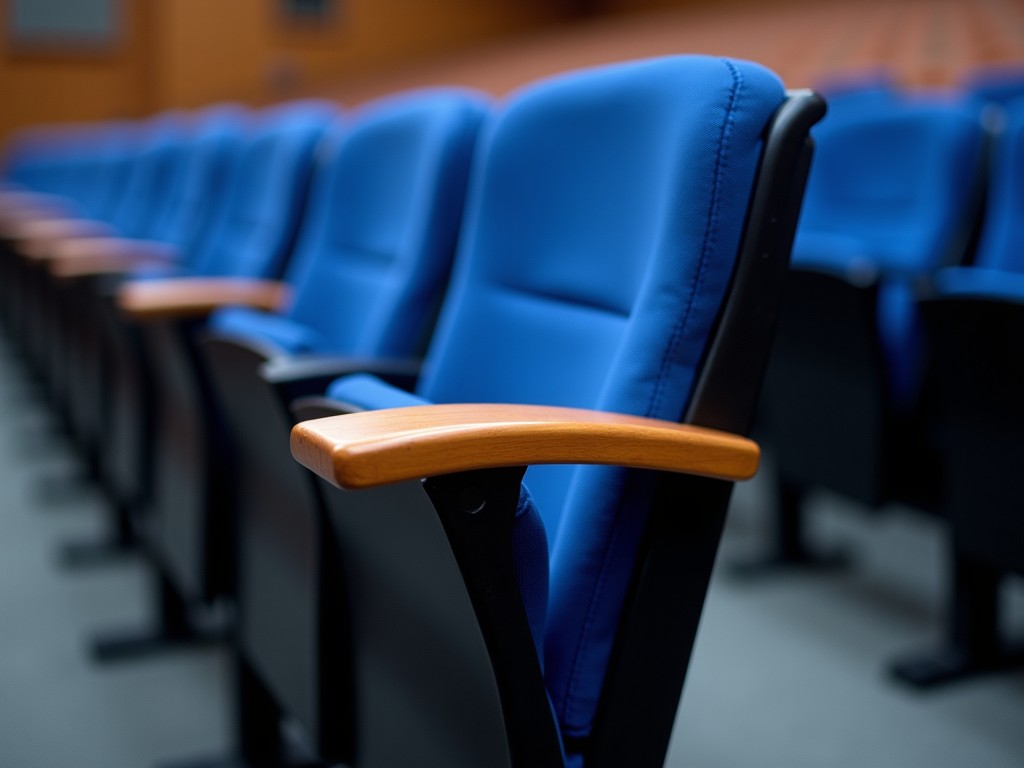
Row spacing is configurable between 750mm and 900mm center-to-center, complying with Chinese higher education classroom design guidelines (GB 50099-2011) for egress and accessibility. Integrated writing tablets, where specified, fold to a thickness of 60mm when stowed and extend to 350mm width with a 15° tilt angle, supported by gas-assisted mechanisms rated for 20,000 cycles. Cable management clips are molded into the frame underside, accommodating up to 6mm diameter power or data bundles.
Manufacturing follows ISO 9001:2015-aligned processes, with incoming material inspection including tensile strength verification for steel frames (minimum 340MPa yield) and melt flow index testing for polymers. Each production batch undergoes random sampling for frame weld integrity using ultrasonic testing, with acceptance criteria set at no porosity exceeding 1mm diameter or cumulative length exceeding 5% of weld seam length. Foam density is verified via ASTM D3574 test Method A, with ±5% tolerance allowed from target values.
Finished seating units are subjected to functional testing per BIFMA X5.1-2021 standards, including seat impact (dropping 41kg from 150mm height, 10 cycles), backrest fatigue (120,000 cycles at 100N force), and rolling resistance (for caster-equipped models, 36,000 cycles over obstacle). Final inspection includes dimensional verification (±2mm tolerance on critical interfaces), surface finish adhesion (cross-hatch test per ASTM D3359, minimum 4B rating), and packaging integrity (drop test from 760mm on all corners and edges).
Lecture halls benefit from fixed-position seating with integrated writing tablets and uniform sightline angles, ensuring every student maintains a clear view of the podium. Tiered installations use riser-mounted frames to achieve 1:12 slope gradients, complying with accessibility standards while maximizing floor capacity. In seminar rooms, mobile seating with locking casters enables rapid reconfiguration for group work, where 360° swivel seats with tension-adjusted tilt promote dynamic posture changes during discussions.
Library reading areas prioritize low-back designs (300mm height) to allow eye-level interaction over desks, while laboratory stools feature 450mm–600mm adjustable height ranges with foot rings positioned at 25% of seat height to reduce lower limb fatigue. Auditoriums requiring acoustic performance specify fabric-backed panels with NRC 0.6+ absorption coefficients to minimize reverberation, paired with seat structures that avoid resonant frequencies between 80Hz–120Hz. Each application is evaluated for load duration, cleaning frequency, and environmental exposure to recommend appropriate material combinations.
To discuss your specific higher education seating requirements, including space planning, material selection, and compliance with local standards, contact our technical team for a detailed project review.
Request Technical Consultation







