
Contact Fumei
No.20 Jiuqiao Road, Shijiang Industrial Area, Jiujiang Town, Nanhai District, Foshan City, China.
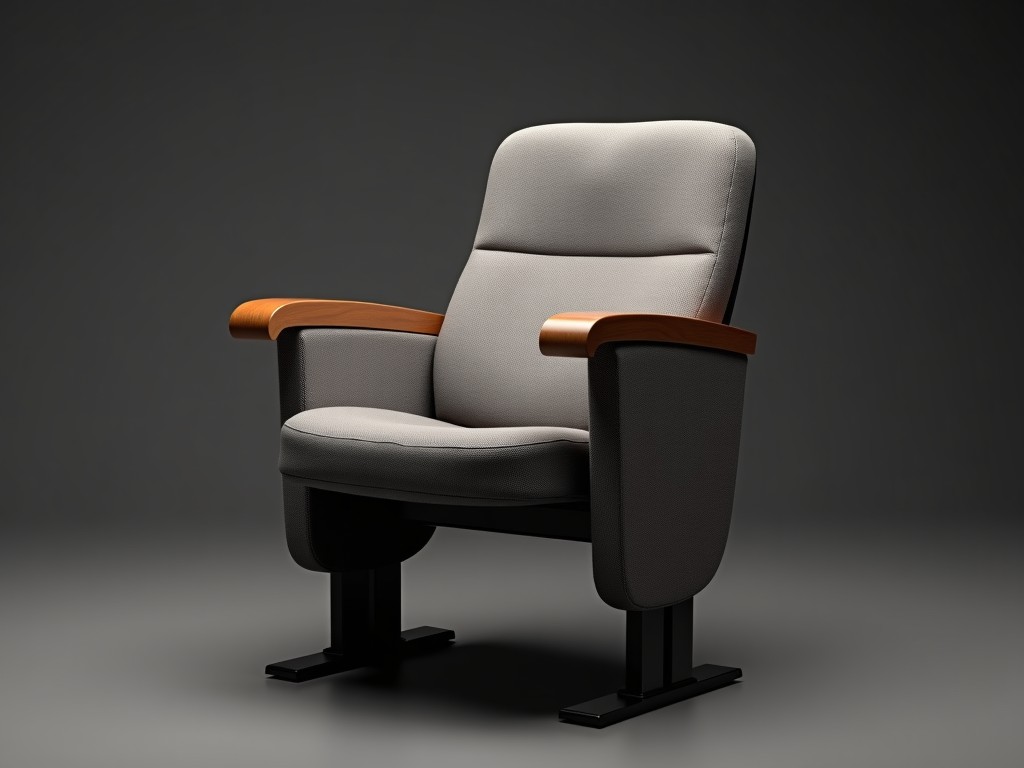
SPCC steel classroom chairs. Featuring 2.0mm cold-rolled steel, fire-retardant foam, and 300kg load frame. Ideal for university hall. B2B wholesale furniture.
Modern auditorium seating chairs integrate structural engineering, ergonomic research, and material science to meet the demands of high-traffic public venues. Design considerations include load distribution, fire safety compliance, acoustic performance, and long-term wear resistance under continuous use.
The chair frame is constructed from cold-rolled steel with a minimum thickness of 2.0 mm, formed using precision stamping and robotic welding to ensure dimensional tolerance within ±0.5 mm. Load testing follows EN 16139 standards, with static load capacity rated at 300 kg per seat and dynamic fatigue endurance exceeding 100,000 cycles without permanent deformation.
Frame joints incorporate gusset reinforcements at stress points, reducing localized strain by up to 40% compared to standard butt joints. Powder coating is applied electrostatically with a minimum thickness of 80 μm, providing corrosion resistance equivalent to 500 hours in salt spray testing (ASTM B117).
Seat depth is fixed at 480 mm to accommodate the 5th to 95th percentile user range, with a 15° rearward tilt to promote pelvic alignment. The seat cushion uses molded polyurethane foam with a density of 65 kg/m³ and ILD (Indentation Load Deflection) of 180 N at 25% compression, maintaining shape recovery after 80,000 cycles.
Backrest height measures 920 mm from seat to top, featuring a lumbar support zone curved to match the L3-L5 spinal contour. The backrest foam density is 55 kg/m³ with graded firmness — softer in the upper thoracic region, firmer in the lumbar area — to reduce muscle fatigue during prolonged sitting.
Fabric options include inherently flame-retardant polyester blends meeting BS 5852 Part 2 (Ignition Source 5) and California Technical Bulletin 117-2013. Weave density is maintained at 220 g/m² with abrasion resistance exceeding 100,000 Martindale cycles, suitable for venues with daily usage exceeding 12 hours.
Vinyl alternatives utilize phthalate-free PVC with a gloss retention rating of 8+ after 500 hours of UV exposure (ASTM G154). Seam strength is tested to ISO 13937-2, with minimum tear resistance of 25 N in warp and weft directions to prevent propagation under repeated stress.
The seat structure incorporates viscoelastic polymer isolators between the frame and floor mounting points, reducing structure-borne noise transmission by 12–18 dB in the 100–500 Hz range. This minimizes sound leakage into adjacent spaces and prevents vibration-induced resonance during performances.
Backrest panels are perforated with 3 mm diameter holes at 15 mm pitch, creating a Helmholtz resonator effect that absorbs mid-frequency sound (500–2000 Hz) with an absorption coefficient of 0.35–0.45, improving speech intelligibility in the auditorium without requiring additional acoustic treatment.
Chairs are designed for either fixed floor mounting via M10 anchor bolts or removable sled-base systems with interlocking aluminum extrusions. Row-to-row spacing (clearance) is adjustable from 850 mm to 1100 mm in 50 mm increments, allowing compliance with local egress codes while optimizing sightline angles.
Optional integrated features include retractable writing tablets (load-rated to 15 kg), cup holders with drainage channels, and low-voltage LED aisle lighting powered via daisy-changed low-voltage DC bus (24V, max 5A per circuit). All electrical components are rated IP20 and isolated from structural metalwork.
| Component | Standard Option | Customizable Alternatives |
|---|---|---|
| Frame Material | Cold-rolled steel (SPCC) | Stainless steel 304, aluminum alloy 6063-T5 |
| Seat Foam | 65 kg/m³ PU | High-resilience foam (75 kg/m³), fire-blocked latex |
| Upholstery | Inherently FR polyester | Wool blend, PVC-free polyurethane, recycled PET |
| Finish | Electrostatic powder coat (RAL 9005) | Anodized aluminum, PVDF coating, antimicrobial powder |
| Tablet Arm | Optional, right-hand | Left-hand, dual-hand, laminate surface, wireless charging pad |
Customization is executed through modular sub-assemblies, allowing partial reconfiguration without redesigning the entire unit. Lead time for standard configurations is 6–8 weeks; custom material or finish requests may extend timelines by 2–3 weeks depending on supplier availability and tooling requirements.
Each production batch undergoes incoming material verification, including mill test reports for steel and foam density validation via ASTM D3574. Dimensional checks are performed on 10% of units using coordinate measuring machines (CMM) with repeatability within ±0.1 mm.
Functional testing includes cyclic load application (100,000 cycles at 150 kg), flame spread testing on fully assembled mock-ups, and acoustic absorption measurement in a reverberation chamber per ISO 354. Final inspection verifies fastener torque, upholstery seam integrity, and smooth operation of moving parts before packaging.
Packaging uses corrugated cardboard with edge protectors and stretch film wrapping to prevent surface damage during transit. Units are stacked no higher than 1.2 m on pallets, with shock indicators attached to monitor handling conditions. Export shipments comply with ISPM 15 wood packaging standards.








