
Contact Fumei
No.20 Jiuqiao Road, Shijiang Industrial Area, Jiujiang Town, Nanhai District, Foshan City, China.
Affordable theater lecture hall seats factory: What Buyers Should Check Before Ordering The Problem Buyers Keep Paying For Failure Mode Typical Root Cause Cost Impact Tip-up mechanism seizes at 18-24
| Failure Mode | Typical Root Cause | Cost Impact |
|---|---|---|
| Tip-up mechanism seizes at 18-24 months | Unlubricated pivot pins; 1.2 mm stamped bracket flex | Full row replacement + labor |
| Foam bottoms out at IT bones | 45 kg/m³ CMHR cut to 40 mm instead of 50 mm | Comfort complaints → seat cushion retrofit |
| Fabric pilling at row edges | < 30,000 Martindale cycles; no backing laminate | Re-upholstery at $45-60/seat |
| Frame weld cracks at rear leg gusset | 1.5 mm tube, MIG only, no fillet reinforcement | Liability risk + full batch recall |
Most quality disputes start with a consistency gap between the approved sample and the container load. The sample gets hand-assembled by the line lead; production runs on piece-rate with no in-process torque check on the pivot bolts. By the time the seats hit the lecture hall, the pivot preload has drifted from 3.5 Nm to 1.8 Nm, and the tip-up spring has lost 15 % of its force. That drift is what buyers pay for — not the unit price.
1.8 mm tube with robotic TIG on the seat-to-back joint holds ±0.3 mm hole-to-hole across 500 units. 2.0 mm adds 1.2 kg/seat but drops weld heat input, reducing distortion on the powder-coat line. The 0.2 mm upgrade costs $1.80/seat and eliminates the gusset-crack warranty claim entirely.
Powder coat at 80-100 µm DFT passes 500 h salt spray (ASTM B117) only when the pre-treatment includes zinc phosphate. Skip the phosphate, and white rust appears at the weld toes within 90 days in humid climates.
Pour-in-place (PIP) into a closed mold gives 50 kg/m³ density at 50 mm thickness with ±3 % IFD repeatability. Slab-cut foam from a 1200×2000 mm bun varies ±8 % IFD across the sheet because skin formation differs at the edges. PIP tooling runs $3,500 per seat profile but pays back at 800 seats through scrap reduction alone.
Fabric attachment: pneumatic staple at 12 mm crown, 10 mm leg, 45 mm pitch on the plywood substrate. Staple pull-out must exceed 180 N per ASTM D1034. Below that, the fabric balloons at the lumbar curve within 6 months of daily use.
Every tip-up seat ships with a torque-seal mark on the pivot bolt. Acceptance range: 3.2–3.8 Nm measured at 20 °C. Values outside this window indicate either under-torqued (noise, premature wear) or over-torqued (bearing bind, spring fatigue). Insist on the torque-seal photo in the pre-shipment report — no exceptions.
Wear shows up at the same point every season: the aisle-end seat gets 3× the tip-up cycles of the center seats, yet buyers spec identical mechanisms for the full row. Spec a heavy-duty pivot (1.5 mm bracket, greased needle bearing) for the first and last two seats only — adds $4.20/seat for 4 seats, saves a row retrofit.
Another assumption: "fire retardant fabric" means the seat passes. The fabric may pass CAL 117, but the foam underneath must also meet CAL 117 or NFPA 260. A non-FR foam block with FR fabric fails the full-assembly test. Always request the composite burn certificate, not the component certificates.
Returns usually trace back to the same weak point: the seat-to-floor anchor. Expanding anchors in concrete drill-out at 25 mm embedment; epoxy anchors need 50 mm. If the structural drawings show 150 mm slab and the installer hits rebar at 40 mm, the seat rocks. Provide the anchor schedule with embedment depth and drill-bit diameter in the shop drawings — not in a separate PDF.
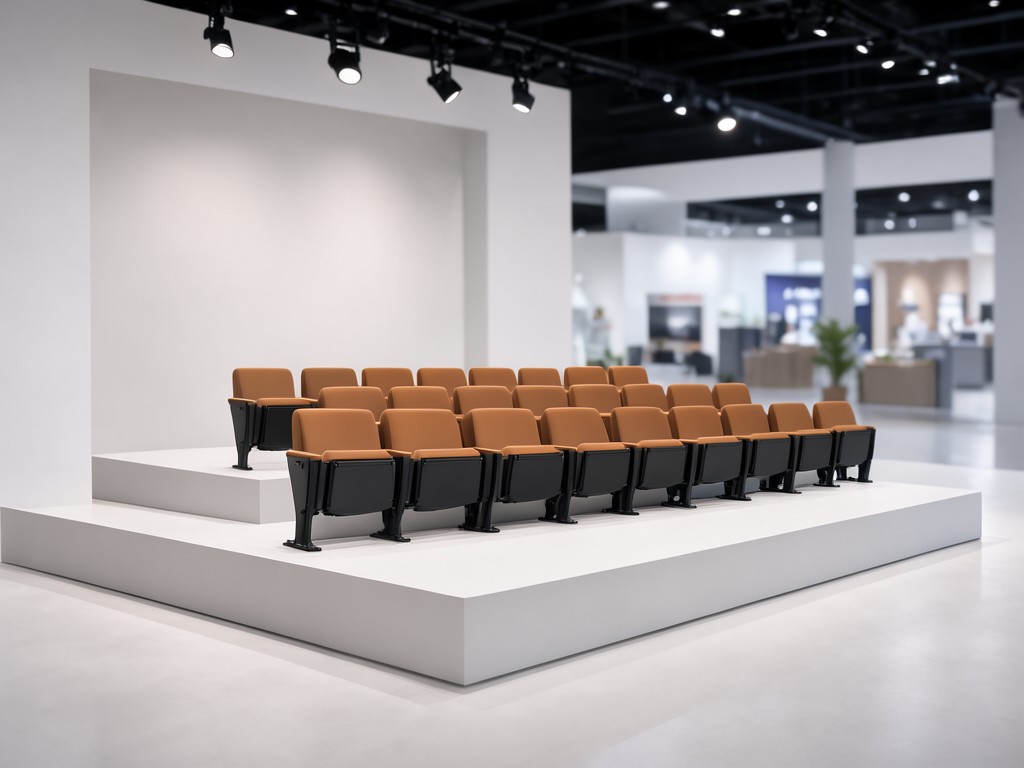
Private-label buyers need more than a SKU list. They need a bill of materials that survives a spec change — say, swapping a 350 g/m² polyester for a 420 g/m² Trevira CS — without re-cutting the foam pattern. Our nesting software links fabric yield directly to the foam CAD; a 5 % width change auto-updates the cut list and the container load plan.
OEM programs run on a 3-stage gate: 1) First-article dimensional report (12 critical dims, Cpk ≥ 1.33), 2) Mid-run audit at 30 % volume (pivot torque, foam IFD, staple pull), 3) Pre-ship container check (packaging integrity, label match, torque-seal photo). Each gate has a go/no-go criterion. No gate passes, the line stops. That discipline is what keeps a 5,000-seat university project on schedule.
Customisation that does not add lead time: frame colour (RAL powder coat), fabric selection from qualified mill card, row-letter/number laser etch on the end standard. Customisation that adds 3 weeks: new tip-up spring rate, non-standard row radius, integrated power/data flip-up. Know the difference before you promise the architect.
| Checkpoint | Method | Frequency | Acceptance |
|---|---|---|---|
| Frame hole pattern | CMM 5-point fixture | Every 50th frame | ±0.25 mm true position |
| Foam IFD @ 25 % deflection | Automated indenter | Every mold cycle | ±5 % of target (e.g., 55 ± 2.7 N) |
| Pivot torque | Digital torque wrench + seal | 100 % final assembly | 3.2–3.8 Nm |
| Fabric abrasion | Martindale per ISO 12947 | Per fabric lot | ≥ 40,000 cycles no thread break |
| Tip-up cycle life | Automated cycler, 30 cycles/min | First article + annual | 50,000 cycles no function loss |
Batch traceability links each seat serial number to the frame heat lot, foam pour date, fabric roll, and assembler ID. When a university facilities manager calls about a squeaky row in year three, we pull the birth record in 90 seconds — pivot batch, torque value, grease lot. That traceability turns a potential recall into a targeted field fix.
Packaging: knock-down frames stacked 12-high on reusable steel stillages, seats and backs in corrugated trays (ECT 44, double wall) at 8 per layer. A 40-ft HQ takes 420 complete seats KD vs 280 assembled. Freight savings alone cover the stillage deposit on orders above 300 seats.
Send the project seating plan, preferred fabric spec, and target installation date. We return a line-item quotation with gate dates, tooling amortisation, and the pivot-torque acceptance window baked into the quality clause. No catalogue pricing — only the configuration that matches your load case.








