
Contact Fumei
No.20 Jiuqiao Road, Shijiang Industrial Area, Jiujiang Town, Nanhai District, Foshan City, China.
B2B training room chair with table factory - Bulk Supply and Specification Guide What This Product Is and Where It Fits Deflection under load governs the structural integrity of a training-room chair
Deflection under load governs the structural integrity of a training-room chair with integrated writing tablet. The category covers fixed-row seating for lecture halls, flip-top tables for reconfigurable classrooms, and mobile units on casters for breakout spaces. Buyers specify these units by the thousand for universities, corporate training centres, and government facilities where daily occupancy cycles exceed eight hours.
The factory builds on a welded steel tube frame (typically 25 mm OD, 1.5–2.0 mm wall) with a cold-rolled steel writing tablet arm. Seat and back shells are injection-moulded polypropylene (PP) or glass-filled nylon for impact resistance; upholstered variants add a 30 kg/m³ CMHR foam layer over a plywood substrate. Table tops are 12 mm high-pressure laminate (HPL) bonded to a 18 mm particleboard core with a PVC edge band. All components are designed to meet ANSI/BIFMA X5.1 static load (113 kg seat, 45 kg tablet) and 100,000-cycle durability tests.
Critical spec rule: tablet arm pivot torque must not exceed 2.5 Nm after 50,000 cycles; otherwise the writing surface will not stay level during use. Verify the factory's cycle-test report before approving a pilot run.
Consistency depends on dimensional control across the frame, shell, and tablet sub-assemblies. The table below captures the standard size and weight envelope that fits 90 % of RFQs; deviations trigger tooling changes and MOQ adjustments.
| Parameter | Standard Range | Typical Tolerance | Impact on Freight |
|---|---|---|---|
| Overall height (mm) | 820–860 | ±5 | Stack height determines container fill |
| Seat height (mm) | 440–460 | ±3 | Fixed by ergonomic standards |
| Tablet depth (mm) | 300–350 | ±4 | Deeper tops reduce row count per container |
| Unit weight (kg) | 7.5–11.0 | ±0.3 | Heavier frames increase sea-freight cost per unit |
| Stack quantity (units) | 8–12 | — | Higher stack = lower cubic metre cost |
The interface between parts determines failure modes. Tablet arm welds that lack full-penetration fusion crack after 18 months of daily flip cycles. PP shells moulded without adequate gate location develop sink marks that become stress concentrators under point loads. Powder coat applied under 60 µm DFT fails salt-spray (ASTM B117) at 240 hours, leading to rust creep at frame joints in humid climates.
Common procurement errors:
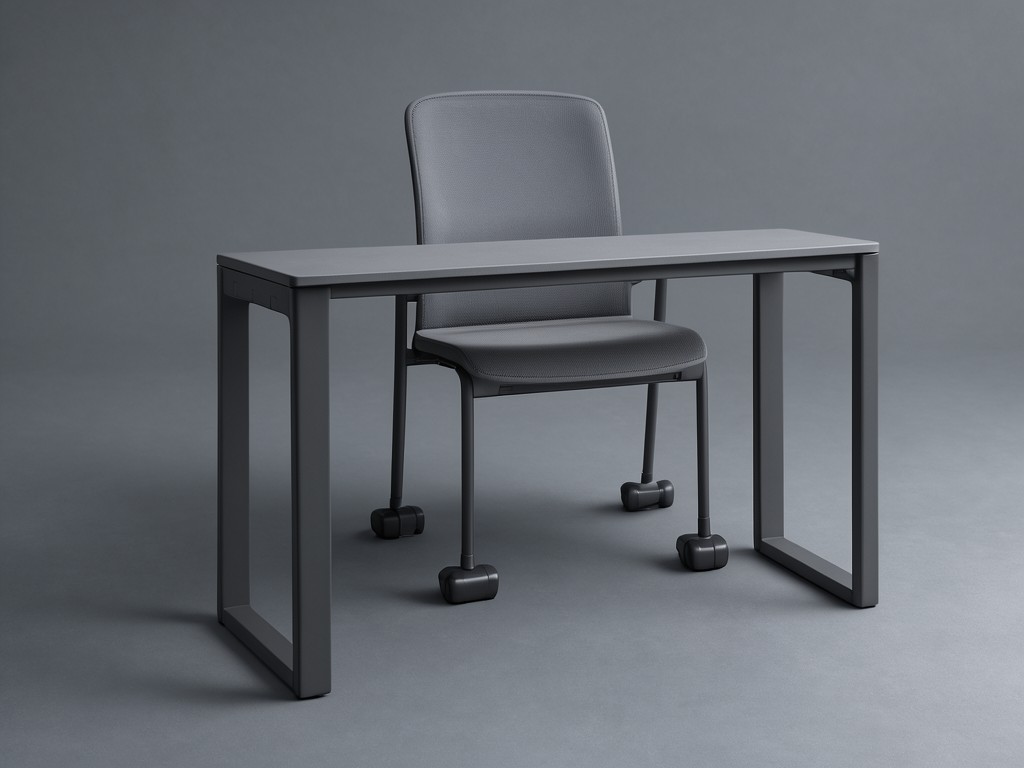
University procurement offices order 500–2,000 units per lecture-hall refurbishment; they require BIFMA Level 2 certification and a 10-year frame warranty. Corporate training centres buy 100–300 mobile flip-top units per floor; they prioritise 15-second reconfiguration and low-profile casters that clear raised-access flooring. Government defence academies specify fixed-row with anti-ligature tablet arms and 12-year parts availability. Each segment stresses different durability vectors: UV resistance for perimeter glazing, chemical resistance for disinfectant fogging, abrasion resistance for backpack traffic.
Finish and colour consistency across batches is verified against the master plaque library. The table below shows the standard options and the test methods used to confirm each batch meets the agreed delta-E and adhesion thresholds.
| Finish / Colour | Substrate | Test Method | Acceptance Criteria |
|---|---|---|---|
| RAL 9005 Jet Black (powder coat) | Steel tube | ISO 2409 cross-cut + ASTM D2247 humidity | Adhesion 5B, no blister at 500 h |
| RAL 9016 Traffic White (powder coat) | Steel tube | ISO 2409 cross-cut + ASTM D2247 humidity | Adhesion 5B, no blister at 500 h |
| Pantone 286 C Blue (PP masterbatch) | Polypropylene shell | Spectrophotometer D65/10° ΔE*ab | ΔE ≤ 1.0 vs master plaque |
| Oak woodgrain HPL (tablet) | Particleboard core | EN 438-2 scratch & stain resistance | Rating ≥ 4, no stain from iodine |
| Markerboard white HPL (tablet) | Particleboard core | Dry-erase cleanability (internal protocol) | Ghosting ≤ 5 % after 500 cycles |
The factory holds safety stock of 15 % of annual forecast for standard frame colours and shell colours. Blanket orders with quarterly call-offs lock in pricing for 12 months; any design change resets the lead-time to 8 weeks for tooling validation. Spare parts (tablet arms, glides, gas lifts) are catalogued by BOM revision and remain available for 7 years after the last production run. Shipping is configured in 40-HC containers: 320 units of fixed-row stacked 10-high, or 240 mobile units on pallets. Custom crating with corner protectors adds 3 % to unit cost but reduces transit damage claims from 2.1 % to 0.3 %.
Send your spec sheet, annual volume, and target delivery window. We will return a line-item quotation with tooling amortisation, first-article timeline, and container loading plan within 48 hours.
Start project discussion







