
Contact Fumei
No.20 Jiuqiao Road, Shijiang Industrial Area, Jiujiang Town, Nanhai District, Foshan City, China.
Specifying Bespoke fixed high density auditorium seating chairs Factory for Wholesale and OEM Orders First-article tooling determines whether a compact row layout can be repeated without seat-width dr
First-article tooling determines whether a compact row layout can be repeated without seat-width drift, misaligned floor plates or interference between tip-up seats. A project with fixed dimensions and repeat volume can spread jig and tooling costs across more units; a short run with frequent revisions usually carries a higher unit cost. Confirm the approved row geometry before production tooling is released.
Consistency is set at the forming stage: frame jigs control the distance between supports, while drilling templates keep floor-fixing points aligned from chair to chair. A typical fixed auditorium chair includes a steel support frame, seat and back panels, cushioning, upholstery, armrests and a floor-mounting plate. Tip-up seat mechanisms can be included where clear aisles between performances matter.
For high-density layouts, the controlling dimensions are seat width, centre-to-centre spacing, armrest projection and the clearance of the folded seat. A small change to one dimension can affect an entire row, so buyers should approve a dimensioned layout and a first-article chair before releasing a repeat order. The factory can supply chairs by seat position or in row-based packs; floor fixings and installation hardware should be defined in the order scope.
Indoor upholstery and standard coated steel suit most enclosed halls. For a covered venue with wind-driven rain or damp cleaning conditions, specify suitable frame pretreatment, coating and hardware; ordinary indoor fabric and finishes are not a weatherproof system.
Process choice shows up later as a difference in cleaning effort, repair method and initial unit price. Both configurations can use a fixed steel frame and tip-up seat; the panel and finish choice changes how the chair responds to daily wear.
Foam over a rigid panel with replaceable fabric covers gives a softer contact surface and lets a distributor offer multiple upholstery colours. It costs more in materials and assembly than a bare shell, and fabric selection affects stain removal and repair time. Confirm the cover attachment method if the buyer expects field replacement rather than full-chair returns.
A moulded polymer shell has fewer upholstered surfaces to stain and can reduce routine cleaning time. Colour and shape changes may require dedicated mould work or production setup, so this option pays off more readily at stable, larger volumes. Check the shell profile against the approved row spacing before committing to a dense installation.
For a distributor serving several venue types, a standard frame with controlled upholstery and colour options can limit spare-part variety. A project importer ordering for one hall should instead lock the seat pitch, end-panel arrangement, aisle access and fixing pattern to the building drawings. The right selection is the one that meets the approved layout without forcing installers to slot holes or alter chairs on site.
Order volume changes the cost calculation. A repeat run with unchanged dimensions can reuse jigs and approved samples; a revised arm shape, frame width or shell profile can trigger setup work and another approval cycle. Lead-time and MOQ figures below are planning ranges, not a substitute for a quotation based on the final drawing, finish and packing method.
| Order stage | Typical planning range | What changes the estimate |
|---|---|---|
| First article and drawing approval | About 2–4 weeks after design inputs are complete | New frame jigs, mould changes, upholstery swatches and revision rounds |
| Production MOQ | Often around 100–300 chairs for a bespoke order | Custom colour, fabric minimums, special tooling and mixed configurations |
| Repeat production after approval | About 4–8 weeks, plus freight | Order quantity, finish schedule, component supply and export packing |
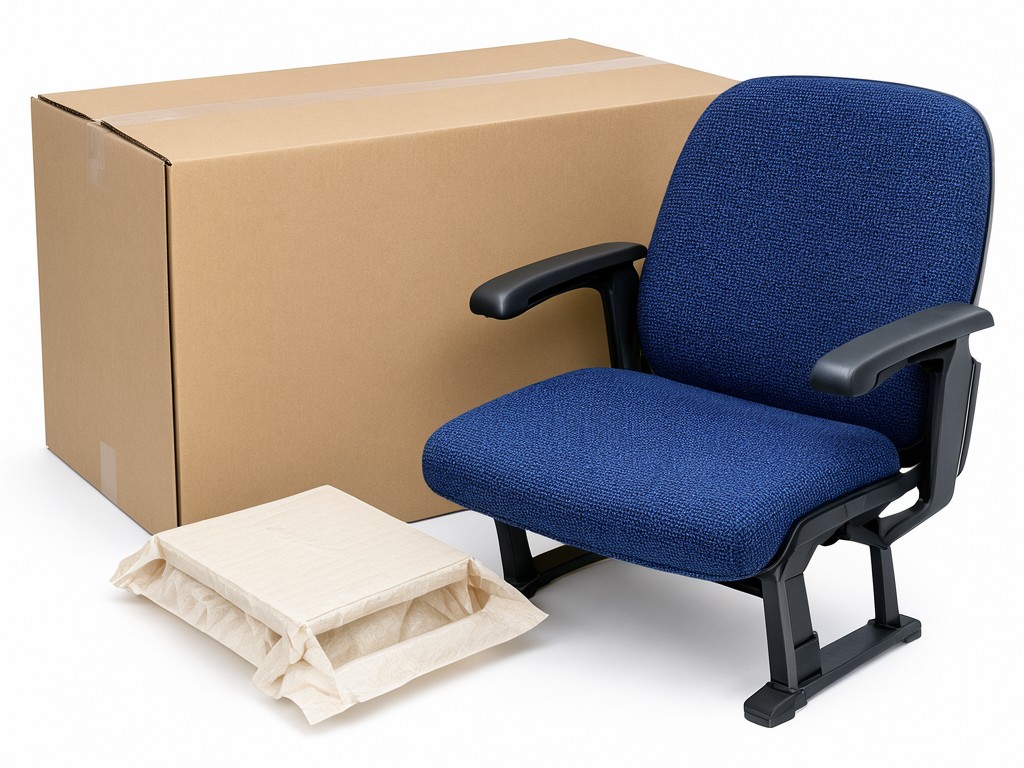
Returns often begin with a mismatch between the approved sample and the project drawing, not with a single failed component. A seat that folds into the aisle, a mounting plate that misses an anchor point or an armrest that reduces usable width can make a full row unsuitable. Distributors should retain the approved drawing, finish references and first-article record against the purchase order.
Another costly error is treating a nominal seat width as the installed width. Arm projection, end panels and frame offsets all affect the row total. Confirm the dimensions from fixing centre to fixing centre, and require a trial assembly of adjoining chairs where the pitch is tight.
Freight damage can also appear as loose hardware or crushed upholstery after transit. Specify whether chairs ship assembled or knocked down, how exposed corners are protected and whether each carton or bundle carries a seat count and row reference. These details reduce receiving disputes and speed installation checks.
Dimensions, finish and branding can be specified, but each change has a different effect on tooling cost and repeatability. Keep structural dimensions fixed across a batch when possible; visual changes such as fabric colour are generally simpler than a revised frame or newly moulded shell. The table separates common order variables from the approvals they require.
| Customisation item | Typical options | Approval or cost implication |
|---|---|---|
| Seat layout and frame | Seat width, pitch, arm arrangement, mounting plate and row-end details | Requires dimensioned drawings and first-article confirmation; changes can require jig adjustment or new tooling. |
| Upholstery and visible finish | Fabric colour, cover style, frame coating colour and selected trim | Requires colour or material approval; special runs may be subject to supplier minimums. |
| Branding and shipment | Labels, carton marks, assembly packs and export packing configuration | Artwork and carton layout must be approved before packing; altered pack sizes can affect freight volume. |
A bespoke order still has practical limits: the chosen frame must carry the intended seat arrangement, and the building substrate must accept the specified anchors. Upholstery, coatings and hardware can be selected for a sheltered or damp environment, but an indoor chair should not be sold as suitable for continuous exposure to rain or standing water.
Distributors and importers supply these chairs to theatre operators, education buyers, conference venues and public assembly projects. In a lecture hall with closely spaced rows, folded-seat clearance and consistent fixing centres affect aisle access and installation time. In a community venue with frequent room turnover, replaceable upholstery and accessible fasteners can reduce the need to return a complete chair for a local repair.
Covered outdoor amphitheatres need a different finish discussion from enclosed halls. Buyers should identify exposure to humidity, wind-driven moisture and cleaning chemicals before confirming frame coating, fasteners and upholstery; these choices add cost but can reduce premature finish complaints. For a quotation review, send the chair count, row layout, fixing details, finish schedule and delivery destination through the project inquiry page. A dimensioned drawing and target repeat-order volume help the factory assess tooling amortisation, MOQ and production timing against the same specification.








