
Contact Fumei
No.20 Jiuqiao Road, Shijiang Industrial Area, Jiujiang Town, Nanhai District, Foshan City, China.
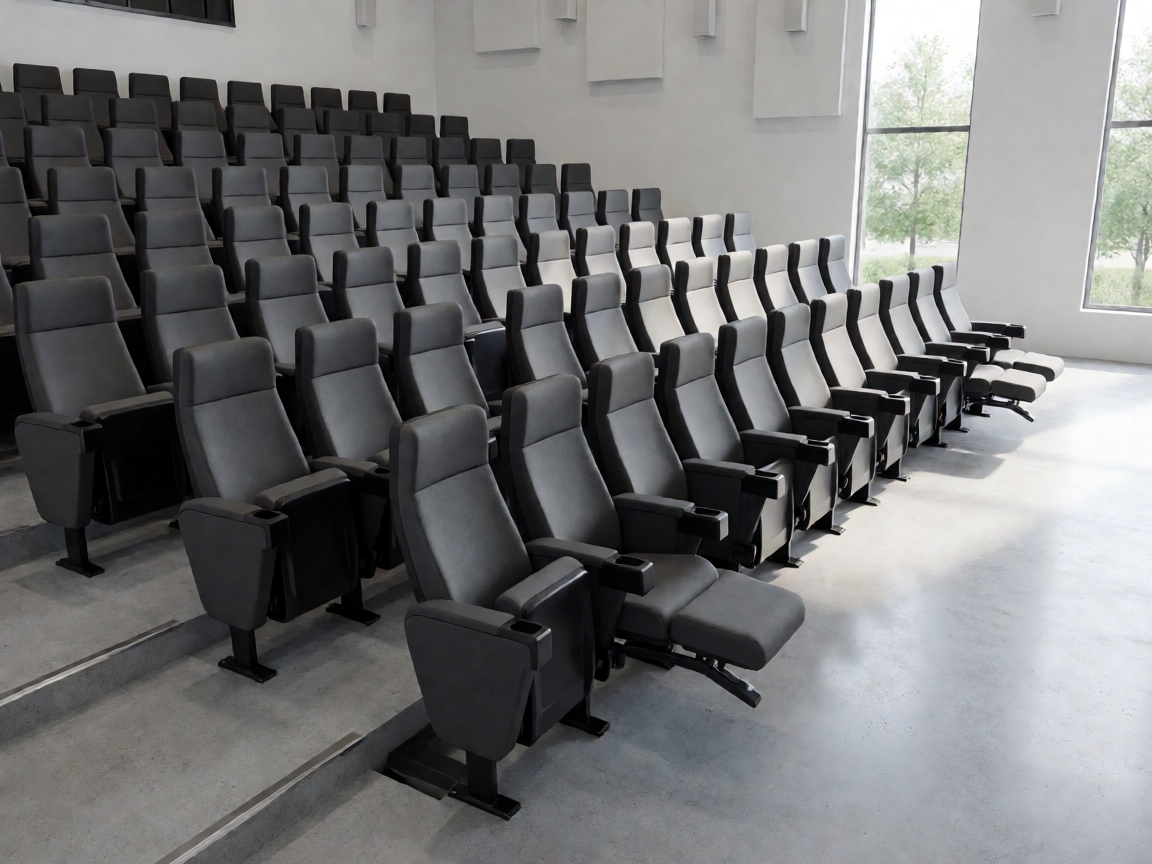
The core trade‑off for a retractable theater seat is between frame mass, retraction cycle life, and fire‑rating compliance. A lighter aluminum frame reduces freight cost but typically caps certified c
The core trade‑off for a retractable theater seat is between frame mass, retraction cycle life, and fire‑rating compliance. A lighter aluminum frame reduces freight cost but typically caps certified cycles at 10 000, while a welded steel frame pushes cycles past 25 000 at the expense of 30 % more weight per row. Upholstery choice follows the same logic: a 250 gsm FR‑treated polyester meets most venue codes and survives 30 000 Martindale cycles, whereas a 350 gsm leather‑look vinyl adds 1.2 kg per seat but extends abrasion life to 80 000 cycles. Selecting the combination that matches the venue’s daily turnover determines whether the warranty claim rate stays below 1 % or climbs above 5 %.
Construction options diverge as soon as weight matters. The standard row width is 560 mm centre‑to‑centre, but the frame can be widened to 610 mm for premium venues that demand extra elbow room. Seat depth is fixed at 460 mm to keep the retraction envelope compatible with existing floor tracks. The retraction mechanism is offered in two grades: a spring‑assist manual latch rated for 12 000 cycles, and a 24 V DC motorised drive rated for 30 000 cycles with a soft‑stop controller. Fire compliance follows EN 1021‑1/2 for the foam and fabric; a higher CAL‑117 rating adds a 0.3 mm intumescent layer that increases seat thickness by 4 mm and adds 0.4 kg per unit.
| Configuration | Frame Material | Seat Width (mm) | Weight per Seat (kg) | Certified Cycles |
|---|---|---|---|---|
| Standard manual | Steel, powder‑coat | 560 | 13.2 | 12 000 |
| Standard motorised | Steel, powder‑coat | 560 | 14.0 | 30 000 |
| Lightweight manual | Aluminium, anodised | 560 | 9.5 | 10 000 |
| Premium wide motorised | Steel, powder‑coat | 610 | 15.3 | 30 000 |
Upholstery is specified by the buyer: 250 gsm FR polyester (standard), 350 gsm vinyl‑look (high‑traffic), or a 300 gsm wool‑blend for acoustic venues. Each fabric adds 0.2‑0.5 kg per seat and shifts the abrasion rating accordingly. The retraction track is a 30 mm × 30 mm steel C‑channel; a stainless‑steel version is available for coastal installations where salt‑spray corrosion is a concern.
Tooling amortisation drives the minimum order quantity. A new frame die for the steel C‑channel costs roughly US $18 000 and is split across the first 1 000 seats; the per‑unit tooling surcharge drops from US $18 at 500 seats to US $3 at 5 000 seats. Motorised drive housings require a separate injection mould (US $12 000) that is shared across all motorised variants. ODM projects that modify the seat shell geometry (e.g., integrating a cup‑holder or a USB charging port) add a 6‑week design‑for‑manufacture review and a one‑time US $8 000 engineering fee. Branding – embossed logos on the seat back or custom fabric prints – is handled in a dedicated print‑run cell; artwork must be supplied as vector AI or high‑resolution PDF at 300 dpi, with a 5 mm bleed. Colour matching follows Pantone Solid Coated; a ΔE ≤ 2 tolerance is guaranteed on the first production batch.
Sample approval follows a three‑step gate: (1) dimensional first‑article inspection, (2) 500‑cycle functional test on the retraction drive, (3) fire‑rating verification on the upholstery. Only after the buyer signs off on all three does the line release for volume. Changes after gate 2 incur a US $2 500 re‑tool charge and a two‑week schedule slip.
Every production lot undergoes a defined inspection sequence before palletising. The first 10 % of seats are measured for seat‑height tolerance (±2 mm), row‑spacing tolerance (±1 mm), and retraction force (target 45 N ± 5 N). A random 5 % sample is cycled to 1.5 × the rated life (e.g., 45 000 cycles for a 30 000‑cycle rating) while monitoring motor current and latch engagement. Upholstery abrasion is verified on a Martindale tester at 12 kPa for the specified cycle count; colour fastness to light is checked with a Xenon arc exposure of 200 h (ΔE ≤ 3). Fire performance is confirmed on a single seat per batch using the EN 1021‑1 smouldering cigarette test.
| Test | Method | Acceptance Criteria | Frequency |
|---|---|---|---|
| Dimensional check | CMM / hand gauges | ±2 mm height, ±1 mm spacing | 100 % first‑article, then 10 % per lot |
| Retraction force | Force gauge at full extension | 45 N ± 5 N | 10 % per lot |
| Cycle life | Automated cyclic rig | 1.5 × rated cycles, no latch failure | 5 % per lot |
| Abrasion (Martindale) | ISO 12947‑2 | ≥ specified cycles, no fabric breakthrough | 5 % per lot |
| Fire rating | EN 1021‑1 | No ignition, no after‑flame >2 s | 1 seat per batch |
Batch traceability is maintained by a laser‑etched serial number on the frame cross‑member and a QR‑coded label on the upholstery. The data set links to the raw‑material heat‑lot, the powder‑coat batch, and the fabric roll, enabling a root‑cause investigation within 48 h if a field claim arises.
Unit cost drops sharply once the order exceeds the tooling break‑even point. At 500 seats the fully‑landed price (EXW) is US $215 for a manual steel seat; at 2 000 seats it falls to US $178; at 10 000 seats the price stabilises around US $152 because the fixed tooling share becomes negligible. Motorised variants carry a US $22 premium per seat for the drive and controller, but the same volume curve applies. Lead time from purchase order to first‑article shipment is 6 weeks for standard configurations (steel frame, manual drive, 250 gsm polyester). Adding a custom fabric print adds 2 weeks for the print‑run set‑up; a new frame width adds 3 weeks for die modification. The production line runs two 8‑hour shifts, delivering up to 1 200 seats per week at peak capacity. Orders above 5 000 seats are scheduled in 2‑week rolling windows to keep the line balanced and to allow in‑process QC without bottleneck.
Freight packaging is optimised for 40‑ft high‑cube containers: each container holds 240 manual seats or 210 motorised seats on custom steel stillages that prevent frame racking. The stillages are reusable and returned on the next shipment, reducing packaging cost by US $4 per seat after the first round‑trip.
For any other configuration – stainless‑steel track, integrated power outlets, or a bespoke row‑spacing – submit a request through the contact form and the engineering team will return a feasibility memo within 5 business days.
Ready to lock in your seat specification and artwork? Request a quotation and artwork review.








