
Contact Fumei
No.20 Jiuqiao Road, Shijiang Industrial Area, Jiujiang Town, Nanhai District, Foshan City, China.
Specifying buy auditorium lecture hall seating from china supplier for Wholesale and OEM Orders Cheaper stock options fail at the worst point in the season: loose fasteners, chipped frame coating, or
Cheaper stock options fail at the worst point in the season: loose fasteners, chipped frame coating, or seat upholstery that splits after repeated cleaning can leave an auditorium with mismatched rows and costly replacements. For importers and purchasing managers matching an existing private-label specification, the cost decision is not just the unit price. It is whether the supplier can hold the same frame, foam, upholstery, dimensions, and finish from approval sample through repeat orders.
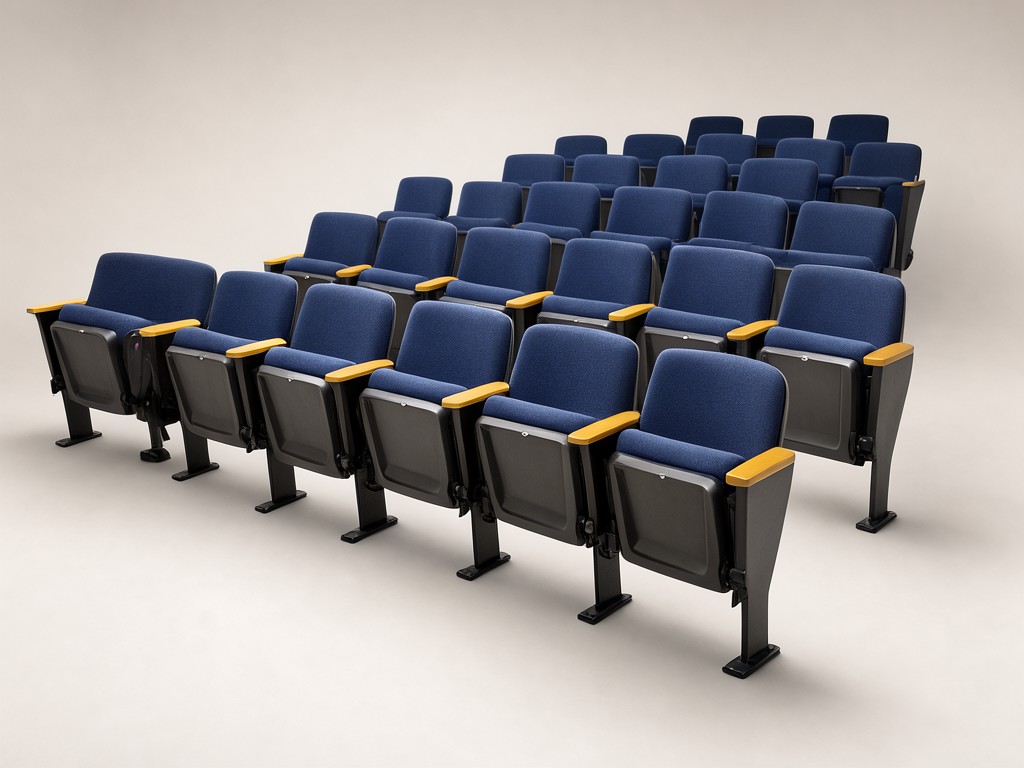
A practical OEM route is a welded steel frame with a powder-coated finish, a foam seat and back, and customer-selected fabric or vinyl upholstery. Keeping those core parts unchanged helps control fit and appearance; changing upholstery, armrests, or tablet hardware can affect price, packing, and the approval sample.
A low quote can conceal differences in steel section, weld coverage, foam density, upholstery backing, and coating preparation. Each may look acceptable on a showroom sample, but repeated occupancy and cleaning expose weak points: frame joints loosen, foam takes a set, seams abrade, or coating chips at floor-level contact points.
Cleaning chemistry also matters. Alcohol-based or chlorine-containing cleaners can dry, discolour, or crack some upholstery finishes; compatibility depends on the specific material and cleaner concentration. For halls with strong window exposure, UV can fade upholstery over time, so fabric colourfastness and vinyl formulation should be confirmed against the actual room conditions rather than assumed from a colour card.
Approval rule: Compare the production-intent seat against the approved sample for seat width, back profile, upholstery shade, frame finish, and hardware. Record cleaner compatibility and permitted cleaning method before release; a generic “wipe clean” claim does not define chemical resistance.
Tooling amortisation decides whether a bespoke feature makes commercial sense. If the hall needs a specific arm profile, row number plate, or branded upholstery, using a supplier’s existing frame and seat construction can avoid new tooling while preserving the visible details that define the buyer’s specification.
Compared with a basic stock chair, a coordinated OEM configuration can hold a consistent seat pitch, upholstery colour, and frame finish across the ordered rows. The trade-off is that non-stock fabric, custom embroidery, or special hardware may require a higher minimum order or a separate sample approval. Select those options only when the venue’s layout or brand requirements justify the added cost.
Total cost of ownership shifts once returns are counted. A modest increase in upholstery specification or coating preparation can be less expensive than replacing chairs with visible fading, peeling surfaces, or repeat frame defects, particularly when spare parts and matching replacement upholstery are difficult to source later.
Dimensions and finishes should be agreed against the hall plan, aisle clearances, row spacing, and mounting method. Values below are typical selection points, not a substitute for a signed drawing; the chosen frame and seat model determine the final dimensions.
| Buyer choice | Common options | Specification check |
|---|---|---|
| Seat and back dimensions | Model-dependent widths and back profiles; fixed or tip-up seat formats | Approve a dimensioned drawing and check clearances against the row layout. |
| Frame and floor fixing | Welded steel frame; powder-coated finish; floor-mounted or row-linked configuration where supported | Confirm fixing points, floor substrate, coating colour, and exposed-edge coverage. |
| Upholstery and foam | Commercial fabric or vinyl; foam profile and firmness vary by model | Approve shade, seam layout, cleaning instructions, and any requested abrasion or colourfastness evidence. |
| Accessories and branding | Writing tablet, armrest finish, row identification, label, or approved logo detail | Check accessory clearance, artwork placement, colour match, and whether the option changes packing dimensions. |
The most economical customisation is usually a surface or accessory change on an existing frame. Altered frame geometry can change weld fixtures, row alignment, and carton arrangement, so it should be priced separately from upholstery or branding. Keep one signed reference sample and a revision-controlled specification for repeat orders.
Lecture halls used for daily classes need consistent seat dimensions and finishes across long rows, with upholstery suited to frequent wipe-downs. Conference venues may prioritise a writing tablet and a coordinated appearance, while multipurpose halls need a frame and floor-fixing plan that fits their layout and cleaning access.
| Venue use condition | Complaint seen in service | Specification to control it |
|---|---|---|
| Daily lectures with frequent seat turnover | Loose joints, uneven seat return, or visibly compressed foam | Specify the frame and seat mechanism by model; inspect fasteners, movement, and cushion recovery on the approval sample. |
| Repeated cleaning after classes or public events | Faded colour, cracked vinyl, or worn seams | Select upholstery with documented compatibility for the venue’s cleaner; confirm seam construction and cleaning limits. |
| Rows near bright windows or variable indoor humidity | Uneven upholstery fading or corrosion at damaged frame edges | Request a suitable colourfast upholstery option and continuous coating coverage; inspect storage and installation conditions for moisture exposure. |
| High-density seating with bags and repeated contact at aisle ends | Abraded armrests, chipped coating, or damaged tablet edges | Review exposed contact points, edge finishing, accessory clearance, and packing protection before order release. |
Stock availability usually depends on the exact chair model, upholstery colour, frame finish, and accessory combination. Standard frame options may be easier to repeat than a discontinued fabric shade or a one-off armrest finish. Before placing the first order, ask which parts are standard, which are order-specific, and how long the supplier can maintain the selected materials.
For phased venue projects, record the approved sample, drawing revision, material references, carton labels, and production batch details. Reorder against that record rather than a colour name alone. If long-term colour matching is important, confirm whether the supplier can reserve fabric or provide a repeatable reference for later procurement.
Usually, if the buyer can provide a dimensioned drawing, reference sample, finish details, and approved artwork. The factory should identify any parts that cannot be matched from the current model range before sampling, especially frame geometry, seat profile, and tablet hardware.
Approve the actual upholstery material and shade, then confirm the venue’s cleaner and cleaning frequency with the supplier. Request available test information for relevant colourfastness or abrasion properties; do not assume fabric or vinyl options share the same cleaning limits.
Logo method, placement, colour count, and whether the artwork is applied to upholstery or a separate label can change setup cost and minimum quantity. Send vector artwork and placement dimensions with the inquiry so the supplier can quote the requested branding against the selected chair configuration.
They can be specified against a retained approval record, but upholstery availability and material batches can change. Agree on the shade reference, frame finish, model revision, and any acceptable colour tolerance before the first shipment, then verify those details for each reorder.
Share the hall layout, target chair model or reference sample, upholstery and frame finish, branding files, and expected order quantity. Contact the supplier to review a project specification and identify which details can be matched with existing components before sampling.








