
Contact Fumei
No.20 Jiuqiao Road, Shijiang Industrial Area, Jiujiang Town, Nanhai District, Foshan City, China.
Specifying china advanced lecture theater seating manufacturer for universities for Wholesale and OEM Orders The integrity of lecture hall seating begins with the structural geometry of the steel fram
The integrity of lecture hall seating begins with the structural geometry of the steel frame and the density of the polyurethane foam. When procurement officers evaluate manufacturers for universities, the manufacturing process determines whether the seat will maintain its ergonomic profile over a decade-long cycle. High-grade production utilizes cold-rolled steel tubing with reinforced welding to ensure the frame does not warp under the dynamic load of thousands of students. This structural focus is what lowers the total cost per unit by eliminating the need for frequent mid-cycle replacements.
Standard university-grade seating requires a minimum wall thickness of 1.5mm to 2mm for the steel frame and high-density foam (typically 55kg/m³) to prevent premature sagging and sagging.
Lecture theater seating is engineered for high-occupancy environments where durability and rapid configuration are paramount. Unlike standard auditorium chairs, these units feature integrated tablet-arm mechanisms designed to clear walkways quickly, meeting fire safety egress codes. The design focuses on fixed tiered layouts where the seat-to-back ratio must be precisely calibrated to maintain sightlines across the hall.
| Component | University Specification |
|---|---|
| Frame Material | Powder-coated cold-rolled steel tubing |
| Upholstery | Fire-retardant fabric or high-grade vinyl |
| Mechanism | Heavy-duty spring-loaded tablet arm |
| Mounting | Floor-mounted or beam-integrated |
Lower-cost alternatives often utilize thinner-gauge steel or low-density foam that loses its memory within the first twenty-four months of heavy use. The joints in the tablet mechanisms are frequently the first point of failure, leading to wobbling that requires constant maintenance. Furthermore, budget-grade coatings are prone to chipping under abrasion, exposing the underlying metal to corrosion in humid or high-traffic campus environments.
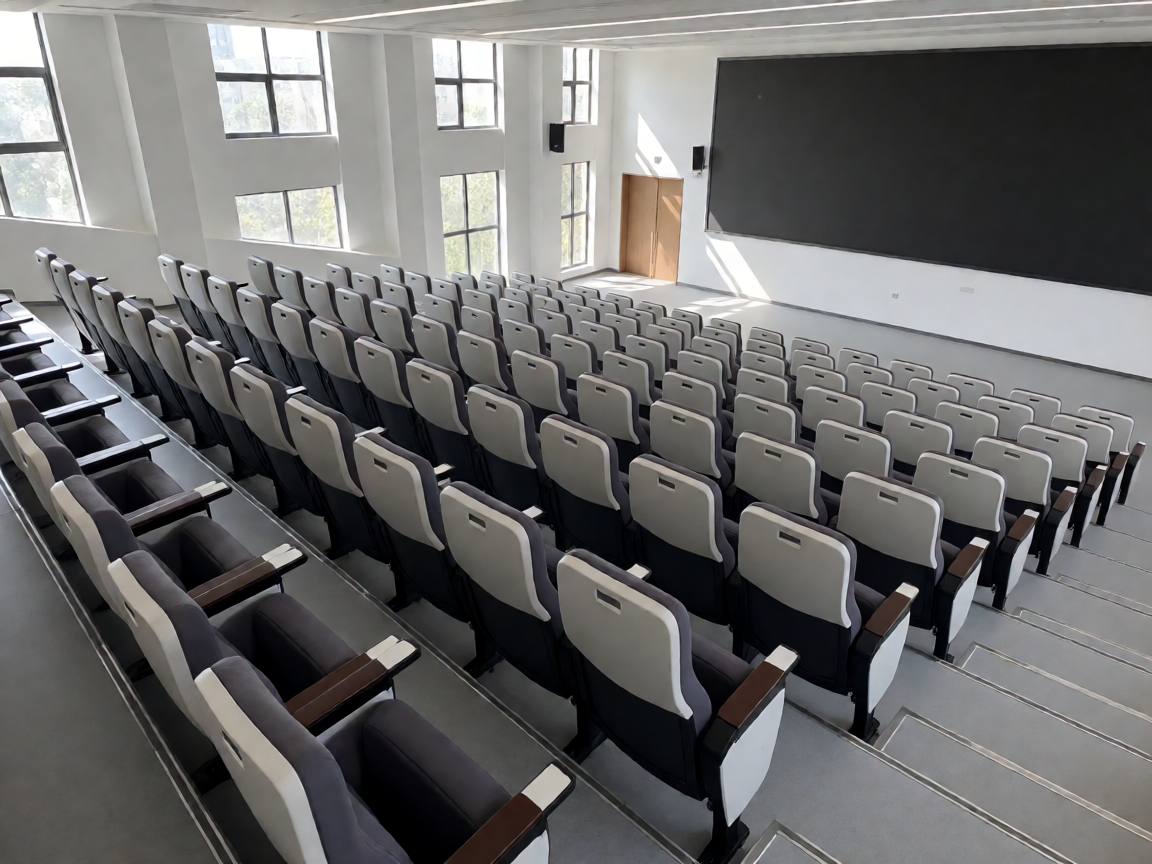
Procurement errors often involve neglecting the load-bearing capacity of the seat pan. If the seat pan is not tested for static and dynamic loads, the material will crack at stress points, creating safety hazards for the university.
Focus is on acoustic dampening materials and integrated power outlets for laptop use. Comfort must be prioritized for multi-hour study sessions.
Requires high-durability surfaces that are easy to sanitize. Tablet mechanisms must withstand high-frequency use during transitions between classes.
The service life of university seating is typically 10 to 15 years when the structural integrity is maintained. Regular cleaning with non-abrasive disinfectants prevents chemical degradation of the fabric finish. During storage for renovations, seats must be kept in climate-controlled environments to prevent moisture buildup within the foam or oxidation of the steel joints.
What is the load test standard for the tablet arm?
Standard units are tested for a minimum of 100kg downward force to ensure the mechanism does not shear under leaning.
Can the upholstery colors be customized for university branding?
Yes, OEM production allows for specific powder-coating colors and fabric swatches to match institutional color palettes.
Ready to discuss technical specifications for your next campus project?
Contact our engineering team for a wholesale quote







