
Contact Fumei
No.20 Jiuqiao Road, Shijiang Industrial Area, Jiujiang Town, Nanhai District, Foshan City, China.
Specifying china commercial theater seating manufacturers for Wholesale and OEM Orders Most quality disputes start with a consistency gap: the first production run has firm seat support and a smooth t
Most quality disputes start with a consistency gap: the first production run has firm seat support and a smooth tip-up action, while a reorder arrives with softer foam, a different upholstery shade, or hardware that needs adjustment. For private-label buyers, those differences show up after installation as uneven seat feel, loose fittings, and warranty claims that are difficult to trace back to a single component.
Commercial theater seating has to handle repeated occupancy, frequent surface cleaning, and the wear caused by bags, clothing fasteners, and seat turnover. Venue exposure matters too: chairs in a sunlit multipurpose hall face more UV fading than seats in a dark auditorium, while damp cleaning and strong disinfectants can shorten the life of upholstery and coatings. Define those conditions before choosing a factory and upholstery package.
Returns often trace to wear at contact points or variation between batches, rather than a single dramatic failure. A loose armrest or binding seat can trigger service calls across an entire row. Abrasive cleaning can dull a coating, and unsuitable chemicals can discolor synthetic upholstery or make its surface tacky.
Transit protection also affects what the installer finds on arrival. Ask how the manufacturer separates finished surfaces and secures detachable parts; carton condition alone does not show whether a chair arm or upholstered panel was protected from rubbing.
| Packaging detail | Why it matters to the buyer | Check against the approved sample |
|---|---|---|
| Assembled chair or knockdown components | The chosen format changes handling, assembly work, and the chance of contact damage. | Confirm which fittings are packed separately and how each finished part is restrained. |
| Upholstery and armrest surface protection | Unprotected surfaces can arrive with rub marks, pressure impressions, or edge scuffs. | Review the protective material and its contact points on the finished upholstery. |
| Hardware and installation parts | Mixed or missing fasteners can delay installation and complicate after-sales support. | Match the parts list and identification method to the approved order configuration. |
Long performances reward supportive foam and a seat profile that does not create pressure at the front edge. Softer foam may feel inviting during a brief showroom test, yet lose its shape sooner under repeated occupancy. Denser or firmer foam can retain its profile longer, but the comfort difference should be reviewed with a representative finished chair rather than inferred from a material description.
A steel frame with welded joints and a durable powder-coated finish suits fixed seating in indoor halls, provided weld quality, coating coverage, and floor-fixing details match the project. For venues with strong window exposure or covered outdoor use, specify the actual conditions: ordinary indoor upholstery and coating should not be treated as weatherproof. Direct rain, persistent damp, UV exposure, and chlorine-based cleaners call for materials and finishes selected for that environment.
Tip-up action also has a comfort and noise trade-off. A controlled return keeps aisles clear, but an overly forceful mechanism can create a sharp impact and faster wear at contact points. Ask the factory to demonstrate the seat return on a production-representative unit, with the selected upholstery, armrests, and mounting arrangement.
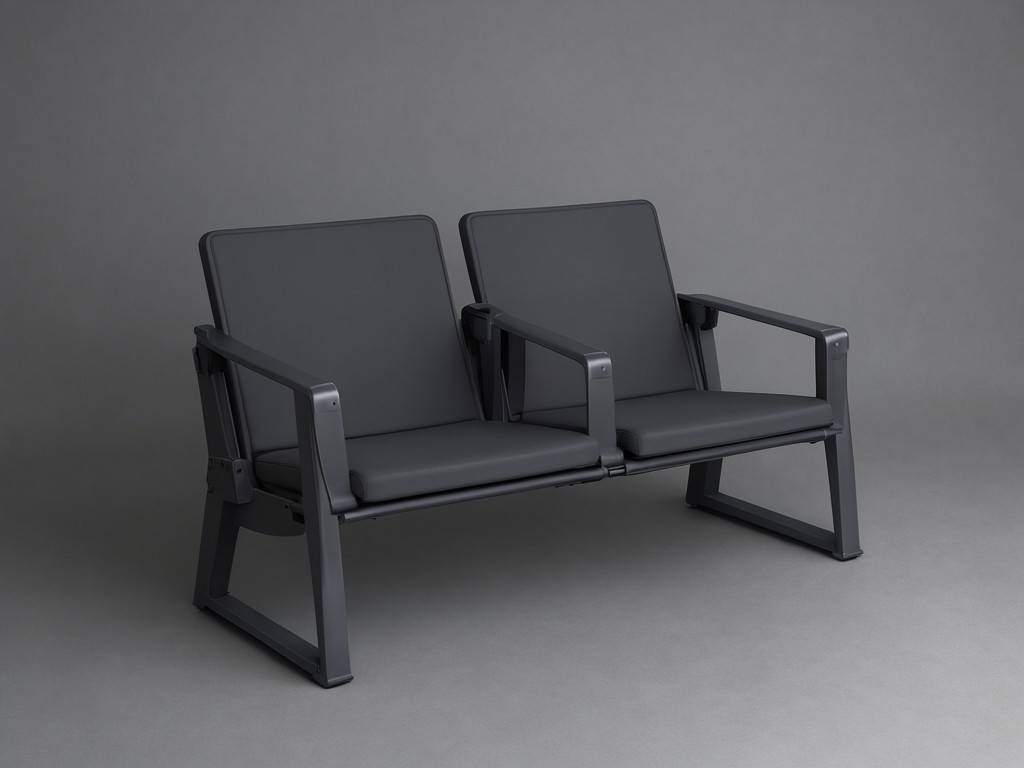
Start with the venue and its cleaning routine, then compare upholstery against those conditions. A private-label buyer should also send the manufacturer a reference chair, finish sample, or approved drawing where available. For clubs and academy halls, include the expected daily seat turnover and whether food, outdoor footwear, or sports equipment regularly contacts the chairs.
A coated synthetic surface is easier to wipe than most woven fabrics and can suit venues with frequent spot cleaning. Its performance depends on the coating and the cleaning agents used; abrasive pads and unapproved disinfectants can mark or degrade the finish. Confirm the care guidance and inspect seams and edge wraps on the sample.
A woven cover can offer a less slick hand feel and a broad choice of textures. Choose by abrasion performance, colourfastness, and cleanability rather than appearance alone. Fabric that suits a dim auditorium may fade more visibly beside large windows, so review a physical swatch under the venue's lighting.
Compare complete chair assemblies, not upholstery swatches in isolation. Frame geometry, seat width, arm shape, cupholder position, and floor fixing all affect comfort, aisle clearance, and installation fit.
A showroom sample can hide differences that surface only after installation. Buyers get avoidable claims when they approve a fabric card but not the finished chair, or when they assume the tip-up action and mounting holes will remain unchanged across model revisions.
Do not specify “easy-clean” without naming the intended cleaning method. A surface that tolerates a damp cloth may not tolerate chlorine, solvent, or repeated use of concentrated disinfectant. Keep the care instruction in the purchase specification and check it with the upholstery supplier.
Another repeat-order risk is approving a colour by screen image. Lighting, fabric lot, and coating batch can alter the appearance. Retain a signed physical sample and record the fabric code, foam choice, frame finish, hardware, and approved drawing revision with the order.
Most manufacturers can discuss upholstery colour and type, embroidery or logo placement, armrest finish, cupholder selection, and frame coating. Those choices still depend on fabric availability, minimum order quantities, and whether the selected components fit the existing frame and upholstery patterns.
Dimensions and mounting details need earlier review. Changing seat width, row spacing, floor fixing, or aisle layout can affect structure, tooling, and local installation requirements; they are not cosmetic edits. For covered outdoor or high-UV locations, request confirmation that each exposed material is suitable rather than relying on a general claim about the chair.
For repeat orders, freeze the approved bill of materials and artwork files. A change in foam, cover, stitching, or coating should go through sample approval before it reaches a production batch.
Inspection should follow the approved chair configuration and include checks that can expose batch variation. Review frame welds and finish coverage, mounting-hole alignment, upholstery seams, armrest fit, and the movement and return of the tip-up seat. A sample of finished units should also be compared for colour, cushion shape, and assembly fit.
Set acceptance points before production: approved surface appearance, correct hardware, smooth seat movement, stable floor-mounting interfaces, and no visible damage to upholstery or coating. Keep inspection records tied to the order and sample revision so a later warranty report can be compared with the shipped batch.
Where cleaning exposure is a concern, confirm the care method against the selected upholstery and finish. Do not treat a general wipe test as proof of resistance to every disinfectant; request a product-specific recommendation and retain it with the approval documents.
Standard frame designs and regularly used upholstery may be easier to repeat than special colours, embroidery, or modified dimensions. Confirm which parts are held as standard and which depend on a fresh material lot. “Same model” does not guarantee an identical look or feel if the original foam, cover, or finish code has changed.
For phased venue fit-outs, record the approved seat drawing, upholstery reference, frame finish, logo artwork, and hardware configuration with the purchase order. Ask the manufacturer to flag any proposed substitution before production. A retained swatch and a finished-chair reference help the incoming team judge a reorder against the original approval.
To discuss a private-label or repeat-order project, send the venue use conditions, seating layout, preferred upholstery, and any approved reference samples through our project inquiry page. Include cleaning products and sunlight exposure in the brief so the proposed materials match actual service conditions.








