
Contact Fumei
No.20 Jiuqiao Road, Shijiang Industrial Area, Jiujiang Town, Nanhai District, Foshan City, China.
Specifying china latest design lecture hall seating factory for Wholesale and OEM Orders How It Performs in Use The limiting factor is rarely the headline specification. A lecture hall seat rated for
The limiting factor is rarely the headline specification. A lecture hall seat rated for 150 kg static load still fails when the pivot bearing seizes after 18 months of daily flip cycles, or when the seat pan cracks at the front edge because students brace their feet against it. Real-world durability comes down to three variables: the fatigue life of the tip-up mechanism under eccentric loading, the abrasion resistance of the upholstery against backpacks and denim, and the dimensional stability of the frame when bolted to a concrete slab that expands and contracts with the building HVAC.
Comfort is not a single metric. Seat depth, backrest angle, and foam indentation force deflection (IFD) interact. A 460 mm seat depth with 35 mm foam at 55 IFD supports a 95th-percentile male for a 90-minute lecture without pressure-point migration. Reduce foam to 25 mm to save 1.2 kg per seat and the same user reports numbness at 45 minutes. The factory specifies foam density by application: 45 kg/m³ for tiered auditoriums, 55 kg/m³ for flat-floor lecture halls where students shift posture more frequently.
Material selection drives both unit cost and warranty exposure. Cold-rolled steel frame (Q235B, 2.0 mm wall) is the baseline. Upgrading to 2.5 mm wall adds 0.8 kg per seat but raises the yield point enough to prevent permanent set when a row is overloaded during graduation ceremonies. Aluminum alloy (6063-T5) extrusion cuts weight by 35% but requires thicker wall sections to match stiffness, negating half the weight savings. For the seat pan, injection-molded polypropylene with 20% talc filler resists impact better than plywood at half the cost, but transmits more vibration — acceptable in carpeted halls, noticeable on hard flooring.
| Component | Standard Grade | Upgrade Option | Cost Delta | Service Life Impact |
|---|---|---|---|---|
| Frame tubing | Q235B, 2.0 mm wall | Q235B, 2.5 mm wall | +8-12% | +3-5 years before permanent set |
| Seat pan | PP + 20% talc, 4.5 mm | PP + 30% glass fiber, 4.0 mm | +18-22% | Eliminates flex cracking at front edge |
| Foam | 45 kg/m³, 35 mm, 55 IFD | 55 kg/m³, 35 mm, 65 IFD | +15% | Retains 90% IFD after 100k cycles |
| Upholstery | 100% polyester, 300 gsm, Martindale 50k | Polyester/wool blend, 420 gsm, Martindale 100k | +35-40% | Colorfast to 50 wash cycles, pilling grade 4-5 |
Fatigue appears at the stress concentration. The tip-up mechanism sees the highest cyclic load — every student sitting down and standing up applies an eccentric moment to the pivot bracket. The factory uses a gravity-assisted counterweight spring rather than a torsion spring. The counterweight distributes load across two bearing surfaces, reducing contact pressure from 420 MPa to 180 MPa. Torsion springs concentrate stress at the anchor point; after 50,000 cycles the anchor hole elongates, the seat drifts down, and the row alignment shifts.
Frame welding follows a fixed sequence: side frames first, then cross-brace, then seat pan brackets. This sequence minimizes thermal distortion. Each weld is inspected for penetration depth (minimum 1.2 mm on 2.0 mm wall) and undercut (maximum 0.3 mm). Powder coat is applied after welding — 80-100 µm epoxy-polyester hybrid, cured at 190°C. Coating thickness below 70 µm shows corrosion at the bracket weld toes within 18 months in humid climates.
Upholstery attachment uses a concealed staple pattern with 12 mm crown staples at 40 mm centers. Pneumatic staple depth is calibrated per foam density; overdriven staples cut the foam cell structure, creating hard spots. The factory runs a pull test on every 50th seat: 150 N for 10 seconds, no staple pull-through or fabric tear.
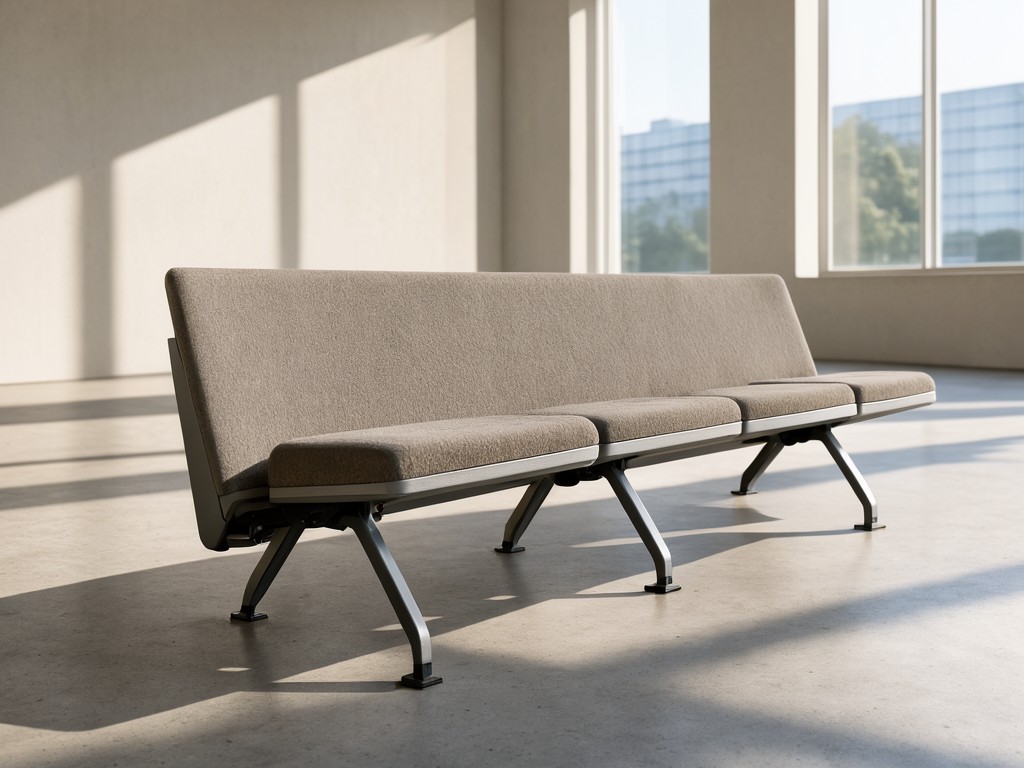
Repeat loading drives the failure points that customisation cannot fix. The center-to-center row spacing is fixed at 560 mm for fire-code egress; reducing it requires re-certification of the entire row assembly. Seat width per position is 480 mm ± 5 mm — the armrest extrusion die is a fixed asset. Changing it adds 8-10 weeks tooling lead time and a minimum 5,000-unit amortization.
What can be customised without new tooling: upholstery color and pattern (MOQ 200 seats per color), writing tablet laminate finish, armrest end-cap profile (three standard profiles in stock), row letter/number laser etching, and floor-mounting bracket pattern (four standard bolt patterns cover 90% of installations). Power/data integration requires a dedicated cable management channel in the cross-brace — specify at order placement, not after production starts.
| Buyer Segment | Typical Project Size | Decision Driver | Critical Spec |
|---|---|---|---|
| University facilities procurement | 300-2,000 seats | 10-year TCO, maintenance staff workload | Mechanism cycle rating, parts availability |
| Private-label furniture brand | 500-5,000 seats/year | Brand consistency, launch date adherence | Color match tolerance, packaging spec |
| AV integrator / turnkey contractor | 100-800 seats | Cable routing, tablet integration, install speed | Cross-brace channel dimensions, pre-wire option |
| Government / defense education | 200-1,500 seats | Fire code compliance, vandal resistance | CAL 117 / NFPA 260, tamper-proof fasteners |
Production runs in 40-seat batches per welding jig. A 500-seat order occupies 13 jigs for one shift (8 hours welding, 4 hours coating cure, 2 hours assembly). Standard lead time: 25 working days from deposit and approved shop drawings. Add 10 days for custom upholstery color (dye lot minimum 300 linear meters). Add 15 days for writing tablet integration (separate injection mold schedule).
Packaging: seats ship knocked down — frame assemblies stacked 8 per pallet, seat/back cushions in cartons of 20. A 40'HQ container holds 320 seats (4 pallets frames + 16 cartons cushions). Freight protection: corner guards on frame stacks, desiccant packs in cushion cartons, humidity indicator cards. Insurance claims for transit damage average 0.3% when packaging spec is followed; rise to 2.1% when buyers consolidate with other freight and skip corner guards.
Sample approval: one pre-production seat ships air freight at buyer cost (typically $180-220 DDP). Buyer has 5 business days to approve or request adjustment. Adjustment resets the 25-day clock. No production starts without written sign-off on the sample inspection report — dimensional check, mechanism cycle test (50 cycles), foam IFD verification, upholstery adhesion pull test.
Validate mechanism feel, foam firmness, and upholstery match before committing to volume. Sample ships within 7 days of spec confirmation.
Request Sample & Quote







