
Contact Fumei
No.20 Jiuqiao Road, Shijiang Industrial Area, Jiujiang Town, Nanhai District, Foshan City, China.
china modern chair for auditorium manufacturer: Specification, Ordering and Quality Notes The Problem Buyers Keep Paying For Auditorium seating fails first at the hinge, then at the foam, then at the
Auditorium seating fails first at the hinge, then at the foam, then at the fabric. Procurement teams track unit price but rarely track cost-per-seat-year — the metric that actually determines whether a venue reorders or replaces early. The complaints cluster around three failure modes: seat pan sag after 18 months of daily flip cycles, powder-coat flaking at weld joints in humid climates, and fabric pilling that makes a five-year install look tired at two.
Specification rule: If the seat mechanism does not pass 100,000 cycles at 120 kg without permanent deformation >3 mm, the frame gauge or pivot bushing material is underspecified for commercial auditorium use.
| Usage Condition | Typical Complaint | Preventive Specification |
|---|---|---|
| High-traffic university lecture hall, 8 h/day flip cycles | Seat pan drops 10–15 mm, creating uneven rows and noise | 12 GA cold-rolled steel frame, dual-torsion spring with nylon bushings, 100k cycle test |
| Coastal convention center, 70 % RH, salt air | Powder coat bubbles at welds within 24 months | Epoxy primer + 80 µm polyester TGIC coat, salt-spray 500 h per ASTM B117 |
| Performing arts venue, wool-blend fabric, daily use | Pilling grade 3 after 18 months, colour shift under stage lights | ≥40,000 Martindale cycles, solution-dyed polyester, UV stabiliser 0.5 % |
Material choice starts with the conditions the product will meet. A lecture hall in Oslo and a theatre in Singapore demand different foam formulations, different corrosion protection, and different fabric backings. The frame geometry — specifically the distance between front and rear legs — sets the leverage on the flip mechanism; a 50 mm increase in seat depth adds 18 % more moment at the pivot. That moment is absorbed by the bushing material: oil-impregnated sintered bronze lasts 3× longer than plain nylon in salt-laden air, but costs 2.4× more per seat. Foam density is not a comfort metric alone; 65 kg/m³ CMHR foam retains 90 % of its initial IFD after 80,000 impacts, while 45 kg/m³ drops to 68 %. The fabric adhesion method — staple vs. heat-sealed welt — determines whether the cover delaminates when the foam compresses repeatedly. Every spec decision is a trade-off between upfront cost, service life, and the venue's maintenance budget.
Independent lab data from our 2023 validation run on the A-300 series:
These numbers are not marketing claims; they are the pass/fail thresholds we build tooling to hit. Any deviation triggers a first-article rework before the container loads.
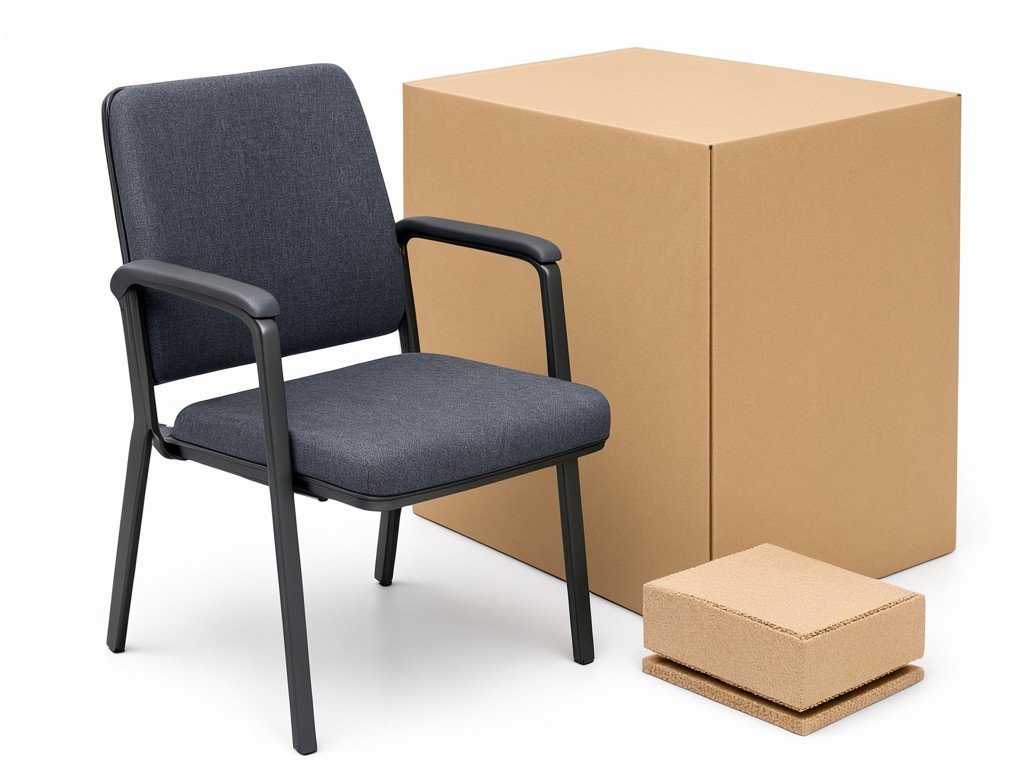
Construction options diverge as soon as weight matters. The table below contrasts our two most-ordered platforms so buyers can price the delta against expected service life.
"Thicker foam equals better comfort" — false beyond 60 mm; the extra height raises the centre of gravity, increases flip effort, and accelerates hinge wear. "All steel frames are the same" — 14 GA vs 12 GA changes deflection by 22 % under a 120 kg dynamic load. "Fabric grade only affects aesthetics" — a 300 gsm knit stretches 4 % under load, causing wrinkles that trap dirt and accelerate abrasion; a 420 gsm woven stabilises the foam surface and reduces cleaning cycles by 30 %. "Powder coat is powder coat" — TGIC polyester at 80 µm survives 500 h salt spray; standard epoxy-polyester at 60 µm fails at 200 h. "One container fits all" — mixing seat widths in a single shipment saves freight but forces a compromise on row spacing that the architect will reject at installation.
Our OEM programme runs on fixed tooling amortisation: the buyer owns the seat mould and frame fixtures, we hold them for the contract duration. Minimum order quantity for custom frame geometry is 500 seats; for fabric-only changes it drops to 200 seats. Lead time from drawing approval to first container: 45 days for standard frame with custom fabric, 75 days for new frame tooling. We provide 3D STEP files, BOM with material certs, and a first-article inspection report (FAIR) before mass production. Branding options include laser-etched logos on the seat pan, woven labels sewn into the welt, and custom colour-matched powder coat (RAL or Pantone). Private-label packaging — unbranded cartons, buyer-specified barcodes, pallet configurations — is standard at no extra charge.
Ready to validate a specification against your venue's actual load profile? Request a specification review and we'll map your usage conditions to the exact frame gauge, foam grade, and fabric construction that eliminates the complaints you're currently budgeting for.








