
Contact Fumei
No.20 Jiuqiao Road, Shijiang Industrial Area, Jiujiang Town, Nanhai District, Foshan City, China.
Custom Advanced Lecture Hall Seating Chairs Supplier: Technical Specification Guide Structural integrity in high-density educational environments depends on the interface between the load-bearing stee
Structural integrity in high-density educational environments depends on the interface between the load-bearing steel frame and the seat pan. While standard commercial seating prioritizes aesthetic variety, lecture-grade hardware must withstand repetitive fatigue from 100,000+ load cycles without losing alignment or loosening the cantilever mounting bolts.
Procurement officers often encounter premature failure in the weld joints at the seat-to-backrest junction. When the gauge of the hollow steel tubing is insufficient, the torsional force applied by a user leaning back leads to micro-fractures in the powder coating. We mitigate this by utilizing reinforced gusset plates and deep-penetration MIG-welding, ensuring the frame geometry remains rigid under a 150kg static load across a 10-year service life.
Material degradation is the secondary cost driver in high-traffic halls. Low-density polyurethane foams lack the cellular memory to recover after prolonged use, resulting in permanent "bottoming" that compromises ergonomic support. We specify high-density injection-molded foam (75kg/m³) which maintains its profile, preventing the sagging that typically triggers early-stage replacement cycles.
Selecting the right substrate for the seat shell requires balancing thermal resistance against impact strength. Thermoplastic polypropylene shells offer superior impact resistance but can be brittle in high-UV environments, whereas engineered wood veneers provide better acoustic properties but require more rigorous maintenance to prevent delamination.
| Material Type | Performance Metric | Primary Failure Mode |
|---|---|---|
| Molded Polypropylene (PP) | High impact resistance; | Surface whitening at stress points. |
| Engineered Plywood | Natural acoustic damping; | Moisture-induced delamination. |
| Fabricated Metal | Maximum fire rating; | Thermal expansion-related noise. |
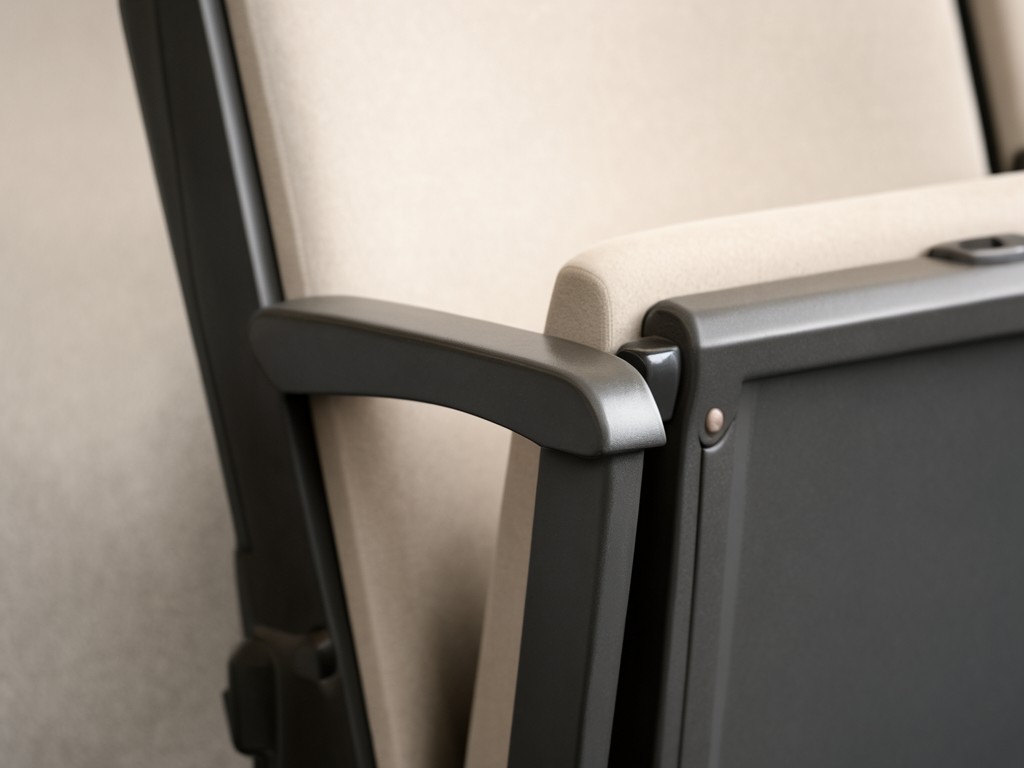
Consistency in lecture seating is measured by the repeatability of the tablet-arm mechanism. Our assemblies utilize a gas-spring assisted system tested for 50,000 opening/closing cycles to ensure the arm does not drop over time. Standard consumer-grade mechanisms often drift by 3-5mm within the first year of use, creating an unstable writing surface for students using laptops.
The configuration of a lecture hall is dictated by the floor-plan geometry. We offer fixed-leg configurations for floor-mounted rows and mobile-base options for flexible learning spaces. The width of the seat is typically adjustable between 450mm and 550mm to accommodate varying ergonomic requirements while maintaining consistent aisle density.
| Parameter | Technical Range |
|---|---|
| Frame Wall Thickness | 1.5mm - 3.0mm (Cold Rol) |
| Seat Height Range | 420mm - 500mm (Adjustable) |
| Powder Coating | 60-80 microns (Electrostatic) |
Evaluate the total cost of ownership rather than the initial unit price. A chair with a 20% higher upfront cost that utilizes reinforced joints and high-grade foam will significantly reduce the labor costs associated with mid-contract repairs and replacements. Provide your floor-plan dimensions and specific tablet-arm requirements to allow us to calculate the structural load for your specific layout.
Need specific technical drawings for your lecture hall project?
Request Technical Consultation and Quote







