
Contact Fumei
No.20 Jiuqiao Road, Shijiang Industrial Area, Jiujiang Town, Nanhai District, Foshan City, China.
Custom Comfortable Auditorium Chairs Seating Factory - Bulk Supply and Specification Guide Long-term ergonomic performance depends on the density rating of the polyurethane foam and the tensile streng
Structural failure in auditorium seating often originates at the junction points where the seat pan meets the backrest. When the gauge of the tubular steel tubing is insufficient, the repeated stress of occupants sitting down leads to metal fatigue and cracking at the weld joints. We mitigate this by employing reinforced gusset plates and a multi-point bolting system, which distributes the load across the entire frame rather than concentrating it on a single point of failure destabilized frame.
Fabric abrasion resistance is another critical metric for procurement officers managing public venues. Standard commercial fabrics often exhibit pilling or thinning within the first twelve months of high-frequency use. We specify textiles with high Martindale counts and treated fire retardancy to ensure the surface remains intact despite rigorous cleaning cycles and constant mechanical friction.
Selection of materials involves a direct trade-off between weight for logistics and structural rigidity. The following table outlines the standard parameters available for our auditorium-grade production.
| Parameter | Technical Specification |
|---|---|
| Frame Material | Powder-coated cold-rolled steel (1.5mm-2mm wall) |
| Foam Density | Cold-molded (45-55 kg/m³) |
| Upholstery Options | Commercial grade, synthetic leatherette, or wool-blend |
| Base Configuration | Fixed floor, cantilever, or row-mounted beam |
| Load Rating | Static 250kg; dynamic load-tested |
Ideal for permanent lecture halls where row alignment is the priority. The integrated steel beam eliminates independent movement between chairs, preventing uneven rows, but requires precision floor-leveling during the initial installation phase.
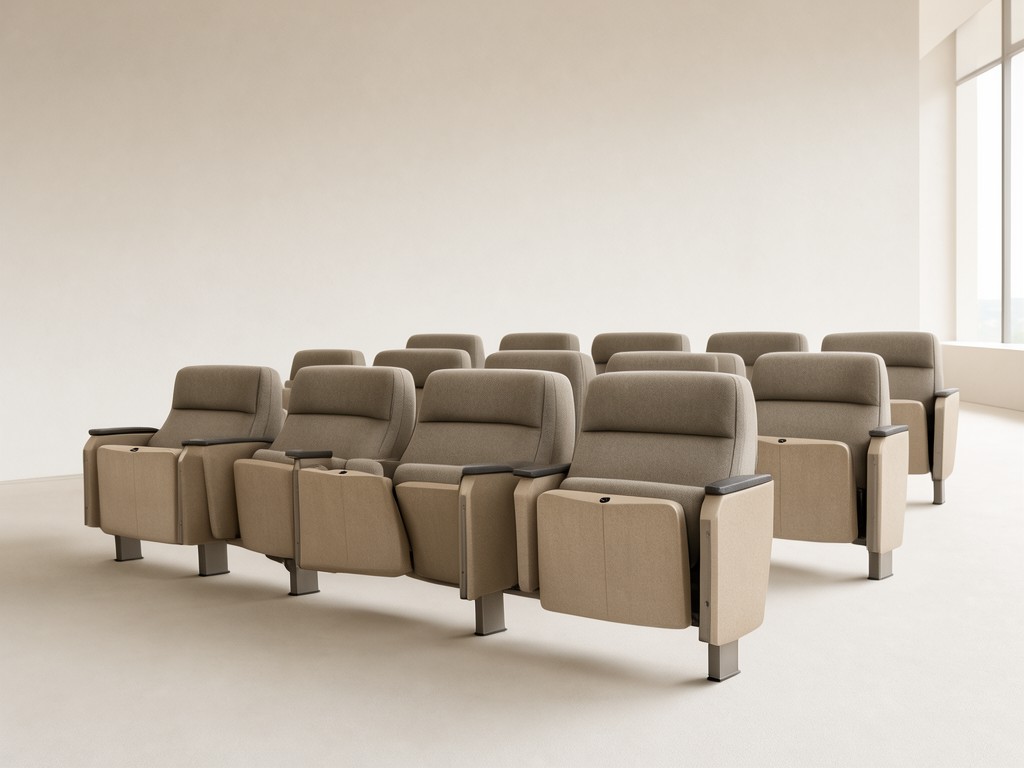
Designed for multi-purpose spaces requiring frequent floor reconfiguration. The spring-steel base provides natural flex for the user, though it requires higher-grade steel to prevent permanent bending over thousands of use cycles.
Procurement needs vary based on the specific environment of the seating area. Indoor theaters prioritize acoustic dampening properties of the fabric and backrest to prevent sound bounce. In contrast, outdoor-adjacent seating requires UV-stabilized coatings and moisture-resistant membranes to prevent internal corrosion and fungal growth.
Managing a large-scale seating project requires dimensional consistency across thousands of units. We provide batch traceability to ensure that dye lots and foam density profiles remain identical from the first shipment to the last. This prevents the visual and tactile discrepancies that occur when components are sourced from disconnected production cycles.
Request a technical drawing or material sample for your project.
Every batch undergoes a rigorous testing protocol to validate the structural claims. We perform static load-bearing tests on random samples to ensure the frame does not yield under maximum weight limits. Additionally, the coating adhesion is tested via cross-cut analysis to ensure the finish will not chip or peel during transit or installation.
| Service | Details |
|---|---|
| Monthly Output Capacity | Up to 5,000 units per month |
| Tooling Lead Time | 14-21 days for new mold- |
| Standard Lead Time | 6-8 weeks depending on order volume |
Discuss specific technical requirements for your next auditorium project.
Inquire for Quote







