
Contact Fumei
No.20 Jiuqiao Road, Shijiang Industrial Area, Jiujiang Town, Nanhai District, Foshan City, China.
Specifying customized auditorium seating with writing table producer Tooling amortisation decides the per-unit cost efficiency for large-scale institutional installations. When procuring for high-occu
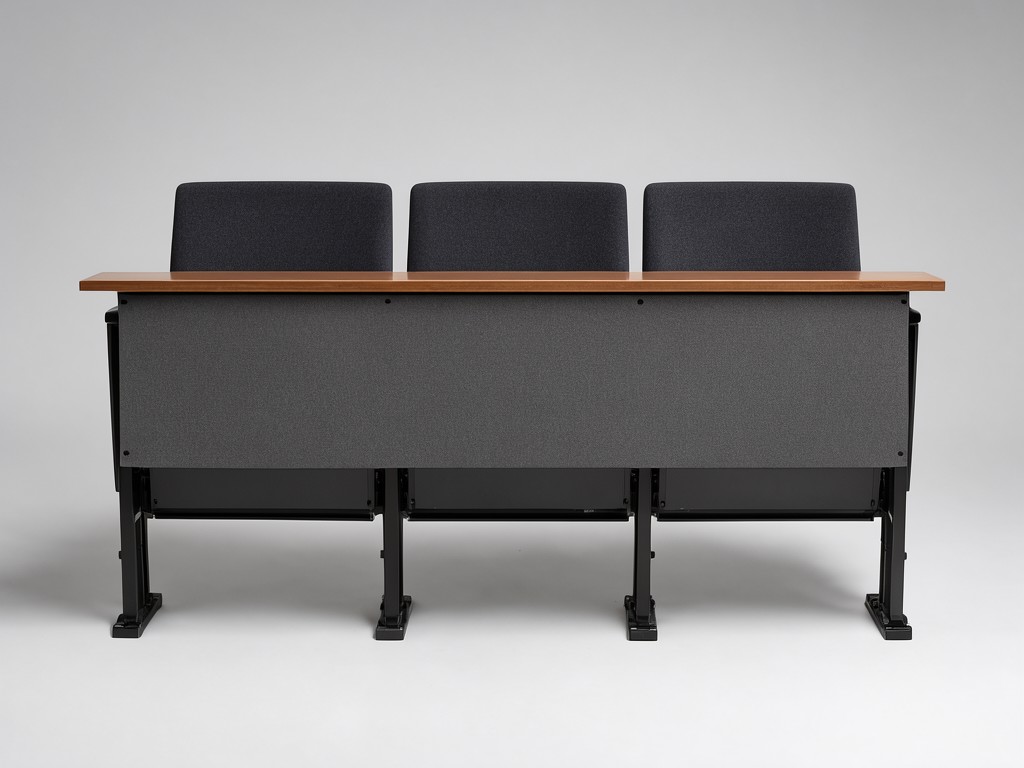
Tooling amortisation decides the per-unit cost efficiency for large-scale institutional installations. When procuring for high-occupancy environments, the mechanical integrity of the folding tablet arm and the tensile strength of the upholstery determine the service life of the assembly. We focus on cold-rolled steel frames with reinforced pivot points to ensure the writing surface remains level after 100,000+ deployment cycles without sagging or bolt-loosening.
Standard configurations utilize high-density polyurethane foam (35kg/m³) to prevent seatset over years of use, paired with commercial-grade fabrics rated for abrasion resistance and chemical cleaning agents.
| Parameter | Specification Standard |
|---|---|
| Frame Material | Powder-coated cold-rolled steel (14-16 gauge) |
| Tablet Surface | High-Pressure Laminate (HPL) or ABS |
| Load Rating | 150kg static load-per seat |
| Upholstery Abrasion | 100,000+ Martindale cycles |
The mechanism for the writing table utilizes a gravity-assisted spring system to ensure the tablet locks flush against the seat back when retracted. This prevents impact damage to the laminate during high-traffic egress periods. We utilize nylon-locking nuts on all structural joints to mitigate vibration-induced loosening common in lower-grade modular auditorium seating.
Selecting between fabric and synthetic leather involves balancing acoustic absorption against maintenance requirements. Fabric options offer superior sound dampening for lecture halls but are more susceptible to staining if not treated with antimicrobial coatings. Conversely, high-grade vinyl provides rapid wipe-down capabilities for medical-training facilities but increases the reverberation time of the room.
Fixed-base configurations provide maximum structural stability and simplify floor-mounting. These are ideal for long-term theater installations where the layout is unlikely to change frequently.
Pedestal mounted systems allow for flexible room reconfiguration. However, these require heavy-duty floor anchoring to prevent lateral shifting when users lean on the writing tables.
Cheaper stock options fail at the worst point in the season when the foam cells lose elasticity. Our process utilizes injection-molded foam which maintains its original profile height even after 10 years of continuous daily use. This prevents the "sagging" effect that leads to premature replacement and high maintenance costs in university environments.
The choice of writing tablet material impacts the perceived and functional utility of the seat. For standard classrooms, a slim flip-up tablet is sufficient. For technical training requiring laptop use, a wider surface area with a contoured edge is necessary to prevent wrist strain during extended sessions.
Audit the venue's acoustic requirements before finalizing fabric selection. If the auditorium has high reflective surfaces, prioritize upholstered-backed seats to help manage echo levels. Additionally, ensure the tablet width is compatible with the seat width to allow for ergonomic-compliant legroom between rows.
We provide private-label manufacturing services including custom-integrated branding and bespoke powder coating finishes. Our production line allows for batch-traceable components, ensuring that color matching remains consistent across thousands of units for multi-phase construction projects.
Need a technical datasheet or bulk quote for your project?
Contact our technical sales team today







