
Contact Fumei
No.20 Jiuqiao Road, Shijiang Industrial Area, Jiujiang Town, Nanhai District, Foshan City, China.
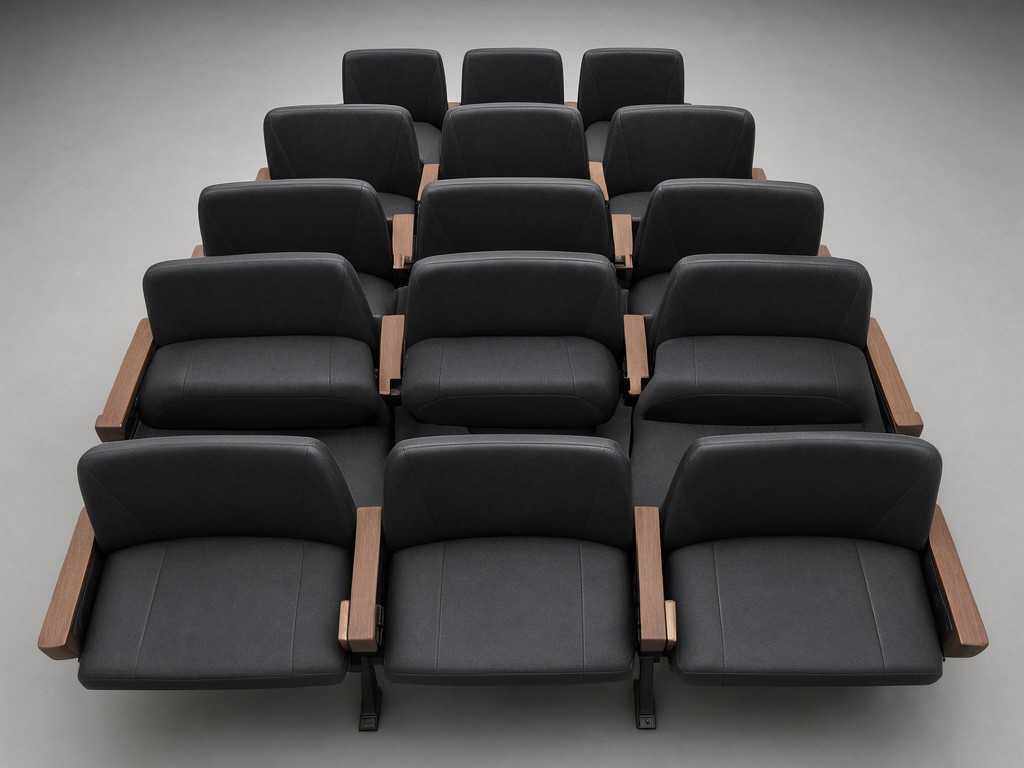
Customized Fabric Leather Covering Auditorium Theater Chairs Exporter Structural integrity of auditorium seating depends on the mechanical bond between the upholstery material and the tensile strength
Structural integrity of auditorium seating depends on the mechanical bond between the upholstery material and the tensile strength of the foam core. In high-occupancy environments, standard-grade foams often fail through permanent deformation after under 100,000 cycles. We utilize high-density cold-molded polyurethane foam to ensure the seat profile retains 98% of its original height after long-term use, preventing the sagging that leads to premature replacement cycles for theaters.
The choice between synthetic leather and performance fabrics involves a trade-off between breathability and maintenance frequency. Performance fabrics offer superior airflow for long-duration events but are susceptible to staining if the weave density is insufficient. Synthetic leather options provide a moisture barrier that simplifies sanitation protocols, yet require specific tensioning techniques to prevent cracking at the primary flex points.
| Parameter | Performance Fabric Grade | Synthetic Leather/PU |
|---|---|---|
| Abrasion Resistance | 50,000+ Martindale | 100,000+ Martindale |
| Foam Density | 45-55 kg/m³ | 50-60 kg/m³ |
| Fire Retardancy | BS 5852 / CAL 117-20 | BS 5852 / CAL 117-20 |
| Color Fastness | Level 4-5 | Level 4-5 |
Procurement officers often overlook the impact of seam tension on the long-term aesthetic life. If the fabric is pulled too tightly over the frame radius, the seams will experience shear stress within the first six months of commercial use. We utilize double-reinforced stitching with high-tenacity thread to distribute load across the seam line rather than concentrating it at the corners.
Another common error is the neglect of UV exposure for theater seating. In auditoriums with significant natural light, standard dyes will undergo photochemical degradation, fading within a single season. We offer UV-stabilized coatings for leather surfaces to maintain colorimetric consistency over a 5-year projected lifecycle.
Large-scale projects require strict batch-to-batch consistency. Variations in fabric thickness or dye lots between different shipments can create visual inconsistencies across a single auditorium floor. Our export process includes spectrophotometer matching for every production run to ensure that the 1,000th chair matches the approved sample within a minimal Delta E tolerance.
We also address the logistical realities of international furniture shipping. By utilizing flat-packaging and reinforced corner-wrapped pallets, we reduce the risk of frame deformation or fabric abrasion during maritime transit. You can review our technical shipping specifications here.
<Every unit undergoes a load-test to verify the steel-to-upholstery connection. We apply a static load to the seat pan and backrest to ensure no structural shifting or foam-separation occurs. This prevents the "racking" noise common in lower-quality assembled theater chairs after months of use.
Export orders are protected by individual shrink-wrap polyethylene to prevent moisture ingress during sea-transit. Each pallet is marked with a QR code linked to the material batch, foam density, and production date, allowing for full traceability in your project's inventory management.
Request a technical material deck and custom quote for your auditorium project.
Inquire Technical Specifications







