
Contact Fumei
No.20 Jiuqiao Road, Shijiang Industrial Area, Jiujiang Town, Nanhai District, Foshan City, China.
durable campus lecture hall seating furniture solution: Specification, Ordering and Quality Notes Selection for high-occupancy environments requires a balance between tensile strength and impact resis
Selection for high-occupancy environments requires a balance between tensile strength and impact resistance. In a lecture hall setting, the primary failure mode is often localized fatigue at the joint connections or the delamination of surface finishes due to chemical cleaning agents. Selecting high-grade cold-rolled steel or high-density polyethylene (HDPE) ensures the frame maintains dimensional integrity over 100,000 load cycles without warping.
The configuration typically comprises the primary structural frame, the ergonomic seat pan, and the integrated tablet arm. Fixed-base solutions prioritize floor-bolted stability, which eliminates the torque-induced wobbling common in cantilevered designs. The surface finish must be a non-porous powder coating to prevent oxidation oxidation if the substrate is scratched during heavy daily use.
Consistency across large batches depends on the welding process and assembly tolerances. Manual spot-welding often results in heat-affected zones that are prone to stress cracking under repetitive stress. Robotic MIG welding ensures a uniform penetration depth, meaning that every unit handles the same 150kg static load rating without structural deformation at the weld point.
| Parameter | Specification Range | Industrial Impact |
|---|---|---|
| Frame Material | Cold-rolled steel (1.5-2.5mm) | Prevents sagging under sustained load |
| Seat Material | HDPE or Reinforced Polypropylene | Resistant to graffiti and impact impact |
| Coating | 60-80 micron powder coat | Chemical resistance to cleaning agents |
Standard commercial seating often utilizes thin-gauge fasteners that loosen over time. Our solution uses recessed hex-set bolts with vibration-locking washers, ensuring the tablet arm does not pivot downward under the weight of a laptop. By increasing the surface area of the mounting plates, we distribute the stress across the frame, which reduces the likelihood of metal fatigue at the bolt point.
While seat colors can be varied, the structural geometry remains fixed to maintain safety-rated load capacities. We offer widths ranging from 500mm to 900mm to accommodate different lecture densities. Note that modifying the frame height requires a recalibration of the cantilever physics, as it affects the lateral stability of the entire row assembly.
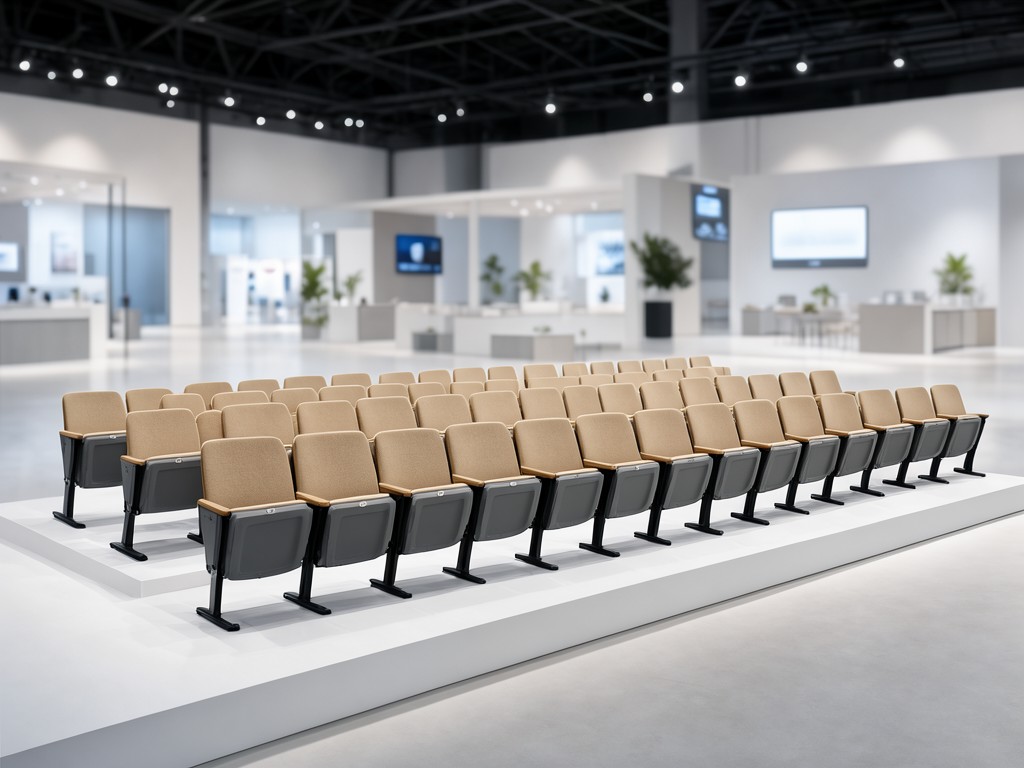
Best for high-density auditor halls. The floor-bolted configuration prevents any movement, making it ideal for permanent-install environments.
Ideal for flexible learning spaces. Allows for easier floor cleaning but requires higher-gauge steel to prevent oscillation.
Buyers must define the expected usage frequency of the hall. If the hall is used for heavy laptop work, the HPL-faced tablet is mandatory to prevent edge chipping. Determine the center-to-center distance required between rows; this is typically 800mm to 1100mm to allow for ergonomic clearance and egress compliance.
Do not assume that all plastic is equally durable. Without UV-stabilizers, polypropylene seats will crack within 24 months if exposed to direct sunlight. Furthermore, "heavy" is not a proxy for strength; the wall thickness of the steel and the weld penetration are what determine the actual lifespan in a high-traffic environment.
| Usage Condition | Typical Complaint | Prevention Spec |
|---|---|---|
| Heavy lateral leaning | Bolt loosening/frame sag | Torque-tested joints & locking washers |
| Daily chemical cleaning | Surface peeling/fading | Cross-linked epoxy powder coating |
| High impact/dropping | Cracking in seat | Impact-tested HDPE (ASTM D256 compliant) |
Requires specific technical specifications for a campus project?
Contact our engineering team for a tooling review







