
Contact Fumei
No.20 Jiuqiao Road, Shijiang Industrial Area, Jiujiang Town, Nanhai District, Foshan City, China.
factory direct budget friendly lecture theater seating company: Specification, Ordering and Quality Notes How It Performs in Use Repeat loading drives the failure in lecture theater seating long befor
Repeat loading drives the failure in lecture theater seating long before the frame yields. A 300-seat hall sees 15,000 flip-up cycles per week during term; the gravity tip-up mechanism, not the steel tube, is the component that dictates service life. Our standard mechanism is rated for 250,000 cycles at 120 kg static load — equivalent to seven academic years at 90% occupancy — before the pivot bushings require replacement.
The seat pan uses 18 mm birch plywood with a 50 kg/m³ molded polyurethane foam core, wrapped in 450 g/m² polyester fabric rated 80,000 Martindale cycles. Foam indentation force deflection (IFD) is held at 55 ± 5 N at 25% compression; this keeps the occupant's pelvis supported without bottoming out at the 95th-percentile male weight. Seat depth is fixed at 460 mm, back height at 880 mm from floor, and row-to-row clearance at 900 mm center-to-center — dimensions that meet EN 12727 and BIFMA X5.4 without custom tooling.
Critical spec rule: If the project specifies row spacing below 850 mm, the standard flip-up envelope collides with the row ahead. You must either specify the compact damper mechanism (adds 18% unit cost, reduces flip-up envelope by 60 mm) or accept fixed seats. There is no middle ground.
The limiting factor is rarely the headline specification — it is the consistency of the powder coat adhesion on the cold-rolled steel frame after 500 hours of salt spray. Budget imports typically run 60–80 µm DFT; we hold 90–110 µm with a zinc-rich primer layer. That difference translates to 12–15 years before first rust bloom in a coastal university versus 4–6 years on the cheaper alternative.
Upholstery attachment is another separation point. Standard staples pull through plywood at 180 N; we use 1.2 mm hardened T-nuts with M6 machine screws at 8 N·m torque. The joint survives 500 N pull-out — the force generated when a 110 kg occupant drops into the seat off-center. Staple-only constructions fail that test at half the load.
| Parameter | Standard Import | Our Factory Direct Spec | Test Basis |
|---|---|---|---|
| Frame powder coat DFT | 60–80 µm | 90–110 µm + zinc primer | ASTM B117 500 h |
| Tip-up mechanism cycle rating | 100,000 cycles | 250,000 cycles | BIFMA X5.4 §7.2 |
| Upholstery pull-out strength | 180 N (staples) | 500 N (T-nut + M6) | EN 12727 Annex B |
| Foam IFD retention after 80k cycles | 65% of initial | 88% of initial | ASTM D3574 |
| Fabric abrasion (Martindale) | 40,000 cycles | 80,000 cycles | ISO 12947-2 |
Fatigue appears at the stress concentration where the seat back meets the frame — the weld line on the backrest bracket. We offer three bracket gauges: 2.5 mm (standard, 250k cycles), 3.0 mm (heavy-use, 400k cycles), and 3.5 mm (institutional, 600k cycles). The 3.5 mm gauge adds 1.2 kg per seat and requires a separate stamping die; MOQ for that die is 500 seats or a $4,200 tooling charge amortised over the order.
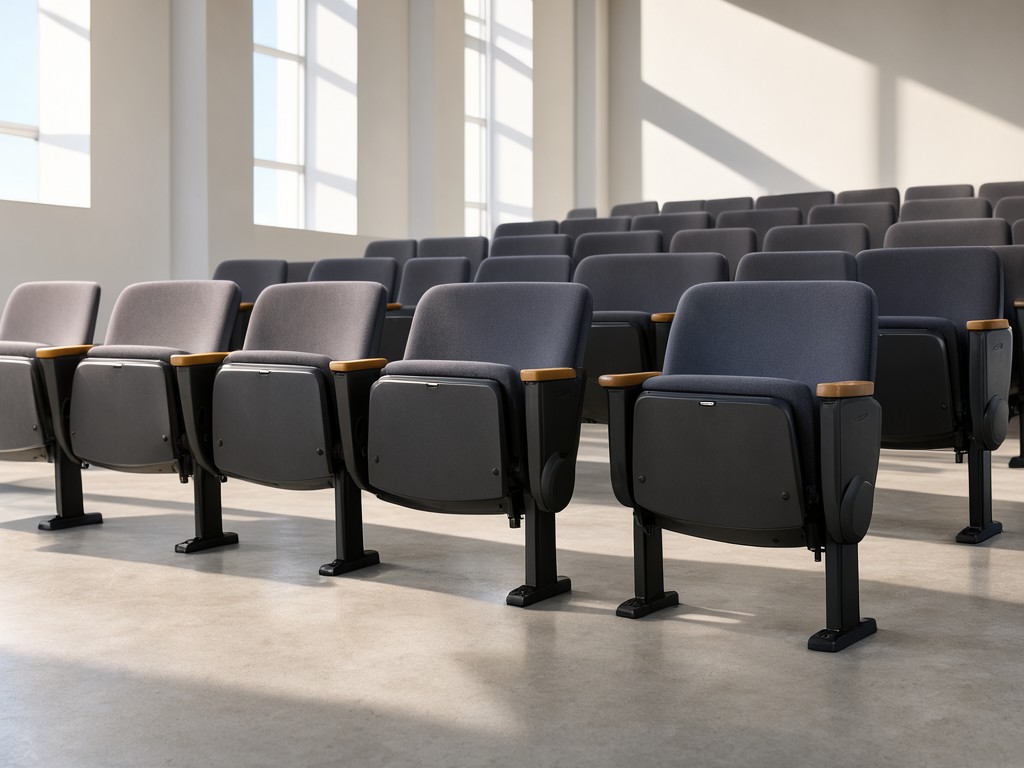
Cost/volume trade-off: Orders above 1,000 seats absorb tooling amortisation into unit price. Below 500 seats, tooling appears as a separate line item. Between 500–1,000 seats we split the difference — 50% in unit price, 50% as NRE. This is negotiable per project but the structure is fixed.
OEM buyers receive our standard lecture theater platform — frame geometry, mechanism, and dimensional envelope — with their branding on the seat back label and carton marks. No design review required; first article inspection (FAI) at 50 seats, then full production. Lead time: 6 weeks from PO to first container at 1,000 seats/month capacity.
ODM projects follow a gated process. Gate 1: concept review against our existing tooling library — we map your requirements to the closest standard platform and identify delta items. Gate 2: prototype build (10 seats) with full BIFMA test report. Gate 3: pilot run (50 seats) for field installation feedback. Gate 4: production release. Typical ODM cycle: 14–18 weeks from kickoff to first shipment. Tooling investment is shared 60/40 (factory/buyer) with IP ownership remaining with the buyer; we retain manufacturing rights for the contract term.
Every production batch (max 200 seats) receives a traveler card recording: steel coil heat number, powder coat batch, foam pour date and density, fabric roll number, and mechanism lot. This traceability links to the incoming inspection reports for each raw material. If a warranty claim arises at month 36, we can pull the exact material lots and process parameters for that seat's production week.
Dimensional control uses a go/no-go fixture for the critical three: seat height (460 ± 3 mm), back height (880 ± 4 mm), and flip-up envelope (max 320 mm from seat front). Fixtures are calibrated monthly against a master gauge block set. Cpk on seat height runs 1.67; back height 1.52; flip-up envelope 1.33 — the envelope is the widest distribution because it stacks tolerances from pivot pin, bracket, and seat pan.
Weld inspection is 100% visual per AWS D1.3, plus 10% magnetic particle on bracket-to-tube joints. Any reject triggers 100% MPI on that batch. We do not ship reworked welds — rejected frames are scrapped and remade. This policy adds 2% to frame cost but eliminates the callback risk that drives procurement managers to dual-source.
Incoming inspection covers five material streams. Steel tube: wall thickness (ultrasonic, ±0.1 mm), yield strength (tensile coupon, min 350 MPa), surface cleanliness (Sa 2.5 visual). Plywood: formaldehyde emission (EN 717-1, E1 class), moisture content (8–12%), bond shear (ASTM D2559). Foam: density (ISO 845, 50 ± 2 kg/m³), IFD (ASTM D3574, 55 ± 5 N), tensile strength (min 120 kPa). Fabric: Martindale (ISO 12947-2, 80k min), colour fastness to rubbing (ISO 105-X12, dry 4/5, wet 3/4), tear strength (ISO 13937-1, min 25 N). Mechanisms: pivot pin hardness (HRC 45–50), bushing ID/OD (CMM, ±0.02 mm), cycle test (100 cycles at 120 kg, no bind).
In-process checks: weld visual every unit, powder coat DFT every 20th unit (Fischer scope, 5 points), foam pour weight every mold (scale, ±15 g), staple/T-nut torque audit every 50th seat (click wrench, 8 N·m ± 0.5). Final inspection: dimensional fixture, flip-up function (3 cycles, measure envelope), fabric alignment, label presence, carton drop test (ISTA 1A, 1 corner 3 edges 6 faces at 76 cm).
Periodic validation (quarterly): full BIFMA X5.4 sequence on a random batch sample — static load, impact, durability, stability, and cycle. Results are archived for three years and available to OEM buyers on request. We do not publish generic test reports; the data belongs to the batch and the buyer.
Standard configuration (530 mm width, 900 mm row spacing, gravity tip-up, RAL 9005 frame, stock fabric Pattern 07) carries a 200-seat buffer in the EU warehouse and 150 seats in the US West Coast depot. These turn in 3–4 weeks. Reorder lead from buffer: 10 business days ex-works. Reorder from production: 4 weeks for 200–500 seats, 6 weeks for 500–1,000, 8 weeks above 1,000.
Container loading: 40 ft HQ holds 280 seats (beam-mounted, 4 seats per beam, 7 beams high) or 320 seats (floor-mounted, knocked down). Mixed loads with tablet arms reduce count by 12%. We provide load plans and installation sequencing diagrams with every shipment — seat numbers match the architect's row/position schedule. Missing this step is the single most common cause of install-day delays.
Reorder trigger: Set your internal reorder point at 8 weeks of projected consumption. At 50 seats/week that is 400 seats. Place the PO when inventory hits 450 — this absorbs the 6-week production lead plus 1 week buffer for freight and customs. We do not expedite outside the published lead times; the line is scheduled in 200-seat blocks.
Send the project seating layout (DWG or PDF with row dimensions), occupancy target, and desired warranty period. We return a spec-compliant BOM with unit pricing at three volume tiers, tooling amortisation schedule if applicable, and a lead-time commitment — no marketing deck, just the data your procurement file needs.








