
Contact Fumei
No.20 Jiuqiao Road, Shijiang Industrial Area, Jiujiang Town, Nanhai District, Foshan City, China.
Specifying factory direct lecture theater seating chairs exporter for Wholesale and OEM Orders Weight and stiffness trade off against each other in every row of fixed‑back lecture seating. A buyer who
Weight and stiffness trade off against each other in every row of fixed‑back lecture seating. A buyer who specifies a 1.2 mm steel tube frame with a 12 mm plywood seat core will see a 15 % increase in load rating over a 1.0 mm tube, but the added mass raises freight cost per container by roughly 8 %. The decision point is usually the floor‑load limit of the venue and the number of seats per pallet.
| Parameter | Standard Range | Typical Tolerance |
|---|---|---|
| Overall seat width | 520–560 mm | ±3 mm |
| Seat depth (front to back) | 460–480 mm | ±2 mm |
| Back height from seat | 850–950 mm | ±5 mm |
| Frame tube OD | 38 mm (1.0 mm) / 42 mm (1.2 mm) | ±0.1 mm |
| Seat core thickness | 12 mm plywood / 15 mm MDF | ±0.5 mm |
| Upholstery foam density | 35–45 kg/m³ | ±2 kg/m³ |
The table above defines the physical envelope that every export lot must meet before it leaves the factory floor. Deviations beyond the listed tolerances trigger a re‑work order because they affect row spacing, aisle clearance, and the stacking height used in container loading plans.
Lower unit weight (≈ 4.2 kg per seat) reduces container freight by ~7 %. Yield strength 275 MPa gives a static load rating of 180 kg per seat. Fatigue cracks typically initiate at the welded joint after 120 k cycles of 150 kg cyclic loading.
Heavier (≈ 4.8 kg per seat) but raises static rating to 230 kg and pushes fatigue initiation to ~200 k cycles. Preferred for auditoriums with daily turnover > 300 occupants.
Plywood cores (12 mm, 9‑ply birch) resist delamination better than 15 mm MDF under humid climates; MDF saves ~0.3 kg per seat but shows edge swelling after 6 months at 70 % RH. Foam density selection follows the same logic: 35 kg/m³ cuts material cost 12 % but loses 18 % of initial compression set after 5 years of 8 h/day use.
Customisation is limited to surfaces and finishes that do not alter the structural envelope defined in the Scope table.
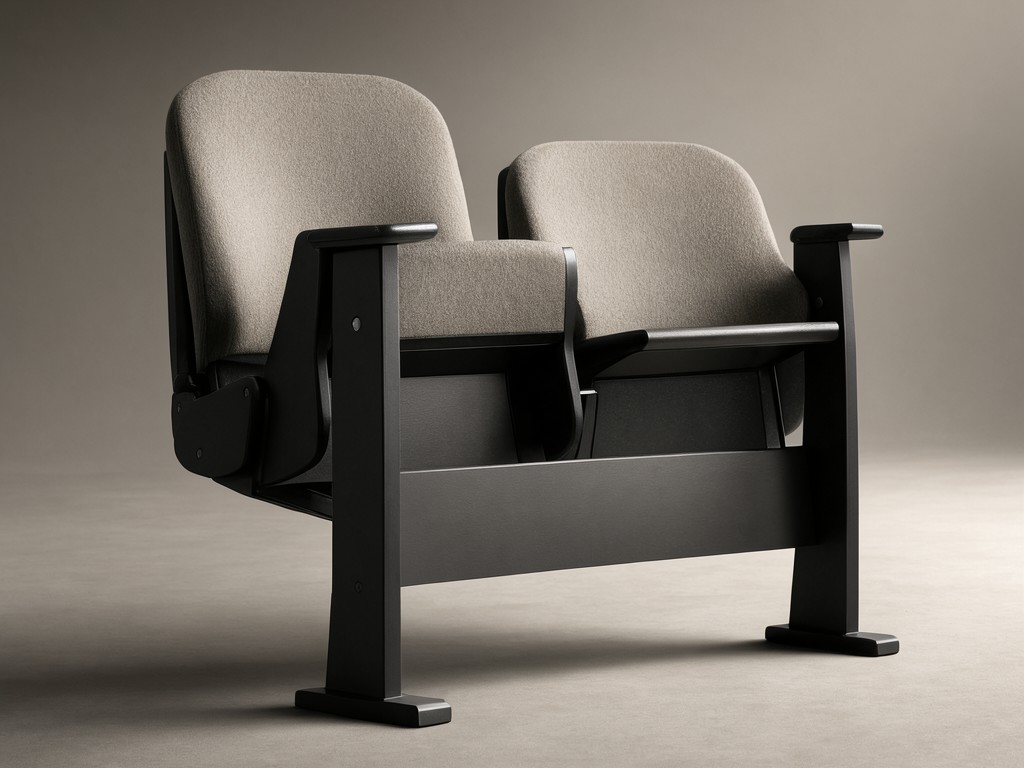
Non‑negotiable: tube OD, wall thickness, seat core material, overall dimensions, and fire‑rating classification (EN 1021‑1/2). Any change to these triggers a new tooling approval cycle.
University lecture halls (150–300 seats) typically order the 1.0 mm tube with plywood core and 35 kg/m³ foam – the lowest total cost per seat while meeting a 180 kg static rating. Corporate training centres that re‑configure rooms weekly request the 1.2 mm tube, MDF core, and 45 kg/m³ foam to survive frequent repositioning. Public auditoriums with fire‑code mandates specify Trevira CS fabric and RAL 9005 powder‑coat; they also require the flip‑up tablet for note‑taking.
OEM orders follow a three‑stage gate: sample approval (T0), first‑article inspection (T1), and production release (T2). ODM projects add a concept‑validation gate before T0, where the factory provides 3‑D CAD, FEA of frame stress, and a foam‑compression curve. Both programmes share the same inspection checklist used at T1 and T2.
| Inspection Point | Method | Acceptance Criteria |
|---|---|---|
| Dimensional audit | CMM on 5 critical points per seat | All within ±3 mm of spec |
| Weld integrity | Visual + ultrasonic thickness | No lack‑of‑fusion > 0.2 mm |
| Foam compression set | ASTM D3574 50 % compression, 22 h | ≤ 15 % loss of initial height |
| Fabric abrasion | Martindale 30 000 cycles | No yarn break, colour ΔE ≤ 2 |
| Fire test | EN 1021‑1 (cigarette) & EN 1021‑2 (match) | No ignition, after‑flame ≤ 2 s |
The line runs two 12‑hour shifts, 22 days/month, delivering up to 4 800 seats per month at the 1.0 mm configuration. Switching to 1.2 mm tube adds a 4‑hour changeover for the tube‑bending fixture and a 2‑hour weld‑parameter validation. New colour powder‑coat requires a 24‑hour cure oven cycle before the first article can be inspected. Typical lead time from artwork sign‑off to first container load: 35 days for standard fabric, 45 days for custom‑dye lots.
Fatigue appears at the stress concentration where the seat‑back bracket meets the tube. Repeated loading drives the failure mode: micro‑cracks propagate after ~120 k cycles on 1.0 mm tube, ~200 k cycles on 1.2 mm. Proper storage (flat, ≤ 30 °C, 40–60 % RH) prevents foam oxidation and fabric yellowing. Routine inspection every 12 months should check bracket bolt torque (12 Nm ± 1 Nm) and foam compression set.
Specification callout: if the venue exceeds 250 occupants per day, specify 1.2 mm tube and 45 kg/m³ foam; otherwise the 1.0 mm/35 kg/m³ combo meets a 10‑year service target with a 15 % safety margin.
Send your logo files (AI or high‑resolution PDF, CMYK, 300 dpi) and fabric colour references. Our design team returns a digital mock‑up within 48 hours and a physical strike‑off sample in 10 working days.








