
Contact Fumei
No.20 Jiuqiao Road, Shijiang Industrial Area, Jiujiang Town, Nanhai District, Foshan City, China.
oem lecture hall seating chairs factory - Bulk Supply and Specification Guide What Actually Determines Performance Two suppliers quoting the same specification often deliver chairs that behave differe
Two suppliers quoting the same specification often deliver chairs that behave differently after three academic years. The divergence starts at the frame: cold-rolled steel tube with 2.0 mm wall thickness resists racking loads better than 1.5 mm, but adds 1.2 kg per seat. Polypropylene seat shells molded at 180 °C hold dimensional stability within ±1.5 mm; lower melt temperatures introduce internal stress that shows as warping once HVAC cycles kick in.
Upholstery choice shifts the maintenance budget. A 300 g/m² polyester fabric rated 100,000 Martindale cycles survives five semesters before pilling becomes visible. The same seat in 450 g/m² wool blend pushes that to eight semesters but costs 22 % more per unit and requires fire-retardant back-coating to meet local codes. Writing tablets — flip-up laminate versus injection-molded ABS — change the center of gravity enough to affect tip-test results on raked floors.
Specification lock point: Agree on frame wall thickness, shell material grade, and fabric abrasion rating before first sample. Changing any of these after tooling approval adds four weeks and a new mold charge.
| Parameter | Light Use (Seminar Rooms) | Standard Lecture Hall | Heavy Use (Auditorium, 12 h/day) |
|---|---|---|---|
| Frame tube wall thickness | 1.5 mm | 2.0 mm | 2.5 mm |
| Seat shell material | PP + 15 % talc | PP + 20 % glass fiber | PA6 + 30 % glass fiber |
| Upholstery abrasion (Martindale) | 60,000 cycles | 100,000 cycles | 150,000 cycles |
| Writing tablet | None or shared rail | Flip-up HPL 12 mm | Fixed ABS, anti-panic hinge |
| Row spacing (center-to-center) | 850 mm | 900 mm | 950 mm |
| Unit weight (fully dressed) | 14.5 kg | 18.2 kg | 22.8 kg |
Floor-mounted legs anchor directly to concrete through expansion bolts. Best for flat floors and retrofit projects where core drilling is approved. Adds 15 mm to seat height; verify ADA clearance.
Beam-mounted systems hang seats from a continuous steel beam spanned between floor anchors every 1.8 m. Reduces floor penetrations by 70 % and simplifies alignment on raked floors. Requires 120 mm beam depth under the front row.
Gravity-assisted counterweight keeps the seat down without a latch. Silent, no moving parts to wear, but requires 35 mm clearance behind the seat pan.
Spring-loaded damper adds controlled rise and soft close. Extends mechanism life to 500,000 cycles in lab testing. Adds 0.4 kg per seat and a $3.50 unit cost premium.
Before comparing quotations, confirm the fire code applicable to the project. NFPA 260 (cigarette ignition) and CAL 117-2013 (smolder resistance) are baseline for US public universities. UK projects typically demand BS 5852 Crib 5. Each standard dictates a different foam density and fabric back-coating — mixing them on one order creates a certification gap.
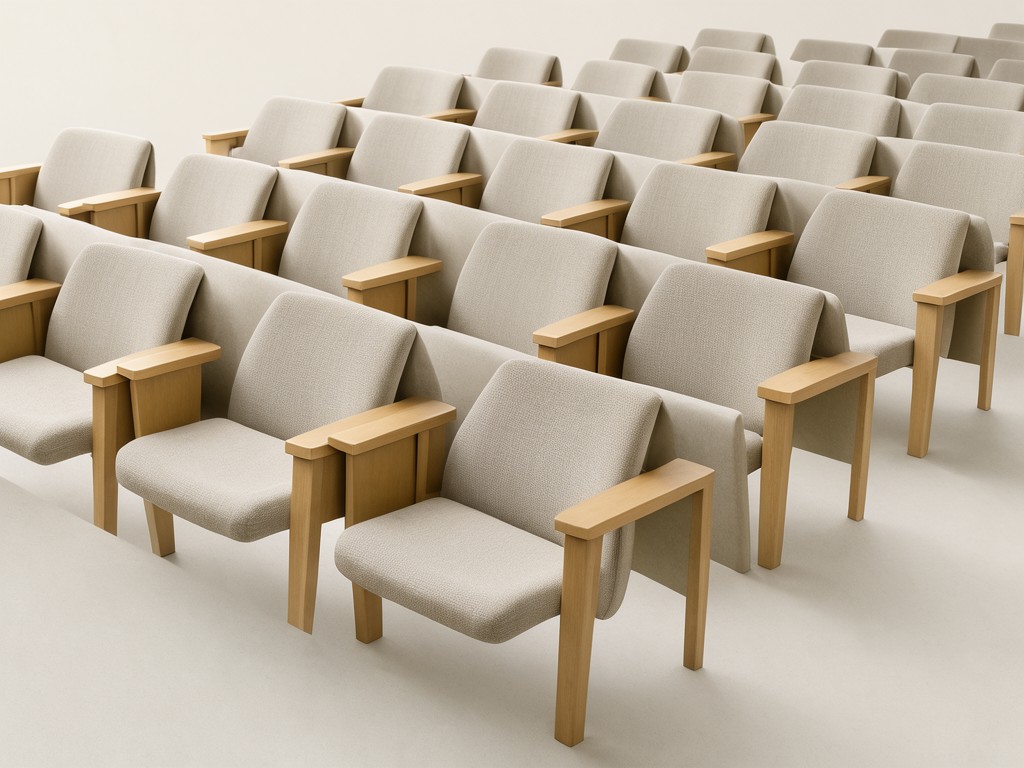
University facilities managers specify the standard lecture hall configuration for 150-seat tiered rooms. They prioritize 10-year frame warranty, replaceable seat pads, and color fastness to light grade 5 minimum. The procurement cycle aligns with summer break installation windows — lead time certainty matters more than unit price.
Community college purchasing committees often bundle seminar-room chairs with lecture hall seats on a single PO. They need interchangeable writing tablets across both product lines to simplify inventory. A shared tablet SKU reduces spare-parts stock by 40 %.
Private academy buyers specify upholstered wood-back chairs for heritage buildings. The frame must accept a 12 mm veneer back panel without visible brackets. Powder-coat color matching to existing RAL 9010 trim is a pass/fail criterion during first-article inspection.
Corporate training centers order beam-mounted rows with integrated power and data grommets. The beam carries a two-compartment cable raceway; seat spacing shifts to 1,000 mm to accommodate laptop clearance. This configuration adds 18 % to unit cost but eliminates floor trenching.
| Customization Element | Options Available | Tooling Impact | MOQ Threshold |
|---|---|---|---|
| Frame powder-coat color | Any RAL / Pantone; textured or smooth | None — line change only | 50 seats |
| Seat shell color (PP/PA) | Standard palette + custom masterbatch | New color chip approval; no mold change | 200 seats |
| Upholstery fabric | COM (customer's own material) or mill selection | Cutting die adjustment if pattern repeat > 500 mm | 100 seats |
| Writing tablet shape/size | Rectangular, trapezoid, kidney; 300×400 to 450×550 mm | New injection mold ($8,000–$12,000) | 500 seats |
| Row spacing & stagger | 850–1,050 mm in 25 mm increments | Beam bracket reposition; no new tooling | 50 seats |
| Logo / branding | Hot-stamp on shell back, embroidery on fabric, laser etch on tablet | Fixture cost $150–$400 per location | 100 seats |
ODM development follows a gated process: concept sketches → 3D CAD → finite element analysis on frame → first-article prototype at week 6 → destructive test report at week 10 → pre-production run at week 14. Buyer sign-off is required at each gate. Skipping the FEA gate saves two weeks but voids the structural warranty.
Installation crews need a laser level, 18 V impact driver, and 12 mm concrete drill bits for floor-mounted legs. Beam-mounted rows require a 3 m level and two-person lift for the 6 m beam sections. Allow 4 minutes per seat for floor mount; 2.5 minutes per seat for beam mount once beams are leveled.
Stocking strategy: keep 3 % of seat pads, 1 % of shells, and 0.5 % of frame legs in the maintenance crib. Writing tablets are low-failure — 0.2 % annual replacement rate — so one spare per 200 seats is sufficient. Powder-coat touch-up pens matched to the project RAL code ship with every order.
Send the project seating layout (DWG or PDF) with row counts, floor slope data, and fire code reference. We return a marked-up specification sheet, unit pricing at three volume breaks, and a sample kit — one dressed seat, one frame section, two fabric swatches — within 10 business days.
Request a specification review and sample kit







