
Contact Fumei
No.20 Jiuqiao Road, Shijiang Industrial Area, Jiujiang Town, Nanhai District, Foshan City, China.
Top Quality auditorium chairs with foldable writing tablet company: Specification, Ordering and Quality Notes Design Constraints Behind the Specification Auditorium seating must survive daily occupanc
Auditorium seating must survive daily occupancy cycles of 200‑300 kg per seat while keeping aisle clearances within 10 mm of the architectural drawing. Fire‑retardant fabric ratings, tablet swing‑clearance envelopes, and stack‑height limits drive the baseline geometry before any material is chosen.
Steel tube frames (30 × 30 mm, 2 mm wall) give the required stiffness at a cost per metre that stays below the budget ceiling for 500‑unit runs. Switching to 25 mm aluminium extrusions cuts weight by roughly 1.2 kg per chair but raises the unit price 18‑22 % because of the anodising step and the tighter tolerance on the tablet‑hinge mounting brackets.
The limiting factor is rarely the headline load rating; it is the hinge‑fatigue life of the foldable tablet. A 12 mm diameter cold‑rolled steel pin, heat‑treated to 45 HRC, survives 12 000 ± 1 000 open/close cycles before measurable play appears. Below that threshold the tablet begins to sag 3‑5 mm under a 2 kg notebook, which users perceive as a quality defect.
Seat foam density (45 kg/m³ high‑resilience) and fabric abrasion resistance (Martindale 30 000 cycles) are secondary but become decisive when the venue runs three shows per day. Frame deflection under a 150 kg static load must stay under 4 mm at the centre of the seat pan; exceeding that value correlates with premature weld cracking at the rear leg junction.
| Parameter | Typical Range | Test Method |
|---|---|---|
| Seat static load capacity | 150‑180 kg (per EN 12727) | Hydraulic press, 5 min hold |
| Tablet hinge cycles | 10 000‑14 000 cycles before 0.5 mm play | Motorised open/close rig, 1 Hz |
| Foam indentation loss | ≤ 8 % after 80 kg, 24 h | ISO 3385‑A |
| Upholstery abrasion (Martindale) | 30 000‑45 000 cycles | ISO 12947‑2 |
| Frame finish adhesion (cross‑cut) | Class 0‑1 (ISO 2409) | Cross‑hatch tape pull |
| Dimensional tolerance (seat height) | ± 3 mm | CMM inspection, 5 points per chair |
Values shown are conditional ranges observed across three production lots; actual figures shift with fabric choice, tablet laminate thickness, and powder‑coat cure schedule.
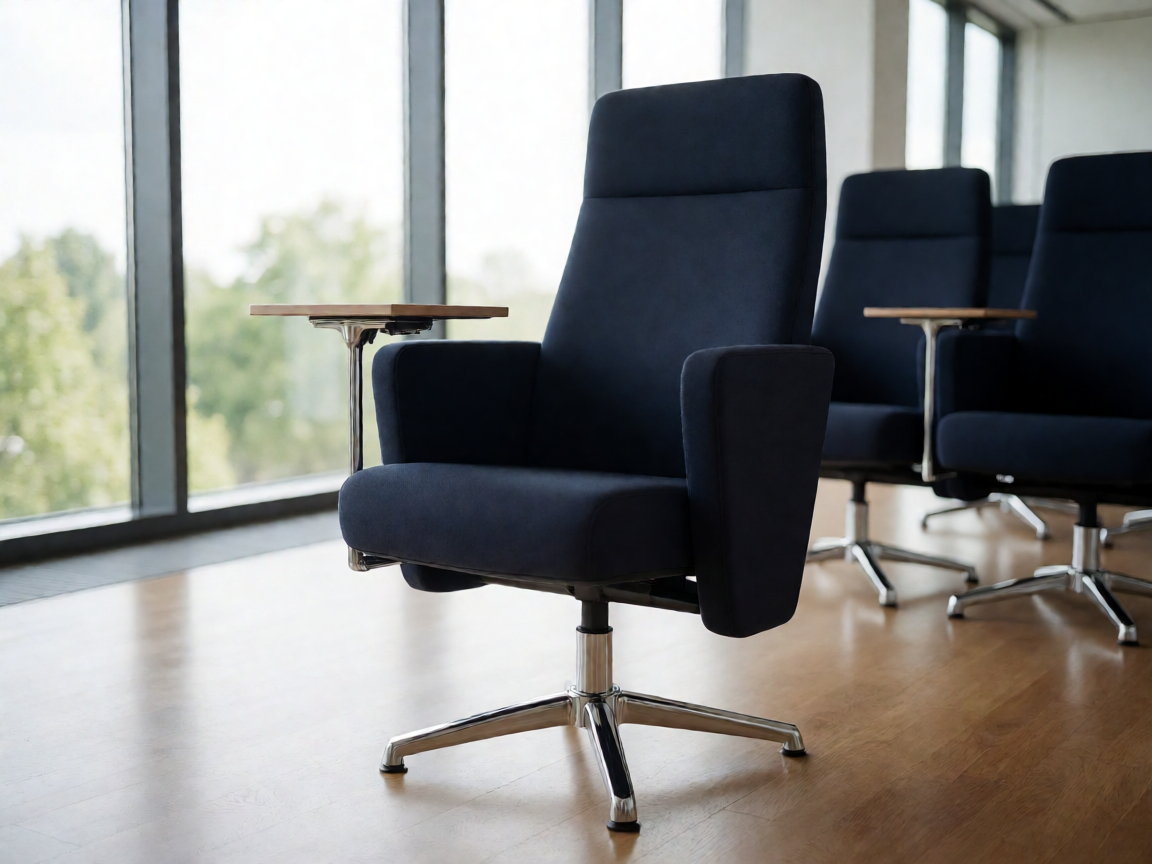
Welded jig‑fixtured, 100 % visual weld inspection, 5 % destructive bend test per lot. Weight per chair 13.2 ± 0.3 kg. Powder coat 80‑100 µm, salt‑spray 240 h no red rust.
CNC‑machined brackets, anodised 15 µm, 100 % dimensional check on hinge bosses. Weight per chair 11.9 ± 0.2 kg. Higher unit cost but reduces freight volume by 9 % for 40‑ft containers.
Lot‑to‑lot weight drift stays within ±0.25 kg when the same welding fixture and powder‑coat oven profile are locked. A change of fixture or cure temperature introduces a 0.5‑0.8 kg shift that propagates into container loading plans and retailer shelf‑space allocations.
CMM checks on seat height, backrest angle, tablet swing radius; 5 points per chair, 10 % sample per batch.
150 kg applied to seat centre for 5 min; deflection recorded, permanent set < 1 mm.
Motorised 1 Hz open/close to 12 000 cycles; play measured at hinge pin, pass < 0.5 mm.
Martindale 30 000 cycles on fabric, 12 kPa pressure; visual rating ≥ 4.
Xenon arc 300 h, ISO 105‑B02; ΔE < 2 for standard palette.
BS 5852 ignition source 5; no flaming after 30 s, char length < 50 mm.
Each inspection point is logged against the batch traveller; any deviation triggers a hold‑and‑review before the lot releases to packing.
A 40‑ft high‑cube container accommodates 22 pallets (88 chairs) when the aluminium frame option is selected, versus 20 pallets (80 chairs) for the steel version. The weight margin leaves 2.5 t headroom for additional accessories such as tablet‑laminate spare kits.
Ready to align the specification with your venue schedule? Request a specification review and we will return a detailed cost‑breakdown within two business days.








