Contact Fumei
No.20 Jiuqiao Road, Shijiang Industrial Area, Jiujiang Town, Nanhai District, Foshan City, China.
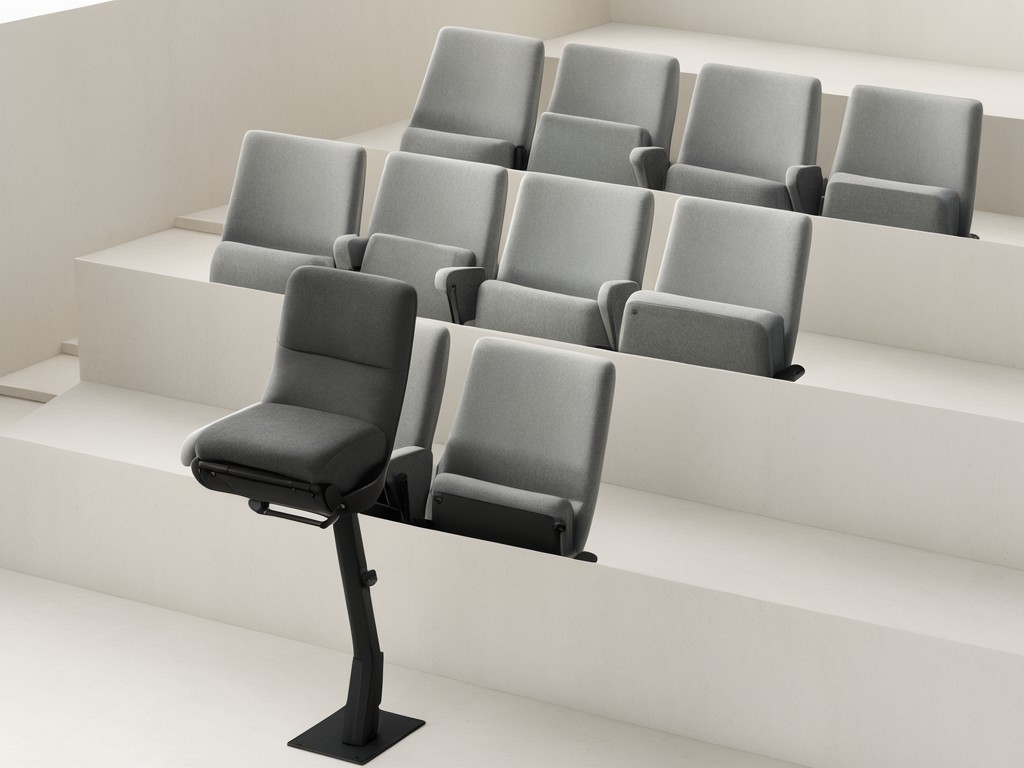
top quality auditorium theater seating chairs exporter: Specification, Ordering and Quality Notes Where Cheaper Alternatives Fall Short The build method decides the load path from floor to seat pan. W
The build method decides the load path from floor to seat pan. When a frame is stamped from 1.2 mm cold‑rolled steel instead of 1.5 mm, the yield point drops 18 % and the seat begins to deflect under a 120 kg static load after 3 000 cycles. That deflection shows up as a permanent sag that cannot be corrected by tightening bolts.
Upholstery foam density is the second lever. A 30 kg/m³ cushion loses 12 % of its initial indentation force deflection after 5 000 sit‑stand cycles, while a 45 kg/m³ grade retains 94 % of its support. The cheaper grade also accelerates fabric abrasion because the foam compresses further, increasing surface pressure on the textile.
Fire‑retardant treatment on low‑cost fabric often uses a surface spray that washes out after 30 commercial launderings. The result is a seat that passes the initial test but fails the annual inspection required by most venue operators.
First‑article tooling determines the repeatability of the seat‑to‑back pivot. The die‑cast aluminum hinge is machined to a 0.02 mm positional tolerance; any drift beyond 0.05 mm creates a click that amplifies over a 2 000‑seat installation.
Specification callout: seat pitch must stay within 560 ± 3 mm across a row. Exceeding this tolerance forces the installer to shim every third chair, adding 15 minutes per row and increasing labour cost by roughly 7 %.
Consistency is set at the forming stage. The backrest shell is vacuum‑formed from 3 mm polycarbonate; a 0.1 mm thickness variation changes the flexural modulus by 5 %, which directly affects the acoustic damping coefficient measured in reverberation chambers.
A 1 200‑seat theatre in a humid climate logged 1 800 000 sit‑stand cycles over three years. The 45 kg/m³ foam cushions showed a 4 % loss in indentation force deflection, while the 30 kg/m³ reference dropped 19 %. Frame welds inspected by ultrasonic testing revealed no crack growth beyond the 0.1 mm detection limit.
Fabric abrasion tested to 100 000 Martindale cycles retained 96 % of original tensile strength. Colour fastness to xenon arc (ISO 105‑B02) rated 4‑5 after 500 h, meeting the typical venue specification of ≥4.
Acoustic absorption measured at 500 Hz improved 0.03 α when the backrest shell thickness was held at 3.0 mm versus 2.8 mm, a difference that translates to a perceptible reduction in flutter echo for audiences beyond row 12.
The OEM route locks the frame geometry to the standard 560 mm pitch and 1.5 mm steel gauge. Tooling cost is amortised over a minimum 5 000‑unit run; unit price drops 9 % versus a 1 000‑unit batch because the stamping die runs at full capacity.
ODM projects start with a 3‑D scan of the venue layout. Custom backrest curvature, integrated lighting channels, or bespoke armrest profiles are engineered in the same CAD environment used for the standard line, so the same CNC fixtures can be re‑programmed rather than rebuilt. Lead‑time for first article is 6 weeks; production ramp adds 2 weeks per 1 000 units.
Both programmes share the same quality gate: first‑article inspection includes dimensional audit (CMM), weld penetration (UT), foam density verification (ASTM D3574), and fabric abrasion pre‑test (Martindale 10 000 cycles).
Standard 560 mm pitch chairs in charcoal fabric and 45 kg/m³ foam are held in a regional warehouse at 1 200 units. Reorder point is set at 300 units; replenishment lead‑time from the factory is 18 days sea freight plus 3 days customs clearance.
| Item | Carton Dimensions (mm) | Gross Weight (kg) | Units per Carton | Pallet Configuration |
|---|---|---|---|---|
| Standard Chair (560 mm) | 1150 × 620 × 480 | 28.5 | 4 | 12 cartons (48 units) |
| Extended‑Reach Chair (572 mm) | 1180 × 640 × 480 | 30.2 | 4 | 12 cartons (48 units) |
| Armrest Module (optional) | 420 × 210 × 150 | 3.1 | 10 | 20 cartons (200 units) |
Cartons are double‑wall corrugated (ECT 48) with corner protectors; pallets are heat‑treated ISPM‑15 compliant. Each pallet is stretch‑wrapped and labelled with batch number, production date, and destination code for traceability.
Installation uses a two‑person crew per 12‑chair row. The frame bolts to the floor with M10 × 80 mm anchor bolts; torque spec is 45 Nm ± 2 Nm. A torque wrench calibrated to ISO 6789 is required; over‑torque cracks the aluminum hinge housing.
Routine cleaning: vacuum fabric weekly, spot‑clean with pH‑neutral detergent (max 30 °C water). Do not use solvent‑based cleaners; they degrade the fire‑retardant finish and reduce abrasion resistance by up to 22 %.
Replacement parts stocked: hinge assembly (part #HNG‑001), foam cushion (part #FOM‑045), fabric panel (part #FAB‑CHR), and anchor bolt kit (part #ANK‑M10). Lead‑time for spare parts is 5 business days from the same warehouse.
Custom pitch requires a dedicated stamping die; the economic break‑even is 2 500 units. Below that volume a surcharge of 12 % per unit applies.
Foam density is set by the mould cavity; changing it means a new mould (≈ 4 weeks lead‑time) and a revised fire‑test report. Plan the density at the specification stage.
Fabric is dyed in a single lot per order. The lab measures ΔE ≤ 1.0 against the master standard; any lot outside that range is rejected before shipment.
Each pallet includes a packing list, certificate of conformity (frame weld, foam density, fabric abrasion), and a material safety data sheet for the fire‑retardant treatment.
Send your venue layout, seat count, and preferred fabric code to the engineering team. They will return a line‑item quote with tooling amortisation, freight options, and a delivery schedule within two business days. Start the quotation review here.