
Contact Fumei
No.20 Jiuqiao Road, Shijiang Industrial Area, Jiujiang Town, Nanhai District, Foshan City, China.
Top Quality latest design lecture hall chairs Exporter: Specification, Ordering and Quality Notes Two suppliers quoting the same specification can still deliver chairs that differ in seat width, row a
Two suppliers quoting the same specification can still deliver chairs that differ in seat width, row alignment, upholstery hand, and installation details. Those differences affect aisle clearance, the fit of floor fixings, and the time an installation crew needs on site. Agree the drawing revision, dimensional tolerances, finish sample, and packing method before comparing the final landed cost.
Unit price settles the question only after the room layout and shipment plan are fixed. A chair supplied as a floor-mounted row assembly has different hardware and packing needs from a loose chair or a model with a folding tablet. For procurement teams working to an opening date, a signed sample and a dated approval record reduce avoidable changes after materials are ordered.
Lecture hall chair programmes can include seat and back assemblies, a welded or bolted frame, armrests, aisle-end panels, tablet arms, row connectors, and floor-fixing hardware. Confirm which items are included in the quotation; a chair-only price may not cover the brackets, fasteners, or end panels needed to complete an installed row. Dimensions below are planning references, not a substitute for the approved room drawing.
| Specification point | Typical options or approval basis | Buyer check before production |
|---|---|---|
| Seat width and row pitch | Seat widths are often planned around 450–520 mm; row pitch depends on the hall layout and access requirements. | Approve a dimensioned plan with aisle widths, end positions, and any accessible seating spaces. |
| Frame and mounting | Steel frame with floor plates or row brackets; fixing layout is project-specific. | Match hole positions and fasteners to the site substrate and installation drawing. |
| Seat and back construction | Upholstered plywood or a shaped shell with foam and fabric or synthetic covering. | Sign off the material, foam profile, cover colour, and seam placement against a physical sample. |
| Added components | Fixed or folding tablet arm, armrests, numbering, and aisle-end trim. | Approve handedness, writing surface dimensions, label position, and included hardware. |
| Export packing | Assembled or knockdown packing, with protection selected for the frame and finished surfaces. | Confirm carton marks, pack count, assembly instructions, and container loading plan. |
For fixed seating, the floor plan and fixing details are production inputs, not site notes to resolve later. A change to row pitch or arm configuration after sample approval can affect frame tooling, carton dimensions, and the shipping quantity per container.
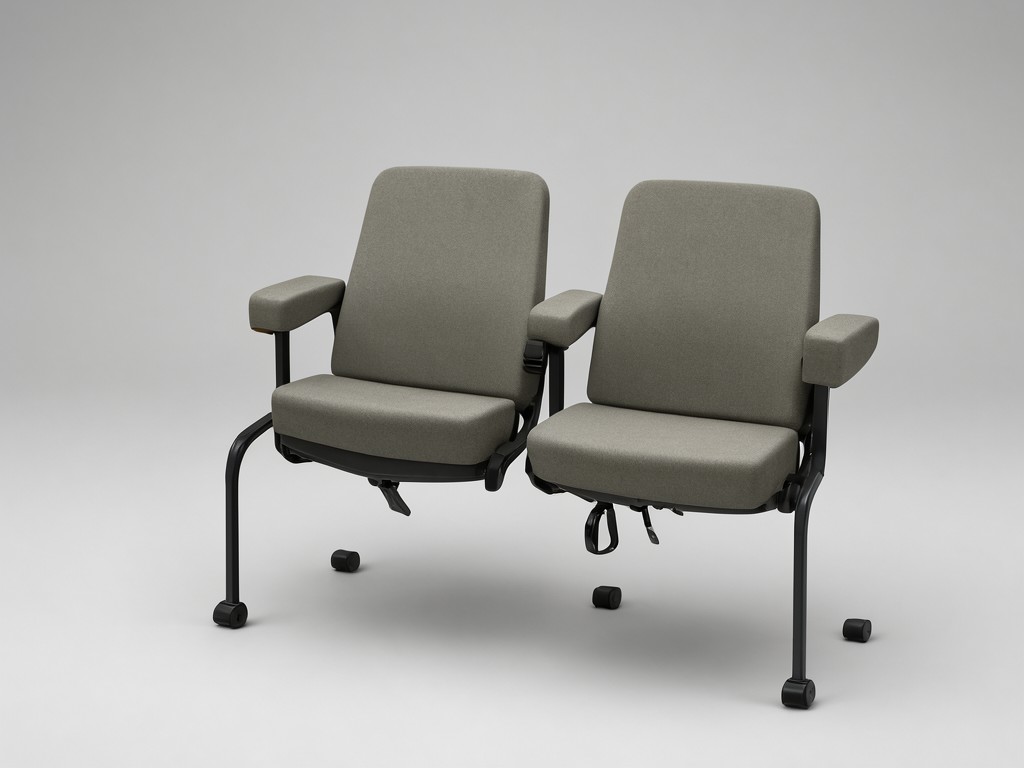
A powder-coated steel frame is a common choice for fixed rows because it accommodates welded brackets and floor plates at a controlled unit cost. A heavier frame section can add mass and freight cost, so it should follow the intended mounting and use conditions rather than serve as a substitute for a defined construction. Plywood under upholstery gives the seat and back a firm profile; a shaped shell with foam provides more freedom in contour and cover treatment. Fabric selection also affects cleaning practice and the appearance of seams after repeated use.
Choose steel when the design calls for fixed floor mounting, welded row brackets, or broad finish availability. Specify the coating colour and gloss against a retained sample; handling marks and coating chips are easier to assess when the acceptance reference is agreed in advance.
Consider aluminum where lower chair mass matters to handling or the specified design requires it. Material cost and fabrication details can raise the unit price, so compare the approved frame section, joint design, and finish rather than comparing metal names alone.
For upholstery, approve the actual cover swatch and a finished chair sample under the intended room lighting. A digital colour reference helps with repeat orders, but it cannot fully show fabric texture, foam firmness, or how a seam sits around a curved back.
Fixed lecture hall chairs suit rooms where seat positions, aisle routes, and sightlines must remain consistent between classes or events. Compared with loose chairs, a floor-mounted row can reduce daily reset work and preserve the planned layout. That advantage depends on an accurate site survey and compatible fixing details; it is not a reason to skip installation checks.
A catalogue image does not establish the chair’s finished dimensions, frame gauge, mounting pattern, or upholstery shade. Nor does a sample chair confirm that every production unit will use the same approved materials unless the bill of materials and revision are recorded against the order. Ask for a tolerance schedule on dimensions that affect row fit, and define how visible finish differences will be accepted.
Release production only against a dated drawing revision, approved finish and upholstery references, confirmed packing configuration, and a signed sample or agreed sample record. If any item changes, document the change and its effect on cost and dispatch timing before the factory revises the order.
A quoted dispatch date also depends on approval timing, material availability, and whether shipment is assembled or knockdown. Set the required arrival date first, then work backwards through sample review, artwork approval, production release, inspection, and freight booking.
For an OEM order, the importer supplies the approved chair design, drawings, finish references, and branding files; the factory confirms manufacturability and records the production specification. An ODM programme starts from an existing frame or chair platform and develops selected changes such as arm style, upholstery, colour, or tablet configuration. Larger design changes can require new tooling or additional sample rounds, so establish ownership of drawings and tooling costs before development begins.
Artwork for seat labels, carton marks, venue numbering, and private-label packaging should be checked against the physical location and finished dimensions. Send vector artwork where available, confirm colour references and language versions, and approve a marked-up proof before print. Pre-production samples should represent the quoted materials and construction; a finish-only swatch cannot confirm assembly or fit.
Artwork and branding review: Share the room schedule, drawing revision, logo files, carton requirements, and target arrival date for a quotation review before production release.
Contact the team to review your chair specification and branding files.








