
Contact Fumei
No.20 Jiuqiao Road, Shijiang Industrial Area, Jiujiang Town, Nanhai District, Foshan City, China.
Specifying top quality public lecture hall seating furniture company for Wholesale and OEM Orders Design Constraints Behind the Specification Material choice starts with the conditions the product wil
Material choice starts with the conditions the product will meet: high traffic, repeated loading cycles, and strict fire‑code compliance.
A lecture hall seat typically endures 10 000–15 000 sit‑stand cycles per year. The frame must resist permanent deformation at a 250 kg static load while keeping seat pitch within ±2 mm across a 200‑seat row. Upholstery fabric is specified at ≥ 45 000 Martindale cycles to avoid pilling and colour fade under fluorescent lighting. The foam core density is locked at 45 kg/m³ to balance comfort and long‑term resilience.
Specification rule: frame wall thickness ≥ 2.5 mm cold‑rolled steel, powder‑coated 80 µm minimum, passes 500 h salt‑spray per ASTM B117. Any deviation triggers a re‑run of the batch.
The premium tier adds 15 % unit cost but extends expected service life from 10 years to 15 years under identical traffic, reducing total cost of ownership by roughly 12 % when warranty claims are factored.
Cost and durability pull in opposite directions once the spec sheet is trimmed to meet a budget line.
| Usage Condition | Typical Complaint / Failure | Spec That Prevents It |
|---|---|---|
| High‑density university lecture hall (200+ seats, 8 h/day) | Seat sag > 10 mm after 2 years; frame weld cracking | 3.0 mm frame, 55 kg/m³ HR foam, 100 µm epoxy coat |
| Community college multi‑purpose room (reconfigurable rows) | Upholstery abrasion, colour bleed after cleaning | Trevira CS 60 000 Martindale, solution‑dyed yarn |
| Corporate training centre (frequent re‑upholstery) | Fastener pull‑out, mis‑aligned seat brackets | M8 grade 8.8 bolts, torque‑controlled 25 Nm, jig‑drilled holes |
Each row maps a real‑world complaint to a measurable spec; skipping any one of them is the most common cause of post‑delivery disputes.
Where chlorine, sweat or UV exposure is routine, the same frame and foam platform is specified with marine‑grade powder coat and anti‑microbial fabric.
The common thread is a need for dimensional repeatability across hundreds of units so that row alignment stays within 2 mm over a 30 m span.
Batch consistency is verified at three gates: incoming steel coil, sub‑assembly welding, and final seat‑level function test.
Gate 1 – coil tensile strength ≥ 420 MPa, thickness tolerance ±0.05 mm. Gate 2 – 100 % weld visual + 10 % ultrasonic scan. Gate 3 – each seat cycled 5 000 times at 150 kg, deflection recorded; any unit > 3 mm permanent set fails the batch.
Statistical process control charts track frame width, foam density, and fabric weight per lot; a shift > 2 σ triggers a hold and root‑cause investigation before shipment.
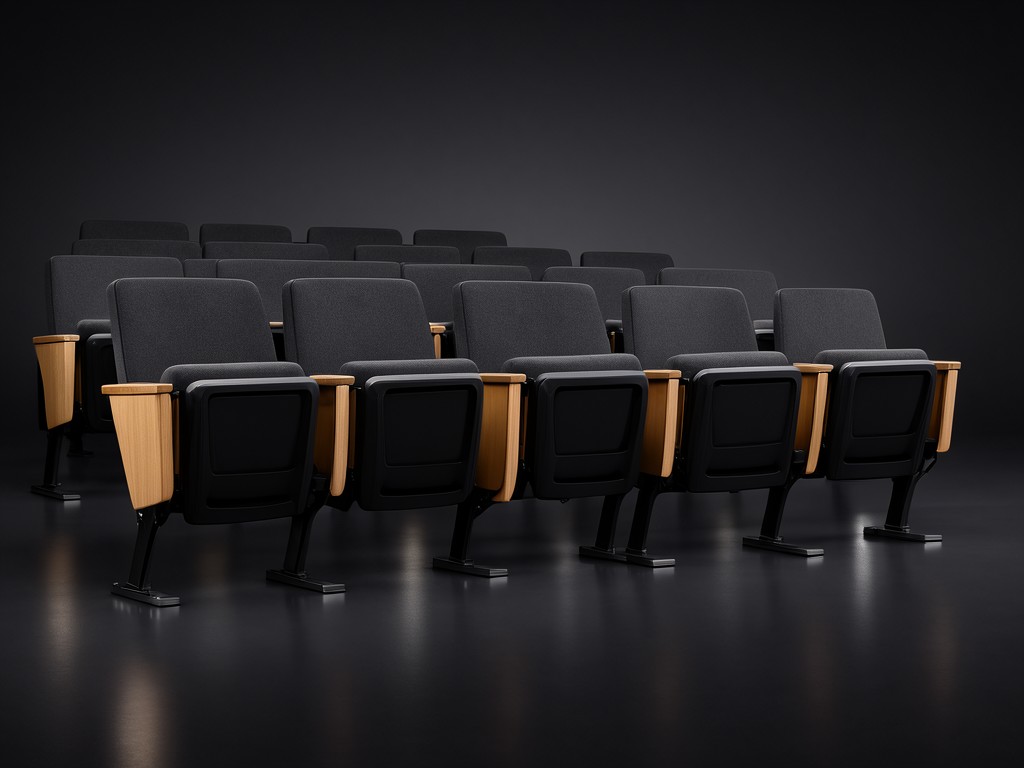
| Inspection Item | Test Method | Acceptance Criteria |
|---|---|---|
| Frame dimensional check | CMM ±0.1 mm on critical datums | All dimensions within spec ±0.5 mm |
| Powder‑coat adhesion | Cross‑hatch tape test (ASTM D3359) | 5B rating minimum |
| Foam indentation force deflection (IFD) | ASTM D3574 25 % compression | IFD 45–55 N for standard, 55–65 N for premium |
| Fabric abrasion | Martindale 45 000 / 60 000 cycles | No yarn break, ≤ 5 % weight loss |
| Fire retardancy | CAL 117‑2013 / EN 1021‑1 | Pass – no after‑flame > 2 s |
Inspection records are stored per batch for 5 years and linked to the serial‑number label on each seat for traceability.
| Option | Range / Choices | Lead‑time Impact |
|---|---|---|
| Frame colour (RAL) | Any RAL standard, plus custom match | +5 days for non‑stock colours |
| Upholstery fabric | Polyester, Trevira CS, wool blend, antimicrobial | +7 days for FR‑rated fabrics |
| Seat numbering / logo | Laser‑etched metal tag or embroidered patch | +3 days artwork approval |
| Power/data integration | USB‑A, USB‑C, 110 V outlet, CAT6 | +10 days for certified modules |
| Row spacing (seat pitch) | 750 mm – 950 mm in 25 mm steps | No extra lead time |
All customisations are captured in a single artwork‑and‑branding review before tooling release; the review packet is shared via /contactus for rapid sign‑off.
Submit your seating layout, fabric swatches, and branding files for a formal quotation and production timeline.
Request Quote & Artwork Review







