Contact Fumei
No.20 Jiuqiao Road, Shijiang Industrial Area, Jiujiang Town, Nanhai District, Foshan City, China.
Wholesale Auditorium Seating Chairs Price List: Specification, Ordering and Quality Notes Deflection under load governs the lifecycle of auditorium seating in high-traffic environments. When procureme
Deflection under load governs the lifecycle of auditorium seating in high-traffic environments. When procurement officers evaluate bulk pricing, the trade-off between steel frame gauge thickness and molded foam density determines the long-term maintenance cost. A 2.0mm cold-rolled steel frame typically reduces structural fatigue over 100,000 use cycles, whereas thinner 1.5mm alternatives may exhibit joint loosening at the mounting points under continuous stress.
Consistency depends on the mechanical bond between the upholstery fabric and the foam substrate. High-density polyurethane foam with a rating of 45kg/m³ prevents the "bottoming out" effect common in lower-grade commercial theater seating. For wholesale orders, the price variance often reflects the seat mechanism—ranging from fixed-back configurations to gravity-tilt assemblies—which impact both floor clearance requirements and shipping logistics.
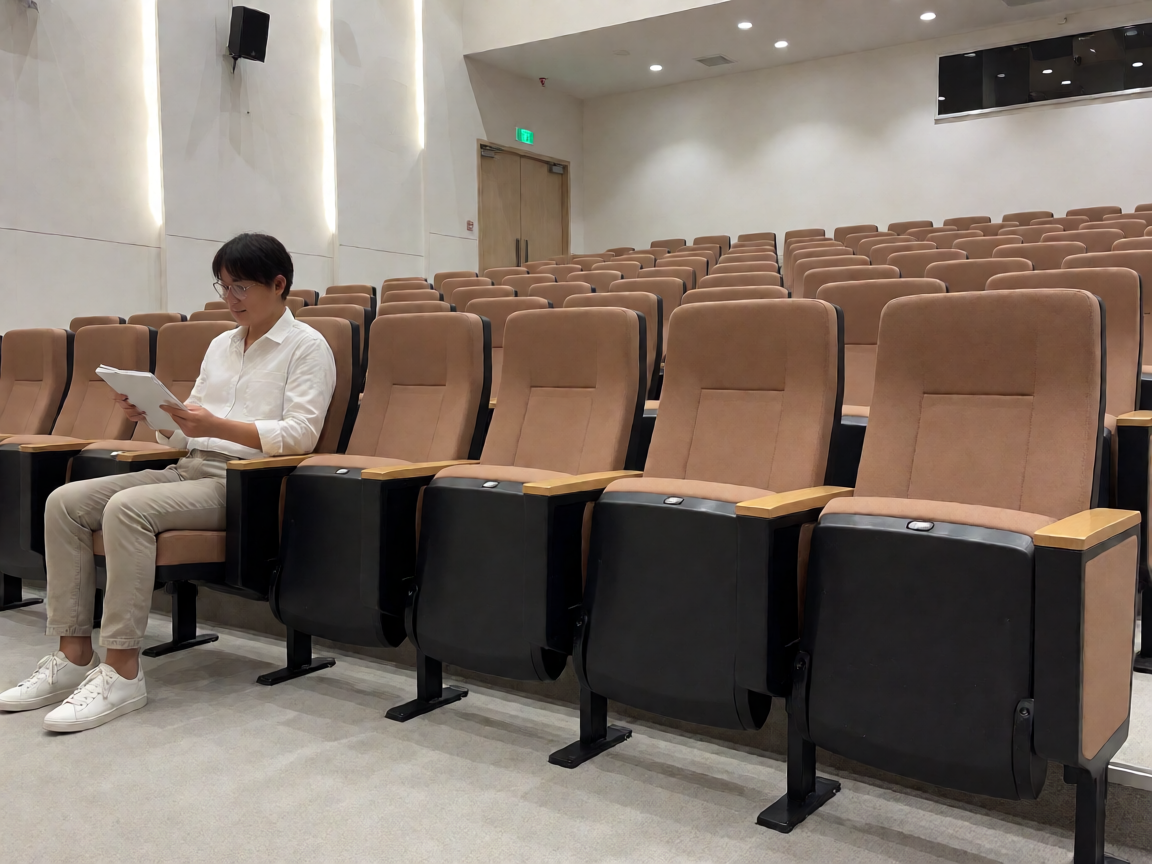
The physical configuration of the chair dictates the mounting method and floor requirements. Floor-mounted legs offer the highest stability for permanent lecture halls, while beam-mounted systems facilitate rapid floor cleaning and flexible room reconfiguration. The choice between wood-veneer and polypropylene shells affects the total weight per unit, which directly impacts international freight costs for large-scale stadium projects.
Structural failure in auditorium seating usually occurs at the pivot point or the seat-back interface. Low-cost wholesale manufacturing utilizes standard adhesive bonds that succumb to delamination within 24 months of seasonal temperature fluctuations. Professional-grade units use mechanical fasteners and reinforced steel brackets to ensure that the backrest angle remains constant even after years of high-impact occupancy use.
| Feature | Standard Grade | Premium Grade |
|---|---|---|
| Frame Material | 1.2mm Square Steel | 2.0mm Reinforced Steel |
| Foam Density | 25kg/m³ | 45kg/m³ Molded |
| Mechanism | Basic Spring | Multi-stage Gravity |
The coating process determines the frame's resistance to industrial cleaning agents. Powder-coating with a minimum thickness of 60 microns provides a barrier against oxidation in humid environments like theaters. For the upholstery, the use of moisture-resistant fabrics with fire-retardant properties ensures compliance with public safety standards without requiring post-production chemical treatments.
Injection molding foam ensures the fabric conforms perfectly to the contours, preventing the internal sagging seen in glued-cut foam assemblies.
Welded joints instead of bolted assemblies eliminate points of failure where vibrational energy could loosen the frame over time.
Standard dimensions are critical for meeting egress codes and capacity planning. A seat width of 500mm is the industry benchmark for auditorium comfort, while 450mm variants are utilized to maximize density in lecture halls. Weight per unit is a factor for installation teams; lightweight polymer shells reduce labor hours during the mass floor-bolting phase.
Private-label buyers require specific color-matching for fabrics and integrated branding on the backrests. This involves custom-weaving of textiles or laser-engraving on plastic components. Lead times for customized specifications typically extend by 4-6 weeks due to the requirement for sample approval and batch production cycles.
Quality control is verified through batch testing of mechanical components. We perform static load testing where 200kg is applied to the seat edge to verify the frame remains within the elastic limit. Salt spray tests are conducted on metal frames to ensure the powder coating prevents corrosion in coastal or humid architectural projects.
Inventory levels for standard configurations are maintained to support immediate replacement needs. For large-scale new developments, a phased delivery schedule is often utilized to align with site-readiness and prevent on-site damage during storage.
Request a current wholesale price list and technical datasheet for your project.
Contact Our Sales Team for a Quotation