
Contact Fumei
No.20 Jiuqiao Road, Shijiang Industrial Area, Jiujiang Town, Nanhai District, Foshan City, China.
Specifying Wholesale commercial lecture hall seating B2B Supplier for Wholesale and OEM Orders Unit price and service life diverge most sharply at the flip mechanism and foam specification. A 2 mm inc
Unit price and service life diverge most sharply at the flip mechanism and foam specification. A 2 mm increase in frame wall thickness adds 1.2 kg per seat but pushes cycle life from 80,000 to 200,000 operations. Fabric abrasion below 50,000 Martindale cycles guarantees reupholstery within three academic years. The decision rule: specify the mechanism cycle rating and foam IFD first, then negotiate fabric and finish within the remaining budget.
Before comparing quotations, isolate the three cost drivers that determine total ownership cost: gravity pivot durability, foam recovery after 1,000 hours of daily occupancy, and powder-coat adhesion on the front-edge radius. A seat that passes 100,000 cycle tests on a test rig still fails in situ if the pivot bushings are unlubricated nylon instead of oil-impregnated bronze. The 15 % price premium for bronze bushings eliminates 90 % of squeak-related service calls over a ten-year horizon.
Foam specification is the second lever. High-resilience (HR) foam at 2.8 lb/ft³ density retains 85 % of its initial IFD after 50,000 cycles; standard 1.8 lb/ft³ foam drops to 60 %. The difference translates to a 40 mm loss in seat height comfort margin, which triggers early replacement requests from facilities managers. Specify HR foam with a minimum 25 % IFD retention guarantee backed by ASTM D3574 Test B data.
Frame finish is the third. Powder coat on 14-gauge steel tube with a 60 µm minimum film thickness survives 500 hours salt spray (ASTM B117) without creep. Thinner films or single-coat processes show rust at weld seams within two heating seasons. The trade-off: each 10 µm of additional film adds $0.18 per linear foot of tube but reduces touch-up frequency from annual to quinquennial.
Two suppliers quoting the same specification often deliver seats that differ by 12 mm in back height and 8 mm in seat depth because they reference different datum points. Fix the datum: seat height measured from floor to front edge of cushion at 460 mm ± 5 mm; back height from seat pan to top of back at 890 mm ± 5 mm; center-to-center spacing 560 mm or 610 mm per row layout. Weight per seat ranges 18–24 kg depending on tablet arm inclusion and frame gauge. Load rating must meet 136 kg static per seat per ANSI/BIFMA X5.1-2017 Section 11.
Seat width: 480 mm (no tablet) / 580 mm (with tablet)
Row rise: 150 mm per tier
Aisle clearance: 400 mm minimum
ADA companion spacing: 915 mm clear
Seat width: 510 mm (integral arm)
Row rise: 175 mm per tier
Anchor pattern: 4 × M10 per standard
ADA companion spacing: 915 mm clear
The most costly assumption is that fire compliance is binary. CAL 117-2013 compliance on the fabric alone does not guarantee the composite assembly passes NFPA 260 or BS 5852 Source 5. Request the full assembly test report, not the component certificate. Second, assuming all flip mechanisms are interchangeable ignores the pivot offset dimension: a 3 mm mismatch between seat pan and beam bracket creates binding that shears the return spring within 15,000 cycles. Third, assuming colour consistency across batches without a master sample and ΔE ≤ 1.5 tolerance leads to visible shade bands in tiered installations.
| Inspection Parameter | Test Method | Acceptance Criteria | Frequency |
|---|---|---|---|
| Flip mechanism cycle life | Internal protocol: 100,000 cycles at 6 cycles/min, 25 kg load | No permanent deformation > 2 mm; spring force retention ≥ 85 % | Per production lot (first article + 10 % random) |
| Foam indentation force deflection (IFD) | ASTM D3574 Test B (50 % compression, 25 % retention) | IFD 25 % ± 15 % of initial; retention ≥ 80 % after 50k cycles | Per foam batch (certificate of analysis required) |
| Fabric abrasion resistance | ASTM D4966 Martindale / Wyzenbeek | ≥ 50,000 cycles Martindale or 100,000 double rubs Wyzenbeek | Per fabric roll (supplier CoA + incoming spot check) |
| Powder coat adhesion | ASTM D3359 Cross-cut tape test | 5B rating (no peel) | Per shift on coating line |
| Dimensional audit | CMM or calibrated fixture: 12 critical dimensions | All within ± 3 mm of drawing nominal | 100 % first article; 5 % per container thereafter |
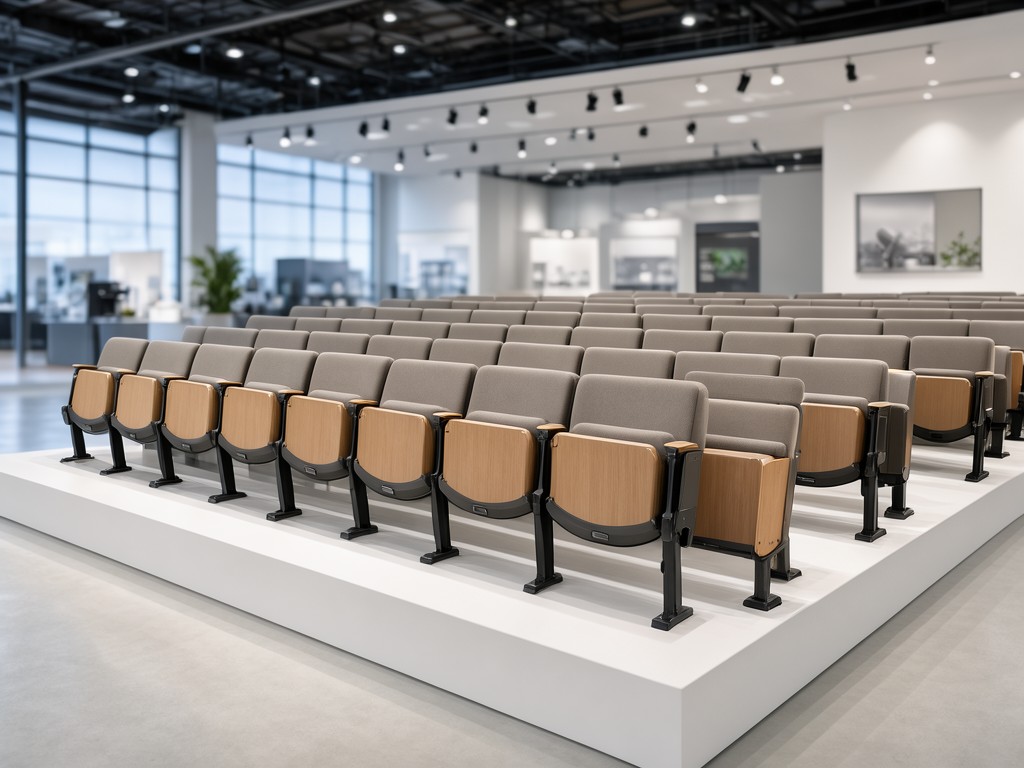
Frame geometry (beam profile, pivot location, floor-mount bracket pattern) is fixed per product platform; changing it requires new tooling ($18k–$35k) and 12-week lead time. What is configurable within the platform: fabric or vinyl selection from qualified mill list, powder-coat colour from RAL classic range, tablet arm style (fold-down, fixed, swivel), power/data module type (USB-A, USB-C, 110 V, RJ45), row letter/number laser etching, and aisle light integration. Cup holders and writing tablets are modular add-ons that do not affect structural certification.
| Finish / Colour Option | Specification | Lead-time Impact | MOQ per Colour |
|---|---|---|---|
| Standard RAL powder coat (stocked) | RAL 7016, 9005, 9010, 5010, 3020 — 60 µm minimum | No adder | 50 seats |
| Custom RAL / Pantone match | Lab-matched, 60 µm minimum, ΔE ≤ 1.0 vs master | + 10 working days | 200 seats |
| Fabric — Grade A (polyester, 100k Martindale) | 12 stocked patterns, CAL 117-2013 compliant | No adder | 50 seats |
| Fabric — Grade B (wool blend, 150k Martindale) | 8 patterns, NFPA 260 compliant | + 5 working days | 100 seats |
| Vinyl / PU — healthcare grade | ISO 10993-5 cytotoxicity pass, 200k Wyzenbeek | + 15 working days | 150 seats |
| Laser-etched row/seat ID | Alphanumeric, 6 mm height, contrast oxide fill | + 3 working days | No minimum |
University facility managers specify beam-mount with HR foam and Grade B fabric for 200-seat lecture theatres running 12-hour days; they prioritise 15-year frame warranty and on-site pivot lubrication kits. Community college procurement offices select floor-mount fixed seats with Grade A vinyl for 60-seat classrooms, driven by 40 % lower unit cost and simplified summer cleaning protocols. Private-label distributors serving K-12 chains order custom RAL frames with laser-etched numbering and pre-wired USB-C modules, requiring batch traceability to container level for warranty claims. Importers targeting Australian universities demand AS/NZS 3808 foam certification and 10-year mechanism guarantee, which forces selection of the bronze-bushing pivot platform.
OEM private-label orders start at 200 seats per SKU with a 50 % deposit, 8-week production after sample approval, and 4-week sea freight to major ports. Sample approval includes dimensional report, fire test summary, and mechanism cycle certificate. ODM development for unique seat profiles (e.g., integrated writing surface, active-learning swivel) requires a $25k tooling deposit, 14-week prototype-to-production timeline, and annual volume commitment of 1,000 seats to amortise tooling. Both programmes include batch-level traceability: each seat carries a laser-etched QR code linking to material lot, assembly shift, and inspection records. Warranty terms: 15 years frame, 10 years mechanism, 5 years foam, 3 years fabric — pro-rated after year 3. Claims process requires photographic evidence and QR code scan; replacement parts ship within 10 working days from regional stock.
Submit your seating layout, occupancy hours, and finish preferences for a line-item cost breakdown that separates mechanism grade, foam specification, fabric tier, and freight configuration. We return a marked-up specification sheet highlighting where unit price reductions increase lifecycle cost.
Start quotation review →







