Contact Fumei
No.20 Jiuqiao Road, Shijiang Industrial Area, Jiujiang Town, Nanhai District, Foshan City, China.
Specifying wholesale lecture hall chairs with desk supplier for Wholesale and OEM Orders The build method decides whether a lecture hall installation survives ten academic years or starts showing tabl
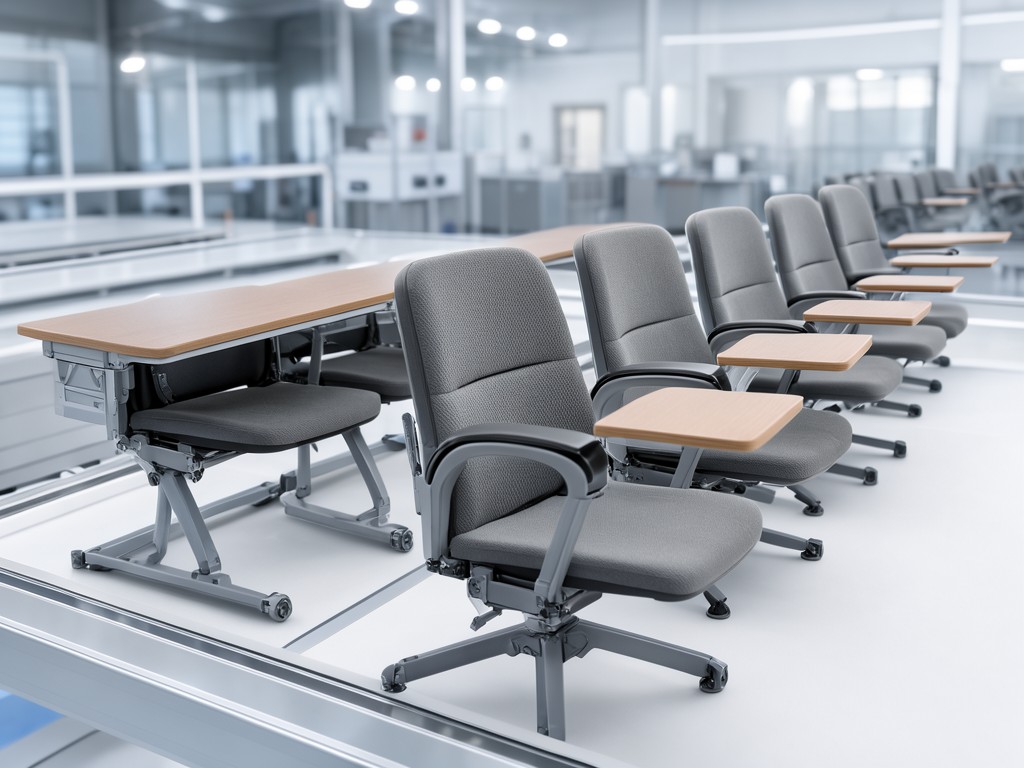
The build method decides whether a lecture hall installation survives ten academic years or starts showing tablet delamination and seat-mechanism slop by year three. Cold-rolled steel tube frames with epoxy-polyester powder coat remain the baseline for volume projects because the 1.8–2.2 mm wall thickness absorbs the daily impact load of 200–300 kg per seat row without permanent deflection. Aluminium extrusion frames cut 30–35% weight — helpful when retrofitting raised floors with limited point-load capacity — but the thinner wall sections (typically 1.5 mm) transmit more vibration to the writing surface, which shows up as student complaints during exams. The choice between gravity-return, spring-return, and damped tip-up mechanisms is not cosmetic; a damped mechanism adds $4–6 per seat but eliminates the "clack" that echoes in tiered rooms and reduces hinge-pin wear from 8,000 cycles to 25,000 cycles under BIFMA X5.4 testing.
Consistency is set at the forming stage. Seat and back shells moulded from 30% glass-filled polypropylene (PP-GF30) hold dimensional tolerance within ±0.3 mm across a 500-unit batch, while upholstered plywood shells introduce ±1.5 mm variance from foam compression and fabric stretch. That variance matters when tablets must align to a 12 mm clearance envelope for ADA-compliant knee space. Tablet cores fall into three practical tiers: 12 mm particleboard with HPL faces (lowest cost, swells at cut edges if humidity exceeds 65% RH), 12 mm compact laminate (phenolic resin throughout, zero swell, 1.8× the price), and 15 mm birch plywood with UV-cured acrylic (warm aesthetic, 12% lighter than compact laminate, but surface hardness drops 40% after 500 Taber cycles). Frame welding fixtures should be hardened-tool-steel, not mild steel — fixture wear beyond 0.15 mm introduces seat-height drift that forces on-site shimming during installation.
Flip-up tablets save 90 mm row depth but add two pivot bearings per seat. In a 300-seat hall, that’s 600 bearings — each a potential squeak point. Fixed tablets with 300 mm depth eliminate the mechanism cost and recover the space via 25 mm tighter row spacing.
Standard 60–80 µm epoxy-polyester passes 500 h salt spray. Coastal or pool-adjacent installs need 100 µm super-durable polyester (1,000 h salt spray) or zinc-rich primer + topcoat. The upcharge is $2.50/seat; the re-coat cost after three years is $45/seat including labour.
Before first article inspection, we run a 50-unit pilot on production tooling. You receive dimensional reports (seat height ±2 mm, tablet flatness ≤0.4 mm/300 mm), cycle-test data (10,000 tip-up cycles), and a freight-packaging stress test (ISTA 3A). Approval locks the BOM; any later change triggers a new pilot. This is the only point where a $1.20 material substitution gets caught before it hits 2,000 seats.
| Programme Tier | MOQ (seats) | Lead Time (weeks) | Customisation Scope |
|---|---|---|---|
| Standard Catalogue | 50 | 4–6 | Fabric/HPL selection only |
| OEM Colour/Material | 200 | 8–10 | Custom PP colour, fabric COM, tablet laminate |
| ODM Geometry Change | 500 | 14–18 | New shell mould, frame jig, tablet profile |
Process choice shows up later as batch-to-batch colour drift. We hold master colour plaques (Pantone-matched, spectrophotometer-verified) for every custom PP shade and fabric dye lot. When a repeat order arrives 18 months later, the new raw-material lot is moulded into 10 test plaques, measured against the master, and rejected if ΔE > 0.8. Frame powder coat follows the same protocol: each new coil of steel gets a 50-seat test run, cured panels are cross-hatch tested (ASTM D3359 5B minimum), and salt-spray coupons run 240 h. Inventory buffer is kept at 15% of trailing 12-month volume for standard catalogue SKUs; custom SKUs switch to a 6-week rolling forecast with a 10% safety stock. The result: zero stock-outs on repeat projects in the last 24 months.
| Configuration | Seats per 40' HC | Packaging Spec | On-Site Handling |
|---|---|---|---|
| Fully Assembled, Nested | 420 | 5-layer corrugated sleeve, corner protectors, stretch wrap | Dolly-mounted, 6 seats per move |
| Knock-Down (Frame + Shell + Tablet) | 780 | Frames: steel crates; Shells: stacked with foam interleaf; Tablets: vertical in honeycomb boxes | Requires 2-person team, 8 min/seat assembly |
| Semi-Assembled (Frame+Shell, Tablet Separate) | 560 | Unit cartons with moulded pulp corners, tablets in shared honeycomb crate | Tablet attach: 4 screws, 3 min/seat |
Every carton carries a QR-coded label linking to the batch traveller: coil heat number, powder lot, mould cavity ID, assembly operator, and final inspection timestamp. Customs descriptions use HS 9401.71 (seats with metal frames) or 9401.61 (upholstered wooden frames) — misclassification adds 4.5% duty and 7–10 days hold at destination port.
Tablet edges take 80% of abuse — pens, keys, ring binders. Compact laminate survives 15 N scratch force (NEMA LD-3 3.4) without visible mark; HPL on particleboard fails at 6 N. Clean with pH-neutral detergent only; quaternary ammonium disinfectants dull HPL gloss by 12% per 100 wipes. Upholstery: hot-water extraction at 60 °C max, 0.5 MPa pressure, dry time <4 h to prevent foam hydrolysis. Tip-up mechanisms need dry PTFE spray every 18 months in high-traffic venues (daily use >8 h); gravity mechanisms need nothing but annual bolt torque check (8 Nm M8 flange nuts). Store spare shells flat, supported at 300 mm centres — stacking >10 high warps PP-GF30 at 40 °C warehouse temps. Design service life: 12 years / 150,000 tip-up cycles / 500 cleaning cycles for compact laminate tablets; 8 years for HPL-on-particleboard.
Send your floor plan and seat count. We’ll return a pilot-run proposal with fixture layout, material certs, and a locked BOM within 5 business days.
Start Tooling Review