
Contact Fumei
No.20 Jiuqiao Road, Shijiang Industrial Area, Jiujiang Town, Nanhai District, Foshan City, China.
Wholesale school lecture hall seating supplier - Bulk Supply and Specification Guide Consistency depends on the structural integrity of the frame and the ergonomic geometry of the seat pan interface.
Consistency depends on the structural integrity of the frame and the ergonomic geometry of the seat pan interface. In high-density educational environments, the primary failure point is often the pivot mechanism where the seat meets the backrest. Wholesale-grade units must utilize heavy-gauge cold steel tubing with powder-coated finishes to prevent oxidation and ensure that the load distribution remains uniform across 100,000 flexion cycles. When sourcing for large-scale installations, the trade-off between weight for transport efficiency and structural rigidity determines the long-term maintenance cost per seat.
Balance and load analysis shows that fixed-row configurations offer higher stability than individual mobile chairs when subjected to lateral shear forces. The mounting plates must be reinforced with gusseting to prevent metal fatigue that occurs when students apply uneven pressure to the seat edge. Procurement officers should evaluate the gauge thickness of the support arms, as thinner materials tend to sag over a multi-year period, leading to misalignment that compromises the aesthetic uniformity of the entire row.
Standard lecture hall seating typically requires a seat height of 450mm to 480mm to accommodate a wide demographic range. The depth of the seat pan usually ranges between 400mm and 450mm to ensure leg clearance while maintaining aisle space in tiered configurations. High-density polyethylene (HDPE) or molded plywood surfaces are preferred for their resistance to impact and chemical exposure from industrial-grade cleaning agents.
Customization in bulk orders is governed by the tooling costs associated with injection molded components. While frame colors can be matched to any specific RAL palette, changing the geometry of the backrest or the integrated tablet-arm mechanism requires new mold-making. Buyers must choose between standardized components that offer faster lead times and bespoke ergonomic designs that extend the production schedule but fit specific architectural requirements.
| Feature | Standard Specification | Customizable Option |
|---|---|---|
| Frame Material | 20mm Steel Tube | Reinforced Aluminum Alloy |
| Seat Material | Molded Plastic | Anti-microbial Upholstery |
| Tablet | Fixed Laminate | Flip-down wood surface |
| Mechanism | Spring-loaded lift | Hydraulic assist arm |
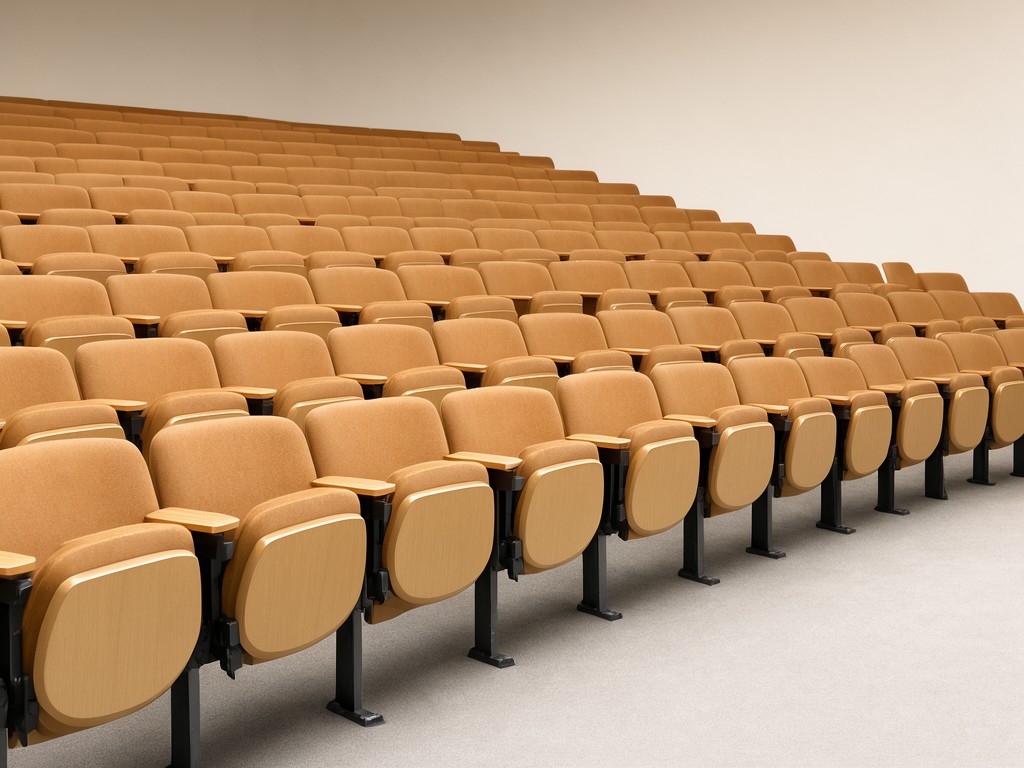
Evaluating the floor geometry is the first critical step in determining the mounting hardware requirements. Tiered lecture halls require specialized brackets that can be adjusted for the specific degree of floor incline, whereas flat halls utilize standard floor-mounted pedestals. Buyers must also specify the required capacity-per-row, as this dictates the width of the unit and the clearance needed when seats are occupied.
A common error is neglecting the clearance distance when the seat is in the fully deployed position. If the swing radius is not accounted for in the floor plan, seats will collide with the row behind, leading to mechanical damage and student user discomfort. Additionally, selecting low-grade fasteners for the pivot joints often results in bolts loosening after only six months of use, requiring extensive onsite maintenance across the entire facility.
Batch consistency is maintained through rigid jig-welding processes that ensure every unit is identical to within a +/- 2mm tolerance. Variations in seat height across a single shipment can create uneven rows, which are immediately visible during professional installation. We utilize torque-testing on all structural joints to ensure that the assembly meets the specified tension requirements, preventing the vibration-induced bolt failure common in cheaper wholesale alternatives.
Production cycles are dictated by the availability of raw steel coils and the capacity of the injection molding machines. For orders exceeding 500 units, lead times must account for the curing time of powder coatings and the sequential assembly of the tablet mechanisms. Scheduling the order three months in advance allows for the allocation of dedicated production lines, reducing the risk of delays caused by peak market demand.
Long-term partnerships rely on the ability to replicate a specification years after the initial purchase. When a facility expands, the ability to order additional units that match the exact original color batch and ergonomic geometry is vital for visual continuity. We maintain digital blueprints and material batch records for every bulk project to ensure that reorders integrate seamlessly with the original installation layout.
International shipments require reinforced palletization to prevent impact damage during transit via sea freight. Each seat unit is wrapped in protective polyethylene-shrink film to prevent surface abrasion and moisture ingress that can cause frame corrosion. Pallets are secured with steel strapping to ensure that the center of gravity does not shift, which could lead to structural bending of the frames during handling.
Standard units are tested to withstand a static load of 250kg at the leading edge of the seat, ensuring safety under heavy use.
Yes, we provide pre-drilled channels in the frames to facilitate wiring for electrical modules during the manufacturing phase.
Need a technical specification review for your project?
Contact our wholesale team for a custom quote







