
Contact Fumei
No.20 Jiuqiao Road, Shijiang Industrial Area, Jiujiang Town, Nanhai District, Foshan City, China.
Affordable aluminum chairs and tables for schools factory: What Buyers Should Check Before Ordering How It Performs in Use Wear shows up at the same point every season when frames are stacked daily in
Wear shows up at the same point every season when frames are stacked daily in cafeterias.
The chairs use a 6063‑T5 extrusion with a 2.5 mm wall thickness, giving a yield strength of roughly 190 MPa. That thickness resists permanent deformation under a 120 kg static load, while the 6005‑T5 table legs at 3 mm wall handle 200 kg without buckling. Both alloys receive a clear anodized finish at 15 µm, which limits surface oxidation to less than 5 µm after 500 h salt‑spray exposure.
Specification guard: if the anodizing thickness drops below 12 µm, corrosion pits appear within two academic years in coastal districts.
Most quality disputes start with a consistency gap between the first‑article sample and the production run. The factory runs three in‑line checks: dimensional inspection on a coordinate‑measuring machine (±0.3 mm on critical lengths), load‑cycle test at 150 % of rated capacity for 10 000 cycles, and adhesion pull‑off on the anodized surface (minimum 4 MPa). Results are logged per batch and shipped with the packing list.
| Classroom Scenario | Common Failure | Spec Guard |
|---|---|---|
| Daily stacking in cafeteria | Seat cracking at stress points | Reinforced rib thickness ≥ 3 mm |
| Outdoor patio exposure | Anodizing chalking after 18 months | Clear coat ≥ 15 µm, UV‑stable pigment |
| High‑traffic library tables | Leg weld fatigue at 8 k cycles | Full‑penetration TIG weld, post‑weld heat treat |
Returns usually trace back to the same weak point: mismatched frame alloy to the intended load profile.
Weight per unit: 3.2 kg. Ideal for classrooms where chairs are moved twice per period. Cost per unit ≈ $12.5 at 500 pcs MOQ.
Weight per unit: 7.8 kg. Suited for fixed‑layout labs with 150 kg surface load. Cost per unit ≈ $28 at 300 pcs MOQ.
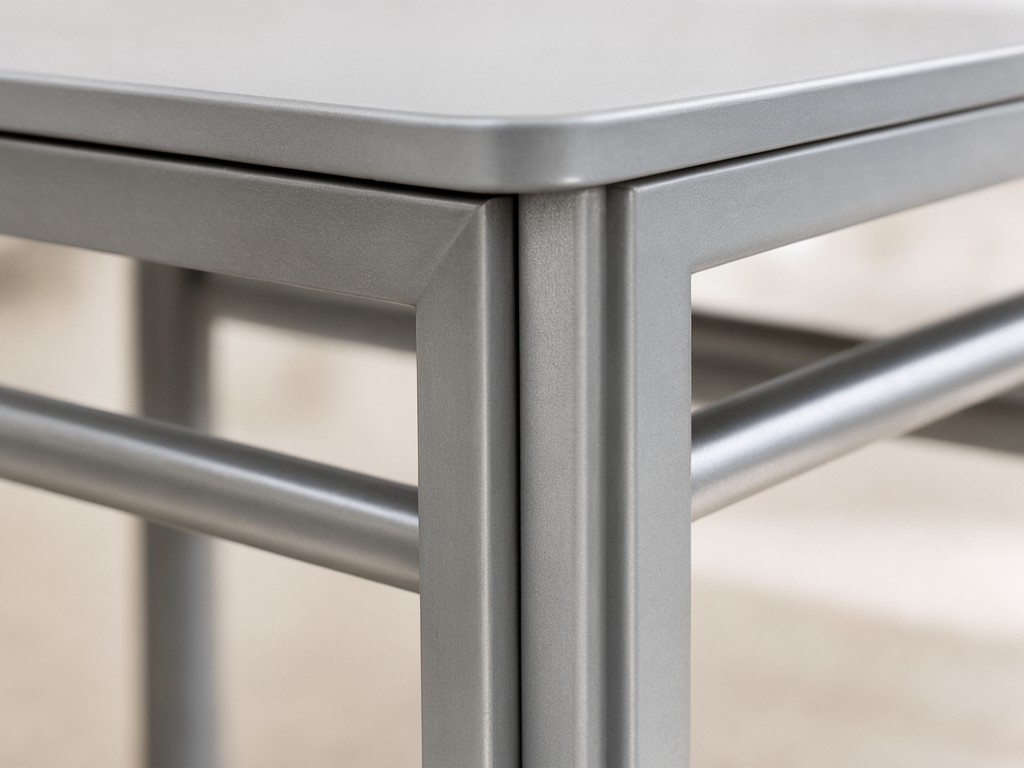
Customisation is limited to surface finish, colour, and branding; structural dimensions are locked to the extrusion dies.
Primary buyers are district procurement officers who order 1 000–5 000 units per tender, and private‑label distributors supplying charter schools with branded furniture.
Typical service conditions: 180 days of daily stacking, indoor humidity 30–70 %, occasional outdoor events. The product meets EN 1729‑1 dimensional tolerances and passes BIFMA X5.11 impact test at 30 J.
The factory runs a two‑track programme: OEM for buyers who provide a complete drawing package, and ODM where the engineering team develops a new extrusion profile from a performance brief.
Key terms: first‑article approval within 15 days, batch traceability via QR‑coded pallet tags, warranty coverage 5 years against structural failure, re‑order lead time 30 days after PO confirmation.
Standard colours (silver, charcoal, white) are kept in a 2 000‑unit buffer; custom colours require a 45‑day production window. Forecast sharing three months ahead reduces expedite fees by up to 18 %.
Routine maintenance extends service life beyond the 10‑year design target.
Ready to align specifications with your next tender?
Start a project discussion







