
Contact Fumei
No.20 Jiuqiao Road, Shijiang Industrial Area, Jiujiang Town, Nanhai District, Foshan City, China.
Specifying Affordable classroom chairs for students Suppliers for Wholesale and OEM Orders Scope of Supply and Physical Form Parameter Config A – 18 in Seat Height Config B – 20 in Seat Height Frame t
| Parameter | Config A – 18 in Seat Height | Config B – 20 in Seat Height |
|---|---|---|
| Frame tube OD | 25 mm × 1.5 mm | 25 mm × 1.8 mm |
| Seat pan thickness | 12 mm polypropylene | 12 mm polypropylene |
| Static load rating | 150 kg | 150 kg |
| Stack height (5 units) | 1.12 m | 1.18 m |
| Powder‑coat thickness | 60–80 µm | 60–80 µm |
The build method decides the dimensional envelope that every downstream process must respect. Tube OD and wall thickness are fixed at the extrusion die; any drift of ±0.05 mm propagates into stack height variance and ultimately into freight cube calculations.
First‑article tooling determines the seat‑pan rib pattern. A 0.2 mm shift in rib spacing changes the flex modulus by roughly 3 %, which buyers notice as a “soft” feel after a semester of daily use.
Polypropylene seat pans dominate the price tier because the resin cost per kilogram stays below $1.30 and the cycle time on a 500‑ton press is under 12 seconds. The trade‑off is a lower heat deflection temperature; in climates where classroom temperatures exceed 35 °C the pan can creep 0.3 mm over a school year.
Steel frame options split between cold‑rolled 1.5 mm and 1.8 mm wall. The heavier wall adds 0.4 kg per chair but raises the buckling load by 22 %, a figure that matters when districts specify a 10‑year service life.
If the buyer requires a 150 kg static rating with a 1.5 mm tube, the powder‑coat must be cured at 200 °C for 12 minutes minimum. Shorter cure cycles leave micro‑porosity that accelerates corrosion at the weld toes.
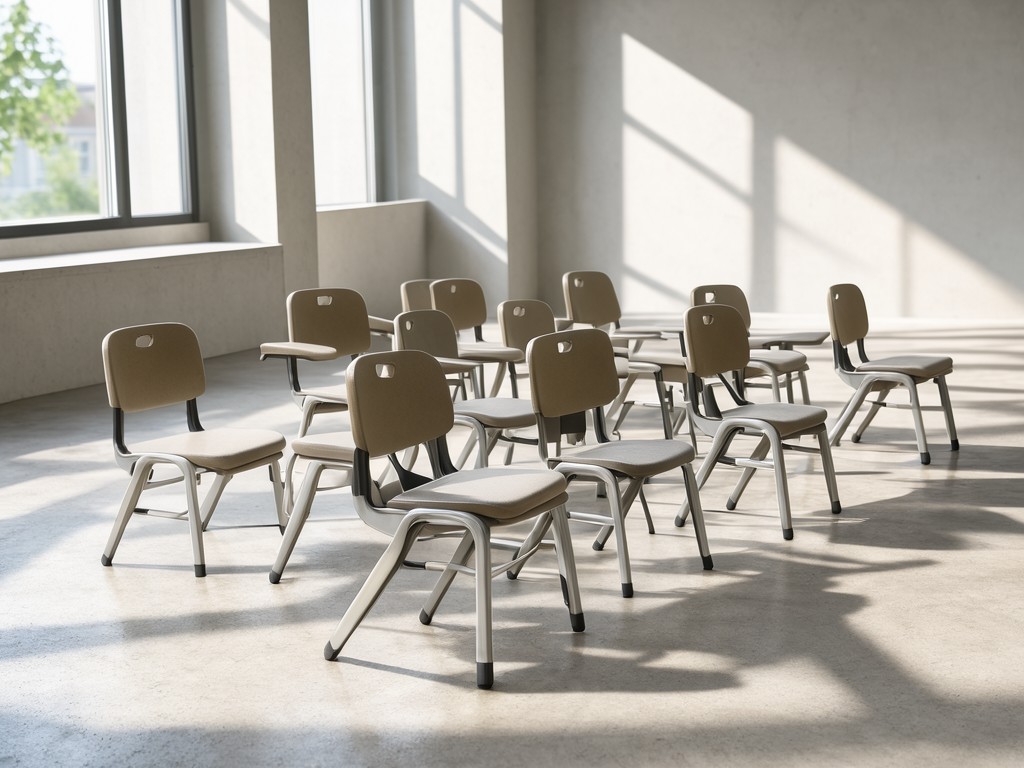
Choosing between them is a freight‑cost decision as much as an ergonomic one. A 40‑ft container holds 720 Config A chairs versus 600 Config B chairs, a 20 % volume advantage that can offset the slightly higher per‑unit price of the taller model.
Distributors serving public‑school tenders usually lock in Config A because the bid spec calls for a maximum unit weight of 4.5 kg. Private‑label buyers targeting the aftermarket often request Config B with a custom powder‑coat colour; the extra 0.4 kg is absorbed in the retail margin.
When the requirement includes a 10‑year replacement‑parts guarantee, the 1.8 mm tube becomes the default because the thicker wall tolerates the repeated re‑welding of damaged legs without loss of section modulus.
Consistency is set at the forming stage. The extrusion line runs a statistical process control chart on tube OD every 30 minutes; any point outside ±0.03 mm triggers an immediate die‑gap adjustment.
Seat‑pan injection moulds are qualified with a first‑article inspection that measures rib height at 12 locations. The acceptance window is 12.00 ± 0.10 mm. Subsequent lots are sampled at 1 % and measured on a coordinate‑measuring machine; drift beyond 0.05 mm initiates a mould‑maintenance work order.
Each pallet carries a laser‑etched lot code linking tube heat number, mould cavity ID, and powder‑coat batch. This enables a recall window of 48 hours if a coating adhesion test falls below 4 MPa.
The cell runs two 500‑ton presses in parallel, each capable of 250 seats per hour. With a 16‑hour shift the theoretical weekly output is 40,000 units; practical throughput averages 35,000 after change‑over and preventive maintenance.
Tooling lead time for a new seat‑pan geometry is 6 weeks from CAD release to first‑article. Existing tube dies are shared across the product family, so a height change only requires a new cut‑length program, not a new die.
Chairs are stacked five high, shrink‑wrapped with 30 µm LDPE film, and placed on 1200 × 1000 mm wooden pallets. Each pallet holds 12 Config A or 10 Config B units, gross weight 55 kg and 62 kg respectively.
Carton labels follow the buyer’s GS1‑128 format: GTIN, lot code, net weight, and country of origin. A QR code linking to the digital inspection report is optional but recommended for distributors who require real‑time traceability.
No tools are required for field assembly; the seat pan snaps onto the frame via two molded clips rated for 30 Nm pull‑out. Replacement clips are stocked in 500‑piece bags and can be ordered with the same lot code to guarantee material match.
Leg caps are polypropylene with a 2 mm wall; they absorb impact from floor‑scraping and are replaceable without disassembly. A wear indicator groove appears when the cap thickness drops below 1 mm, signalling a 6‑month replacement interval in high‑traffic corridors.
Send your spec sheet, target annual volume, and preferred Incoterm to our quoting team. We return a detailed cost breakdown within two business days, including tooling amortisation and freight optimisation options.








