Contact Fumei
No.20 Jiuqiao Road, Shijiang Industrial Area, Jiujiang Town, Nanhai District, Foshan City, China.
Affordable high school exam desk and chair Suppliers: What Buyers Should Check Before Ordering For repeat school orders, the lowest unit price only pays off if the desk stays level, the board resists
For repeat school orders, the lowest unit price only pays off if the desk stays level, the board resists edge damage, and chair joints remain tight through daily use. Compare frame and panel specifications together; a thinner board or lighter tube can lower the quote while increasing repair and replacement work.
The complaint that repeats across reorders is often not a dramatic break. A desk rocks on an uneven floor, a panel edge chips during handling, or a chair develops play at a bolted joint. For procurement teams, those small faults add up across classrooms and can turn a low-cost purchase into repeated warranty claims.
An exam desk carries books and writing pressure, but its frame also takes repeated side loads as students sit down, stand up, and shift position. Welded steel tube resists frame movement; the result depends on tube section, joint fit, and weld consistency rather than steel thickness alone. A powder-coated finish limits routine scuffing, though exposed edges and floor contact points remain more vulnerable to chips.
The work surface is usually a laminated wood-based panel. Panel thickness and edge treatment affect stiffness and resistance to knocks, while moisture at an unsealed edge can cause swelling or peeling. Chairs with bolted connections are easier to service, but the fastener arrangement must resist loosening under repeated movement. Ask suppliers how they check dimensions, frame squareness, weld appearance, coating coverage, and fastener fit across a production batch.
| Item to Confirm | Indicative Range | Buyer Check |
|---|---|---|
| Single-student desktop | About 600 × 400 mm; desk height commonly 700–760 mm | Confirm the finished dimensions and intended student size group against local school requirements. |
| Chair seat height | Commonly about 430–460 mm | Check seat height with the selected desk height; mismatched sizes affect writing posture. |
| Desk and chair weight | Desk often 10–18 kg; chair often 3–6 kg, depending on frame and panel choice | Set an acceptable finished-weight range and verify samples before approving the order. |
These figures are starting points, not a substitute for a signed drawing. Small dimensional changes can affect seat-to-desk fit, packing density, and the number of units that load into a shipment.
A basic configuration can suit classrooms with careful handling and a tight purchase budget. For schools that move furniture between rooms or use the same rooms for multiple exam sessions, the frame, panel edge, and connection details deserve a larger share of the cost review. The table compares common choices; exact specifications vary by design.
| Configuration | Cost and Use Trade-Off | Inspect Before Approval |
|---|---|---|
| Entry-cost frame with laminated panel | Lower purchase cost; appropriate where desks stay in place and handling is moderate. | Check for frame rocking, panel flex, exposed core at edges, and finish gaps around joints. |
| Heavier frame and better-protected panel edges | Higher unit cost and shipping weight; can reduce service calls where furniture is moved frequently. | Compare welds, coating coverage, edge adhesion, and the stability of the assembled sample. |
| Serviceable bolted chair connections | Simplifies replacement of a damaged part; adds a need for consistent hole alignment and fastener control. | Assemble and check a sample, then recheck joint play after repeated use simulation. |
Choose this route when classroom handling is light and local repair is available. Keep a signed reference sample, since slight frame or panel substitutions can change the product after approval.
Where desks are shifted daily, price a stronger frame and protected panel edges against likely repair frequency. The added material is worthwhile only if inspection confirms the details match the quotation.
Returns usually trace back to the same weak point: a purchase specification describes the overall desk set but leaves the parts that control wear open to interpretation. “Steel frame” does not state tube dimensions or joint construction. “Laminated board” does not confirm panel thickness, edge sealing, or how the surface is protected during export packing.
A low quoted weight is not proof of efficient design if the sample rocks or the panel flexes under normal writing pressure. Nor does a stable first assembly prove that fasteners will stay tight after repeated movement. Put the accepted dimensions, materials, finish colour, connection details, and packaging method on the purchase specification; then compare the production sample against that record before shipment.
Ask for batch checks that fit the product: dimensional and weight sampling, visual review of welds and coating, assembly fit, and stability checks on finished units. Agree in advance how defects will be recorded and what evidence is needed for a warranty claim. That gives both parties a practical basis for resolving a repeat-order dispute.
A production partner should be able to hold an approved drawing and sample as the reference for later batches. Useful controls include fixed checks for frame dimensions and squareness, repeatable welding fixtures, consistent coating colour, and a parts list that identifies panel and fastener specifications. These controls help contain variation; they do not replace inspection of the finished order.
For private-label orders, approve the artwork placement, colour reference, carton marks, and instruction or label content alongside the product sample. Keep branding clear of high-wear edges and assembly points, where contact or fastening can damage it.
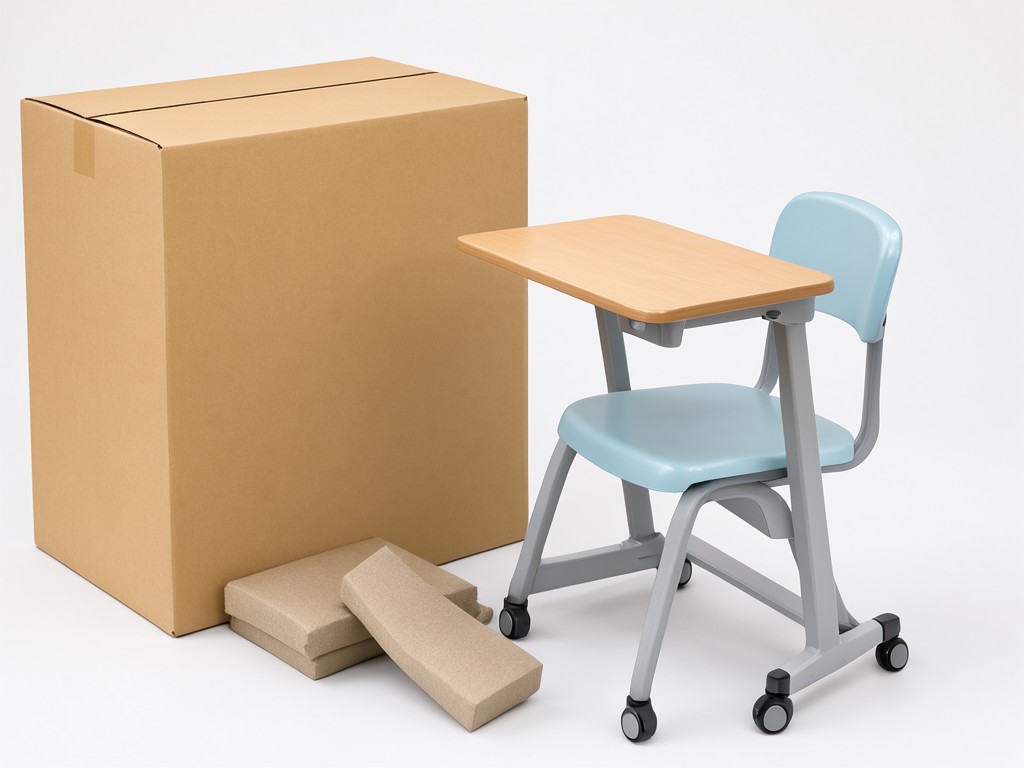
Changes to tube size, panel thickness, chair design, or carton layout can affect price, finished weight, and loading quantity. Request a revised quotation and sample review whenever one of those inputs changes, rather than treating a catalogue image as a complete production specification.
Lead time depends on the confirmed design, order quantity, material availability, sample approval, and packing plan. A standard frame and panel combination is usually simpler to schedule than a new size, colour, logo treatment, or carton format. Share the delivery window and split-shipment needs before the supplier reserves materials.
For a repeat order, keep the previous approved drawing and finish reference with the purchase file. Reconfirm any changes to quantities or destinations early: desk dimensions affect carton volume, and packed chair components may change container loading. Request a production schedule with sample, production, inspection, and dispatch milestones rather than relying on a single estimated ship date.
If branding is part of the order, send editable artwork and the required colour references before sample approval. Request an artwork and branding review to check placement, print area, and packaging marks against the selected desk and chair specification.