
Contact Fumei
No.20 Jiuqiao Road, Shijiang Industrial Area, Jiujiang Town, Nanhai District, Foshan City, China.
buy classroom desk and chair from china factory - Bulk Supply and Specification Guide Selection rule: laminated wood panels usually lower the initial desk price, while sealed panel edges and a consist
Selection rule: laminated wood panels usually lower the initial desk price, while sealed panel edges and a consistent steel finish help control damage, returns, and reorder mismatches. Specify the desk and chair as a matched size set before comparing quotes.
When several classrooms receive desks and chairs from separate production lots, small differences become visible side by side. Seat height, desktop dimensions, frame colour, and panel shade can drift enough to trigger sorting at the warehouse or complaints from schools that expect a uniform installation.
The purchase cost is only one part of the cost per unit sold. A replacement chair that does not match the original finish, or a desk panel with chipped corners after transit, can require extra handling, replacement freight, and retailer credit. Agree on a retained reference sample and a written specification for each reorder; a factory quote alone does not define acceptable lot variation.
Age group and classroom layout set the desk and chair dimensions. A chair seat that suits one student group may leave another group with poor foot support or an awkward desk-to-seat relationship. Fixed-height sets keep the structure and purchasing plan straightforward; adjustable legs add hardware and assembly checks, so the buyer should confirm that the adjustment range addresses a real school requirement.
Most export configurations pair a steel-tube frame with a laminated particleboard, MDF, or plywood desktop and a moulded polypropylene chair seat and back. Panel grade, thickness, edge treatment, tube section, and coating affect price and service conditions. In humid rooms or where wet cleaning is routine, specify sealed panel edges and a coating suitable for the expected exposure; classroom furniture should not be treated as outdoor furniture unless the construction is designed and quoted for that use.
Shipping dimensions also affect landed cost. Knock-down frames can reduce carton volume, but only if the assembly instructions, fixings, and carton protection are controlled. Fully assembled units may suit local delivery programmes, though their freight cube and corner protection need separate review.
Daily movement across a classroom puts repeated stress on frame joints, floor-contact points, and the connection between the seat and its supports. Tube dimensions and joint execution affect frame rigidity; panel support and edge construction affect whether desktops stay flat and resist corner damage. A thicker panel may add freight weight without solving a weak support layout, so review the complete assembly rather than price by panel thickness alone.
Colour consistency is another performance issue for importers. A paint shade that varies across steel components, or a laminate batch that differs from the approved sample, makes replacement stock harder to sell as a matching set. Record the colour reference and approved finish sample against the purchase order, then apply the same controls to repeat orders.
| Inspection point | Factory check | Buyer acceptance basis |
|---|---|---|
| Desk and chair dimensions | Measure key dimensions against the approved drawing on a sample from the production lot. | Signed drawing, agreed tolerances, and approved size pairing. |
| Frame and joint condition | Inspect welds, fasteners, alignment, and contact points; assemble a sample to check for rocking or loose connections. | Approved sample and agreed workmanship criteria. |
| Panel edges and finish | Check for exposed substrate, chips, coating defects, and visible colour differences under consistent inspection conditions. | Retained finish sample, stated edge treatment, and purchase-order defect limits. |
| Carton and packed set | Confirm part count, hardware, labels, and protection at panel corners and frame contact points. | Approved packing layout and export-marking instructions. |
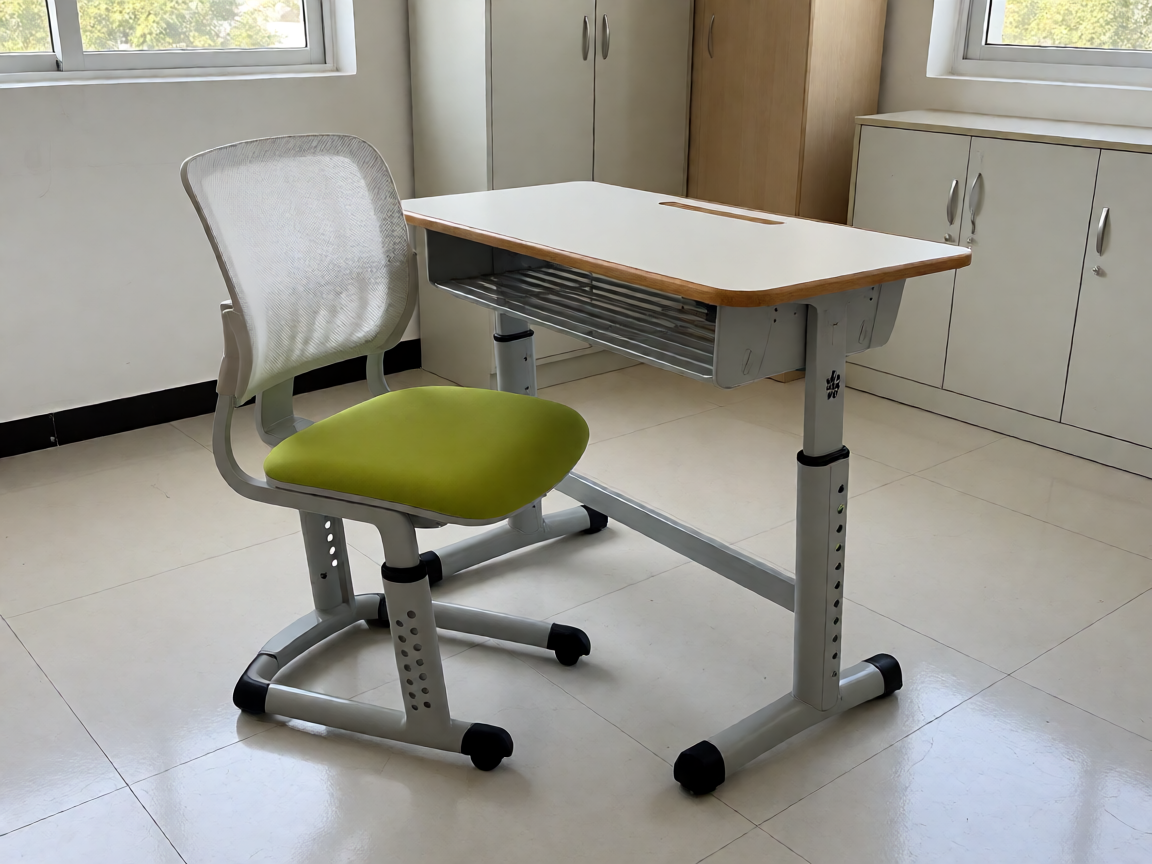
These are inspection checkpoints, not claims of compliance with a particular external standard. Set any required test method and pass criteria in the product specification before the order is placed.
For classrooms with predictable schedules and careful handling, a fixed-height set with a standard laminated panel and powder-coated steel frame can keep the quote and replacement parts simple. The buyer should still define panel edge protection and frame finish, since low handling demands do not prevent damage during freight or school moves.
Choose fixed dimensions, standard frame sections, and a consistent laminate range where furniture remains in one room and is moved infrequently. This option usually keeps assembly and spare-part requirements manageable; validate the desk-chair size match before approving the sample.
For furniture moved between rooms or used across multiple shifts, discuss reinforced joint details, replaceable floor glides, and more protective panel edges. These choices add cost and may add packed weight, but they target common repair points rather than adding material where it has little effect.
If units will sit in direct sunlight, damp storage, or areas with frequent wet cleaning, treat that exposure as a specification condition. A standard classroom finish should not be assumed to retain colour or resist corrosion under prolonged outdoor weather.
A private-label programme can usually set the desktop dimensions, frame colour, laminate or moulded-part colour, logo placement, carton graphics, and assembly instructions. Confirm which colours are available from existing materials and which require a new production minimum; bespoke colours can affect both order quantity and repeat-order timing.
A factory cannot make two materials behave identically by changing the label or carton artwork. Panel thickness, frame geometry, and moulded-part dimensions affect fit and construction, so any revision to those items needs a drawing update and renewed sample approval.
Importers supplying public schools often need a defined size range, consistent finish across multiple classrooms, and replacement parts that remain available for later deliveries. The specification should state how desks and chairs are paired by student group, how each size is marked, and whether cartons ship as individual units or matched sets.
Private-label buyers serving school furniture distributors may prioritize retail-ready cartons, repeatable colour, and simple assembly. For projects in humid regions, ask for sealed panel edges and suitable packing protection during storage and ocean transit; condensation inside a container can expose weaknesses that never appear in a dry showroom.
Training rooms and shared learning spaces place more emphasis on movement between users and room layouts. In those settings, replacement glides and consistent hardware can reduce service calls, while an adjustable configuration only makes sense if the intended users need multiple desk heights.
OEM supply is a practical route when the buyer has approved drawings, size schedules, material choices, and brand artwork. ODM work may begin from an existing desk-and-chair configuration and adapt dimensions, colours, packaging, or details for the target market. New moulded shapes or major frame changes require more development review than a colour or label update.
A controlled programme moves from requirement review to sample approval, order specification, production-lot inspection, and shipment release. Agree which reference sample governs repeat orders, how finish variation will be judged, and what records identify each lot. MOQ and lead time depend on material sourcing, colour requirements, tooling, and the quantity of each size; request those terms against the final configuration rather than a generic set.
Artwork files should identify logo position, print or label method, colour references, carton marks, and destination-language requirements. Packing plans also need the final unit mix, hardware bag count, and protection for exposed corners. These details help keep the delivered assortment aligned with the approved sample and reduce receiving disputes.
Share the student size range, target materials, expected order mix, destination conditions, and private-label requirements. A project review can align the sample, inspection checkpoints, packing plan, and reorder controls before you compare final landed costs.








