Contact Fumei
No.20 Jiuqiao Road, Shijiang Industrial Area, Jiujiang Town, Nanhai District, Foshan City, China.
Custom adjustable classroom desk and chair factory - Bulk Supply and Specification Guide Scope of Supply and Physical Form Cheaper stock options fail at the worst point in the season, leaving schools
Cheaper stock options fail at the worst point in the season, leaving schools with wobbly legs and cracked laminate after a single semester.
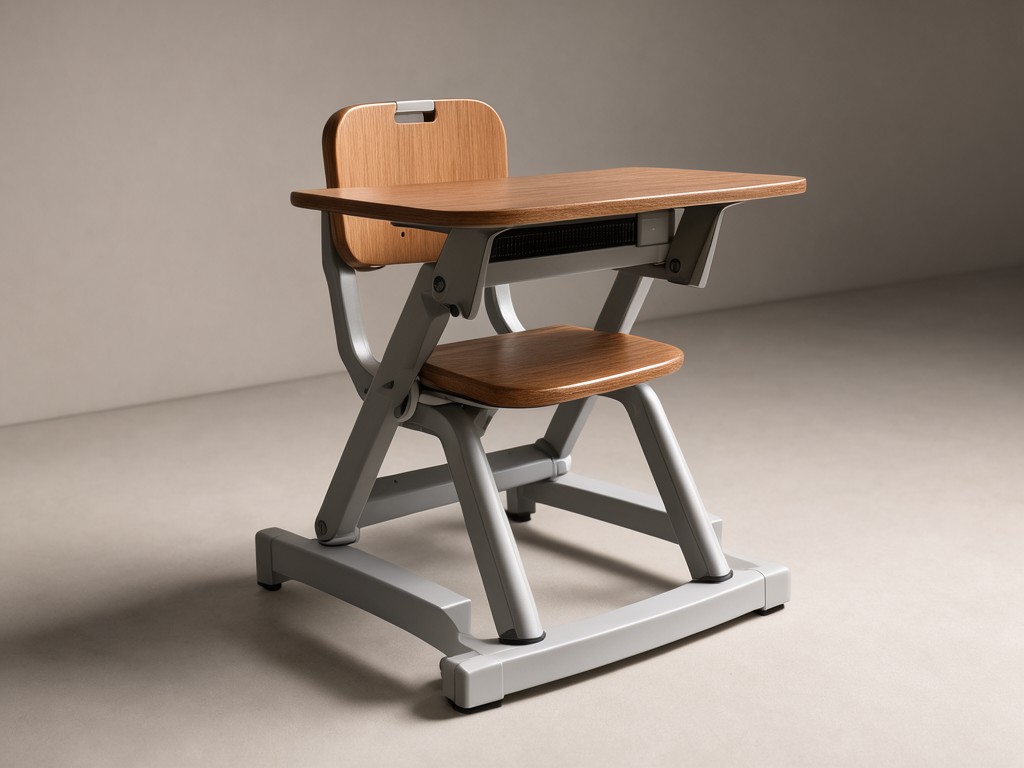
The factory delivers a complete kit: powder‑coated steel or aluminum frame, high‑pressure laminate (HPL) or melamine work surface, injection‑molded polypropylene seat and back, and a gas‑spring height‑adjustment mechanism rated for 10 000 cycles. All components arrive pre‑assembled to the point of final bolt‑up, reducing on‑site labor to a single hex key per unit.
Daily height changes by students cause the gas spring to see peak loads of 120 N; a spring rated below 150 N will lose force within 2 000 cycles, producing the “stuck desk” complaint that drives replacement orders.
The HPL top resists abrasion to 1 500 cycles (Taber) and meets EN 438‑2 Class 2 for impact, while the polypropylene seat retains 92 % of its flexural modulus after 5 000 h of UV exposure. Frame deflection under a 120 kg static load stays under 3 mm, keeping the work surface level for writing tasks.
Total cost of ownership shifts once returns are counted; a 5 % increase in frame gauge reduces warranty claims by 30 % but adds $1.20 per unit.
Adjustable height range: 580‑760 mm (student) or 710‑910 mm (teacher). Frame tube: 30 × 30 mm × 1.5 mm (steel) or 30 × 30 mm × 2.0 mm (aluminum). Top thickness: 18 mm HPL or 15 mm melamine. Seat depth: 380 mm fixed; backrest angle 95° ± 2°. Powder coat: 80‑100 µm, RAL 9005 standard, custom colours on MOQ ≥ 500 pcs.
If the gas‑spring force exceeds 180 N the desk will overshoot the top lock position, causing repeat service calls. Specify 150 ± 10 N for the student range and 170 ± 10 N for the teacher range.
Use the decision tree below to match the configuration to the end‑user environment.
| Parameter | Config A – Steel Frame | Config B – Aluminum Frame |
|---|---|---|
| Frame material | Cold‑rolled steel, 1.5 mm wall | 6063‑T5 aluminum, 2.0 mm wall |
| Top option | 18 mm HPL, Class 2 | 15 mm melamine, Class 1 |
| Height range | 580‑760 mm | 710‑910 mm |
| Gas‑spring force | 150 ± 10 N | 170 ± 10 N |
| Unit weight | ≈ 5.0 kg | ≈ 4.2 kg |
| Typical FOB price (USD) | $42‑$45 | $50‑$55 |
Tooling amortisation decides the real break‑even point; a $12 000 die for the aluminum frame pays back only after 2 500 units, so low‑volume runs stay with steel.
Assuming the same gas‑spring works for both height ranges leads to premature lock‑up. Assuming powder‑coat thickness alone guarantees corrosion resistance ignores edge‑coverage gaps on welded joints. Assuming a single carton size fits all configurations creates freight over‑charge when the teacher‑height desk exceeds 1 m in length.
OEM buyers need a stable BOM for 3‑year contracts; they lock the frame gauge, spring rate, and laminate grade at PPAP sign‑off and require a 0.5 % dimensional CPK on tube length.
Private‑label buyers prioritize brand‑ready packaging: each unit ships in a printed kraft carton with a UPC label, a QR‑code linking to the assembly video, and a 2‑year limited warranty card. They also request a 5 % over‑run allowance for retail replenishment.
Freight damage reports show that 12 % of claims stem from loose bolts rattling inside the carton; the fix is a molded PE insert that holds the frame, top, and seat as a single module.
Standard pack: 1 desk‑chair set per master carton (L 1150 × W 620 × H 210 mm), gross weight 13.5 kg (Config A) or 12.8 kg (Config B). Cartons are double‑wall corrugated, edge‑crush tested to 250 kg, stacked 4‑high on a 1 200 × 1 000 mm pallet, shrink‑wrapped with 70 µm stretch film. Each carton bears a barcode label (GS1‑128) with PO number, batch code, and configuration ID.