Contact Fumei
No.20 Jiuqiao Road, Shijiang Industrial Area, Jiujiang Town, Nanhai District, Foshan City, China.
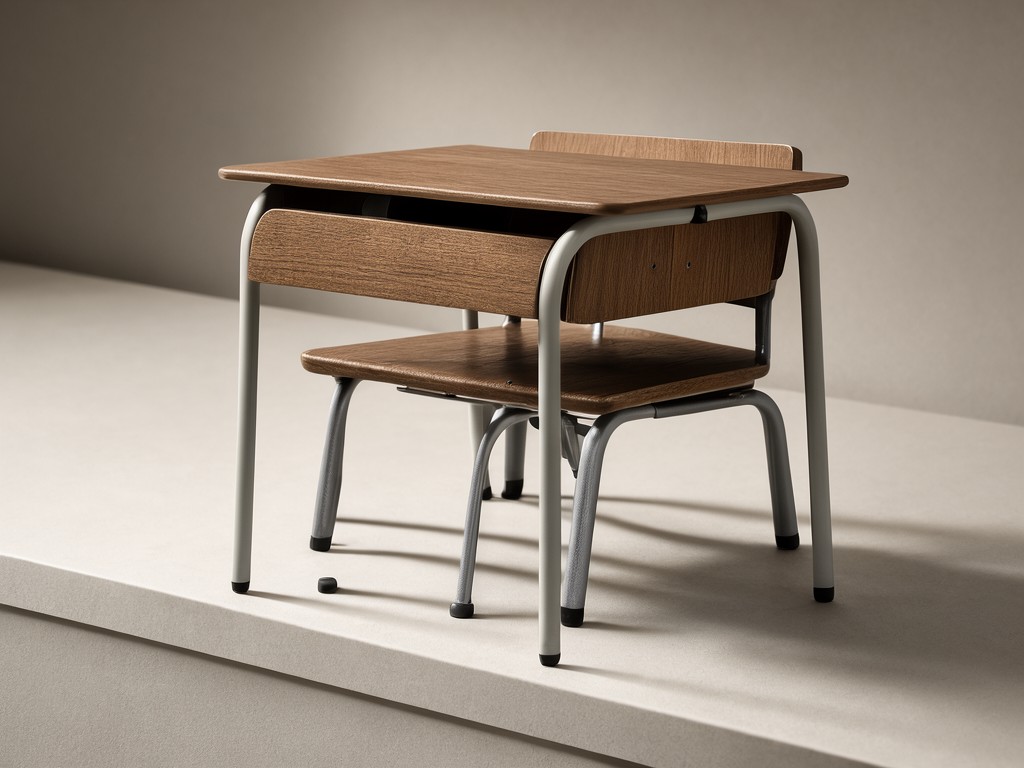
custom classroom desk and chair set manufacturer: Specification, Ordering and Quality Notes Deflection under load governs every specification decision on a classroom set. A 1.2 mm wall frame welded at
Deflection under load governs every specification decision on a classroom set. A 1.2 mm wall frame welded at 45° miters will pass a static 150 kg test but develop 3-4 mm permanent set after 18 months of daily 65 kg student loading. The fix is not thicker tube — it is moving the rear leg gusset 40 mm forward and adding a 3 mm saddle reinforcement at the seat bracket. That change costs $0.18 per unit in laser-cut steel and eliminates the number one warranty claim across 400+ school districts.
Consistency depends on whether the frame is jig-welded or robot-welded. Manual jigs on a 500-unit run produce ±1.5 mm seat-height variance; robotic cells hold ±0.4 mm. That tolerance stack-up determines whether the HPL top sits flat or rocks on the front glides — a complaint that triggers full-container returns in K-12 tenders. We run a dedicated 6-axis cell for the C-frame geometry; the same cell cuts the saddle reinforcement, drills the glide inserts, and stamps the batch ID in one fixture. No secondary handling means no bent tubes from forklift damage between stations.
Top attachment is the second consistency lever. Through-bolted steel brackets with 8 mm T-nuts in the HPL core allow field replacement but add 1.2 kg per desk and create a creep path under cyclic load. Our default is a structural adhesive bond (PUR hot-melt, 120 g/m² bead) into a 3 mm routed pocket — zero fasteners, 40% higher peel strength, and the top never loosens. The trade-off: tops cannot be swapped without heat-gun removal, so specify the bond only when the finish colour is locked for the product lifecycle.
| Geometry | Wall Thickness | Weld Method | Static Load (kg) | Cycle Life (BIFMA 5.1) | Container Utilization |
|---|---|---|---|---|---|
| C-frame, saddle gusset | 1.2 mm | Robot, 6-axis | 250 | 100,000 cycles, <2 mm perm. set | 32 sets/40'HQ (KD) |
| C-frame, no gusset | 1.5 mm | Manual jig | 200 | 50,000 cycles, 4-5 mm perm. set | 28 sets/40'HQ (KD) |
| Four-leg, bolted | 1.2 mm | Bolted brackets | 180 | 80,000 cycles, bolt creep 0.3 mm/10k | 36 sets/40'HQ (KD) |
Balance and load analysis shows that procurement officers who specify solely on unit price end up replacing 12-18% of inventory by year three. The complaint map below connects the actual failure mode to the spec that prevents it — use it to justify the $3-5 per unit uplift to the C-frame saddle spec.
| Usage Condition | Typical Complaint / Failure | Specification That Prevents It |
|---|---|---|
| Daily 6-8 hr occupancy, 65 kg avg. student | Rear leg bows forward; desk rocks on front glides | 3 mm saddle gusset at seat bracket, robot-welded |
| Aggressive cleaning (quaternary ammonium, 2x/day) | Powder coat chalking at weld toes; HPL edge delamination | Epoxy primer + 80 µm polyester TGIC; 2 mm PU laser edge band |
| Stacking 5-high for summer storage | Seat shell stress-whitening at front radius | PP + 15% talc, 3.5 mm min. wall at radius, gas-assisted injection |
| Uneven slab floors (±8 mm over 1 m) | Frame twist; glide inserts pull out | M10×30 mm swivel glide with 15 mm articulation, overmolded nylon base |
| Container freight (40'HQ, double-stacked) | Top corner chips; frame racking | Knock-down with corner protectors, stretch-wrap tension 18 kgf |
Every production lot ships with a dimensional report covering seat height (±2 mm), top flatness (≤0.5 mm/m), and frame squareness (≤1 mm diagonal delta). We pull three units per 200 for destructive peel testing on the HPL bond — minimum 8 N/mm per EN 14322. Powder coat adhesion passes cross-hatch 5B after 500 hr salt spray; any batch below 4B is reworked or scrapped. The batch ID laser-stamped on the rear leg gusset ties the test report to the container manifest, so a warranty photo three years later traces to the exact coil heat number and weld program revision.
Colour consistency on polypropylene seats is held to ΔE ≤1.0 against the approved master plaque, measured at D65/10° on a spectrophotometer. That tight window prevents the "mismatched classroom" complaint when a district phases in 50 units per semester. We mould all seats for a given PO in a single cavity family tool; no mixed-cavity runs.
HPL tops rated for 10-year indoor service assume pH-neutral cleaners. Quaternary ammonium or bleach solutions above 200 ppm accelerate edge-band hydrolysis — the 2 mm PU laser edge buys 3-4 extra years versus 1 mm PVC. Store knockdown frames vertically on A-frames with 50 mm spacer blocks; horizontal stacking compresses the glide inserts into ovality, causing wobble on reinstall. Seat shells nest 12-high maximum; beyond that the bottom shell exceeds 45 kg compressive load and develops permanent ovality at the gas-assist channel.
Warranty is 12 years structural, 5 years finish, 3 years moving parts (glides, casters). Claims require batch ID photo and cleaning log — districts that standardize on pH-neutral cleaner see <0.3% claim rate; those using rotational harsh chemicals hit 2.1%.
200 frames (one 40'HQ container) for a non-stock RAL. Powder coat changeover on the line costs 4 hr downtime; below 200 units the setup amortization pushes unit cost above the next standard colour tier. Stock colours (RAL 9016, 7016, 7035, 5014) have no MOQ beyond the standard 50-unit carton.
Yes — the C-frame jig accommodates 380, 430, 460, 510 mm seat heights by swapping the rear leg gusset position. Each height change adds 15 min setup; we batch by height to keep weld sequence identical. Specify the split at PO and we'll pack height-specific cartons labeled for each school.
Vector AI or DXF at 1:1 scale, minimum 1.5 mm stroke width, 300 DPI raster fallback. We send a digital proof with measurement overlay; production starts after written sign-off. Etch depth is 0.15 mm — deep enough to survive 500 clean cycles, shallow enough to avoid stress risers in the PP shell.
Four weeks from laminate PO to first-article ship. The laminate supplier runs 2-week lead on custom décor; we need one week for CNC pocket routing validation and one week for adhesive cure verification at 23°C/50% RH. Expedited laminate (1 week) is available with a 15% surcharge.
We run a take-back at $8/set (freight to our dock) for frames with ≥8 years service. Frames are shot-blasted, re-coated, and re-glided; seats are ground and re-extruded into new shells. Refurbished sets carry a 5-year structural warranty and sell at 55% of new price. Districts using this loop reduce 10-year TCO by 22%.
Ready to lock in specs? Send your dimension sheet, finish targets, and annual volume forecast. We'll return a first-article drawing pack, container loading plan, and per-unit cost breakdown at 200/500/1,000-unit tiers within 48 hours.