
Contact Fumei
No.20 Jiuqiao Road, Shijiang Industrial Area, Jiujiang Town, Nanhai District, Foshan City, China.
factory price classroom seating furniture solution: Specification, Ordering and Quality Notes When a brand extends an existing range into education furniture, the first constraint is rarely price alon
When a brand extends an existing range into education furniture, the first constraint is rarely price alone — it is the stack height that fits a 40-foot high-cube container without exceeding the 2,700 kg payload limit. A 10 mm increase in seat thickness across 1,200 units adds 480 kg of dead weight, pushing the shipment into a second container and erasing the margin the factory price was meant to protect. The decision rule: lock the seat shell geometry and wall thickness before quoting freight, then negotiate the frame gauge against the BIFMA X5.1 static load target of 1,350 N.
During a private-label launch with a fixed ship date, the artwork approval loop becomes the critical path. A logo pad-print on a polypropylene seat shell requires a 0.15 mm ink film that passes 200 cycles of Taber abrasion (CS-10 wheel, 500 g) without visible wear, but the same artwork on a powder-coated steel frame demands a 60-80 µm coating thickness and a cross-hatch adhesion score of 4B or better. If the brand supplies vector files at 72 dpi instead of 300 dpi, the rework adds seven working days — enough to miss the vessel cutoff. The fix: agree the artwork spec, substrate, and test method in the pre-production sample sign-off, not after the first container lands.
Budget seating often substitutes 1.2 mm cold-rolled steel tube for the specified 1.5 mm, saving 0.3 kg per chair but dropping the rear-leg buckling load from 1,800 N to 1,100 N — below the BIFMA requirement for Grade 1 educational use. The failure mode appears six months in: the rear legs bow outward under dynamic student loading, the glides lose contact, and the chair rocks. Powder coat on thinner tube also chips faster at the weld heat-affected zone because the substrate flex exceeds the coating's elongation limit.
Seat shells molded from recycled polypropylene with inconsistent melt flow index vary in wall thickness by ±0.4 mm. That variance translates to a 12% spread in flexural modulus, so adjacent chairs in the same classroom feel different — one rigid, one springy. Teachers notice; procurement reorders the competitor's SKU. The fix is a single-cavity tool with in-mold pressure sensors holding wall thickness to ±0.15 mm, even if the tooling cost adds $0.18 per unit at 5,000-piece MOQ.
1.5 mm tube meets BIFMA X5.1 Grade 1 at 1,350 N static load. 1.2 mm passes Grade 2 (900 N) but fails the dynamic drop test (100 mm, 10 cycles). Choose 1.5 mm for K-12; 1.2 mm only for adult-education rooms with controlled occupancy.
Virgin PP copolymer (MFI 8-12 g/10 min) holds ±0.15 mm wall thickness. Recycled blend (MFI 18-25) cuts resin cost 18% but widens variance to ±0.4 mm. For private-label programmes requiring consistent feel across SKUs, specify virgin resin and audit the MFI certificate per lot.
Frames are robot-welded on a 12-station rotary fixture: two passes per joint, 100% argon shielding, target penetration 1.2 mm minimum. Post-weld, frames run through a three-stage wash (alkaline degrease, iron phosphate, DI rinse) before epoxy-polyester powder coat at 180 °C cure. The coating thickness window 60-80 µm is verified by magnetic gauge on every 20th piece; salt spray (ASTM B117) passes 500 hours with ≤ 2 mm creep from scribe.
Seat shells are injection-moulded in a 4-cavity family tool (two seat sizes, two back sizes) with hot-runner gating at the seat pan centre. Cycle time 42 seconds. Ejector pins leave 0.8 mm witness marks on the underside — hidden when stacked. Critical dimension: the frame-to-shell boss engagement depth 14 ± 0.2 mm, verified by go/no-go gauge at first article and every shift change. Undersize bosses strip threads; oversize bosses crack the shell during screw driving.
| Parameter | Standard Range | Customisation Limit | MOQ Impact |
|---|---|---|---|
| Seat height (mm) | 310, 350, 380, 430, 460 | ±10 mm via leg cut; new height requires fixture change | 500 pcs per height |
| Frame finish | RAL 9005, 9006, 7016, 7035 | Any RAL classic; add 7 days for powder qualification | 300 pcs per colour |
| Shell colour | Pantone 286C, 348C, 186C, 420C, Black | Custom masterbatch; ΔE ≤ 1.0 vs approved chip | 1,000 pcs per colour |
| Glide type | Nylon swivel, 22 mm diameter | Felt, PTFE, or 25 mm nylon; tooling change for stem | 2,000 pcs per variant |
| Artwork location | Seat pan centre, max 80 × 80 mm | Backrest, leg brace, or under-seat; new pad-print fixture | 500 pcs per location |
| Packaging | 4-high stack, kraft wrap, corner boards | Individual polybag, retail box, or knock-down flat pack | No MOQ change; freight recalc required |
Public school districts ordering 500-2,000 chairs per tender specify BIFMA X5.1 Grade 1 compliance and require a 10-year structural warranty. The frame gauge, weld penetration, and coating thickness above are non-negotiable; the district's test lab will pull one chair per 500 for destructive verification. Private academies buying 100-300 units prioritise shell colour match to brand guidelines and artwork durability — they will reject a shipment if the logo fades after one semester of daily cleaning with quaternary ammonium disinfectant.
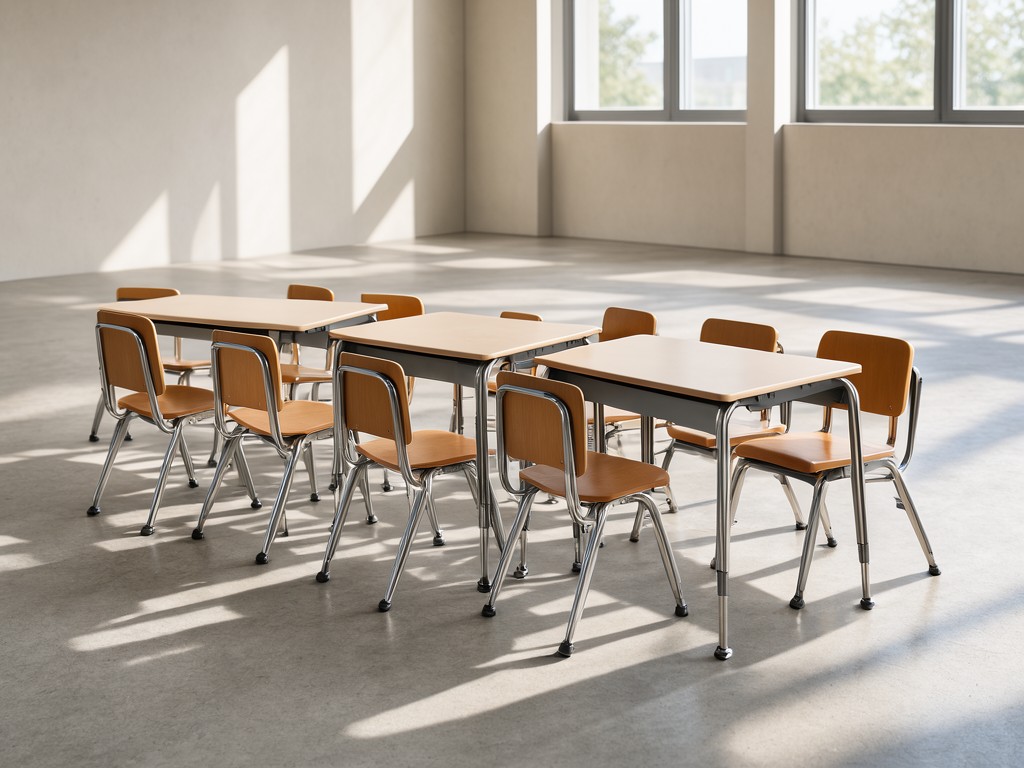
Furniture distributors serving the replacement market need knock-down packaging that fits a standard pallet (1,200 × 1,000 mm) at 48 chairs per layer, 4 layers high. The flat-pack frame uses M8 × 40 mm socket-head bolts with nylon-insert locknuts; assembly torque 18 Nm. Distributors also require batch traceability: each carton labelled with production date, powder lot, resin lot, and artwork batch code. That label is the only link between a field complaint and the corrective action on the line.
| Inspection Point | Method / Standard | Acceptance Criteria | Frequency |
|---|---|---|---|
| Frame dimensional check | CMM per drawing GD&T | All critical dims ±0.5 mm; hole pattern ±0.2 mm | First article + 1/50 pcs |
| Weld visual + penetration | No cracks, porosity >0.3 mm; penetration ≥1.2 mm | 100% visual; 1 macro-etch/lot | |
| Powder coat thickness | Magnetic gauge (ISO 2808) | 60-80 µm on all surfaces | Every 20th frame |
| Adhesion cross-hatch | ASTM D3359 Method B | 4B or 5B (no flaking) | First article + 1/200 pcs |
| Shell wall thickness | Ultrasonic gauge at 8 points | Nominal ±0.15 mm | Every 50th shot |
| Static load (seat + back) | BIFMA X5.1 Section 11 | 1,350 N seat, 680 N back, 1 min hold, no permanent set >3 mm | 1 per 1,000 pcs |
| Impact drop test | BIFMA X5.1 Section 15 | 100 mm drop, 10 cycles, no structural failure | 1 per 2,000 pcs |
| Artwork abrasion | Taber CS-10, 500 g, 200 cycles | No visible wear, ΔE ≤ 2.0 | First article per artwork batch |
| Salt spray | ASTM B117 | 500 hrs, creep ≤2 mm from scribe | Quarterly validation |
No production release until the brand signs the first-article report (FAR) covering: frame CMM, weld macro-etch, coating thickness/adhesion, shell wall map, static load, drop test, and artwork abrasion. The FAR package ships with the pre-production samples (5 pcs). Allow 5 working days for review; any comment triggers a corrective-action loop and a new FAR. Container loading begins only after written FAR acceptance.
Send the drawing pack, artwork files (AI or EPS, 300 dpi minimum), target RAL/Pantone references, and annual volume forecast. We return a detailed quotation with MOQ breaks, tooling amortisation schedule, and a sample timeline — typically 15 working days for pre-production samples after drawing approval.
Submit specification for quotation







