
Contact Fumei
No.20 Jiuqiao Road, Shijiang Industrial Area, Jiujiang Town, Nanhai District, Foshan City, China.
Top Quality higher education classroom furniture Exporter: What Buyers Should Check Before Ordering Tooling amortisation decides whether a private-label furniture program can compete on cost after the
Tooling amortisation decides whether a private-label furniture program can compete on cost after the first order. For a second source, compare the cost of matching approved dimensions, finishes and packing—not just the quoted unit price.
| Product type | Typical size range | Typical unit weight | Design point to confirm |
|---|---|---|---|
| Classroom chair | Seat height about 430–460 mm; overall height about 780–830 mm | About 4–7 kg | Seat size, back angle, frame footprint and stacking clearance |
| Student desk | Top about 600–700 mm wide by 450–500 mm deep; height about 720–760 mm | About 10–18 kg | Top thickness, frame bracing and usable leg clearance |
These are indicative ranges, not a substitute for an approved drawing. A heavier frame can reduce movement on uneven floors, but it also adds freight weight and handling cost. Set the decision rule around classroom use, target price and carton limits, then lock dimensions and tolerances before sampling.
Stacking chairs need clearance between frames and protection at contact points; fixed-row furniture has different footprint and stability priorities. The approved sample should represent the production materials and finish, not a hand-built substitute.
Steel tube frames suit repeated daily use when tube section, wall thickness, weld location and bracing match the load path. A thinner section may lower purchase and freight cost, but flex at joints can lead to loose fasteners or cracked weld areas after repeated movement. Powder-coated steel is a common finish; colour, surface preparation and coating coverage at edges all affect how wear appears over time.
Desk tops commonly use laminated board, with edge treatment selected for expected impact and cleaning conditions. Moulded polypropylene seats reduce part count and simplify cleaning, while upholstered options add comfort at a higher material and assembly cost. Choose by replacement exposure and buyer specification, not by material label alone.
Fewer fabric and foam variables make this a practical choice for large lecture-room orders. Confirm resin colour, seat geometry and attachment points against the approved sample; a low initial price does not offset inconsistent fit across a batch.
Fabric and foam provide a different seating feel, with added fabric, stitching and cleaning variables. Specify fabric colour, foam thickness, seam placement and replacement-part expectations before costing.
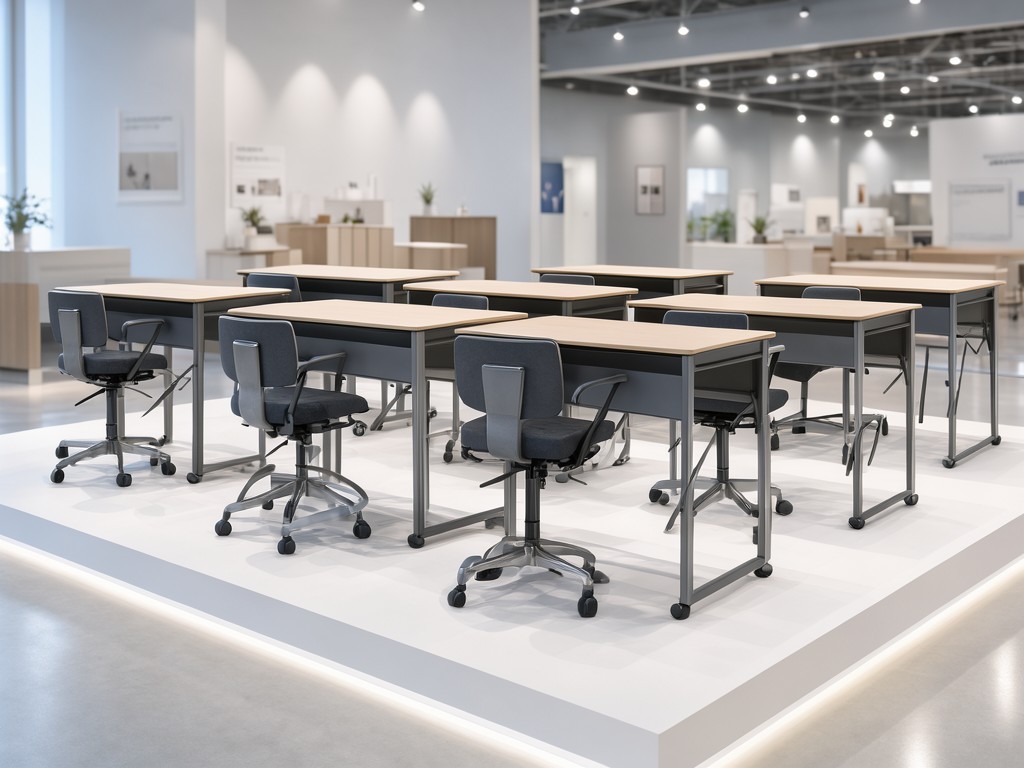
Replacement rate, not unit price, sets the real cost for furniture that sees daily movement between lectures. A frame that loosens, a desk edge that chips or a finish that wears at contact points can create returns, spare-part requests and warranty handling. Standard low-cost stock can be difficult to reorder to the same dimensions and finish once a batch sells through.
A controlled OEM specification gives buyers a reference for the next production run: drawing revision, material callouts, finish sample, hardware and carton arrangement. That control has value when a distributor needs a replacement unit to match the installed furniture rather than merely fill the same category.
Cost check: Compare expected returns, warranty claims, replacement freight and reorder setup against the unit-price difference. A specification that prevents batch drift can cost less across the program even when its first-order price is higher.
Private-label development starts with a drawing or reference sample, followed by confirmation of dimensions, materials, finish and pack-out. When a change affects tooling, such as a revised moulded seat shape, clarify the one-time tooling charge and the expected order volume over which it will be recovered. Frame jigs and repeatable assembly references also help keep hole positions and joint geometry consistent between runs.
Artwork should be supplied as a production-ready file with logo size, placement and colour references. Confirm whether branding applies to labels, cartons or furniture parts, and approve a marked sample before bulk production. These controls help a second-source order match the existing range without relying on verbal colour or dimension descriptions.
Consistency depends on controls at each production stage, not only a final visual check. Incoming material checks should compare tube dimensions, board thickness, hardware and finish samples with the approved specification. During fabrication, jigs and checks at weld and drilling stations help prevent frame alignment and hole-position drift.
For private-label repeat orders, retain the approved sample and revision-controlled drawings as the production reference. Record batch identifiers and changes to materials or suppliers; otherwise a small substitution can create visible differences in finish, fit or assembly across cartons. Agree on acceptable variation and rework handling before the first shipment.
Pre-shipment inspection should use the purchase specification and approved sample as its reference. Check dimensions, unit weight where specified, finish appearance, assembly fit, hardware count and carton marks. Sample assembled units can also be checked for rocking on a flat surface, frame movement at joints and correct stacking or nesting where the design requires it.
Packaging checks matter because bent legs, crushed corners and scratched coatings may appear only after transport. Confirm protective separators, edge guards and carton strength against the shipping configuration, then verify labels and quantity per carton. Inspection records should identify the lot and show any corrective action before release.
Cheaper stock options fail at the worst point in the season when replacement quantities are needed but the original finish or dimensions are no longer available. Separate raw-material availability from finished-goods stock when planning a reorder: steel tube and board may be replenished on one schedule, while branded production requires artwork, production slots and carton preparation.
Share a forecast and required ship window early, especially for mixed chair-and-desk orders or custom finishes. Confirm minimum order quantities for each model and colour, the lead-time effect of tooling or artwork changes, and whether spare parts can ship with the main order. A written reorder specification reduces sourcing risk if the original supplier cannot meet demand.
Send the target dimensions, material and finish requirements, expected order volume, branding files and export packing needs. A review can identify drawing gaps and the checks required to keep a second-source batch aligned with your approved product.
Discuss your classroom furniture specification







