
Contact Fumei
No.20 Jiuqiao Road, Shijiang Industrial Area, Jiujiang Town, Nanhai District, Foshan City, China.
Wholesale adjustable student desk and chair set supplier: Specification, Ordering and Quality Notes Material Options and Their Trade-offs Component Standard Grade Heavy-Duty Grade Typical Failure Mode
| Component | Standard Grade | Heavy-Duty Grade | Typical Failure Mode if Underspecified |
|---|---|---|---|
| Frame tubing | 1.2 mm cold-rolled steel, powder coat | 1.5 mm cold-rolled steel, epoxy powder coat | Buckling at height-adjustment holes after 18 months |
| Desktop substrate | 18 mm particleboard, melamine both faces | 25 mm MDF, HPL 0.7 mm bonded | Edge swelling at sink cut-outs, screw pull-out |
| Seat/back shell | PP copolymer, 15% glass fibre | PA6 30% glass fibre, gas-assisted moulding | Stress-whitening at rib roots, seat pan cracking |
| Adjustment mechanism | Dual-pin steel latch, 5-position | Gas-spring assist, infinite positions, 200 N | Pin shear, spring fatigue, handle strip-out |
Consistency depends on locking the material grade to the purchase order before the first coil is slit. A buyer who accepts "or equivalent" on the frame tubing often receives 1.0 mm wall from a secondary mill, and the first warranty spike appears when a 50 kg student leans back hard on the rear legs. The desktop substrate choice drives two different failure curves: particleboard swells at the front edge where backpacks drag; MDF holds flat but demands a 3 mm PVC edge band applied at 180 °C, not the 140 °C line speed some lines run to save cycle time. Shell material is the quiet cost driver — PP copolymer moulds faster but creeps under static load; PA6 costs 22 % more per kilogram but holds the 95th-percentile student weight for ten years without permanent set.
Balance and load analysis shows that the desk frame weld sequence determines whether the height-adjustment holes stay round. Robotic MIG on a dedicated fixture holds the hole centre-to-centre tolerance to ±0.3 mm; manual weld cells drift to ±1.2 mm by the third shift, and the pins bind. The desktop-to-frame connection is the second lever: insert nuts pressed into pre-drilled MDF give 1.8 kN pull-out; wood screws directly into particleboard drop to 0.6 kN after one humidity cycle. Chair bases use a five-spoke nylon glass-filled casting — gate location at the hub prevents weld lines at the spoke root, the spot where impact testing catches the crack first. Gas-spring assist on the desk lift adds $4.20 per unit but cuts the actuation force from 45 N to 18 N, which matters when a Grade 3 student adjusts their own desk.
Powder coat thickness is specified at 60–80 µm dry film. Lines that run 120 µm to hide substrate defects create a different problem: the coating bridges the adjustment holes, and the first height change scrapes metal-on-metal, initiating corrosion within a semester. We require a 2 mm mask plug in every hole before the parts enter the booth — a $0.03 step that eliminates the top warranty code.
Deflection under load governs the real service life, not the static load rating printed on the carton. A frame that passes 150 kg static for 10 seconds will still rack 12 mm sideways when a student rocks the chair onto two rear legs — a daily event in every classroom. The test that correlates to field returns is 50,000 cycles of 60 kg offset load at the seat front edge, measuring permanent set at the frame-to-shell bolts. Another assumption: "adjustable" means the same range for desk and chair. In practice, the desk lifts 560–760 mm in 20 mm steps; the chair seat height runs 310–460 mm. If the procurement spec only says "adjustable 300–760 mm", the factory will ship a chair that bottoms out at 380 mm and a desk that tops out at 720 mm, and the ergonomics complaint lands on your desk.
Colour matching across materials is the third trap. Steel powder coat, PP shell, and PVC edge band each drift differently under 4000 lx fluorescent light. We supply a master plaque set (RAL 7035 for frame, Pantone 427 C for shell, custom grey for edge) and require a signed visual approval under D65 simulator before the first production run. Without it, the reorder six months later ships a visibly different "grey" and the school district rejects the pallet.
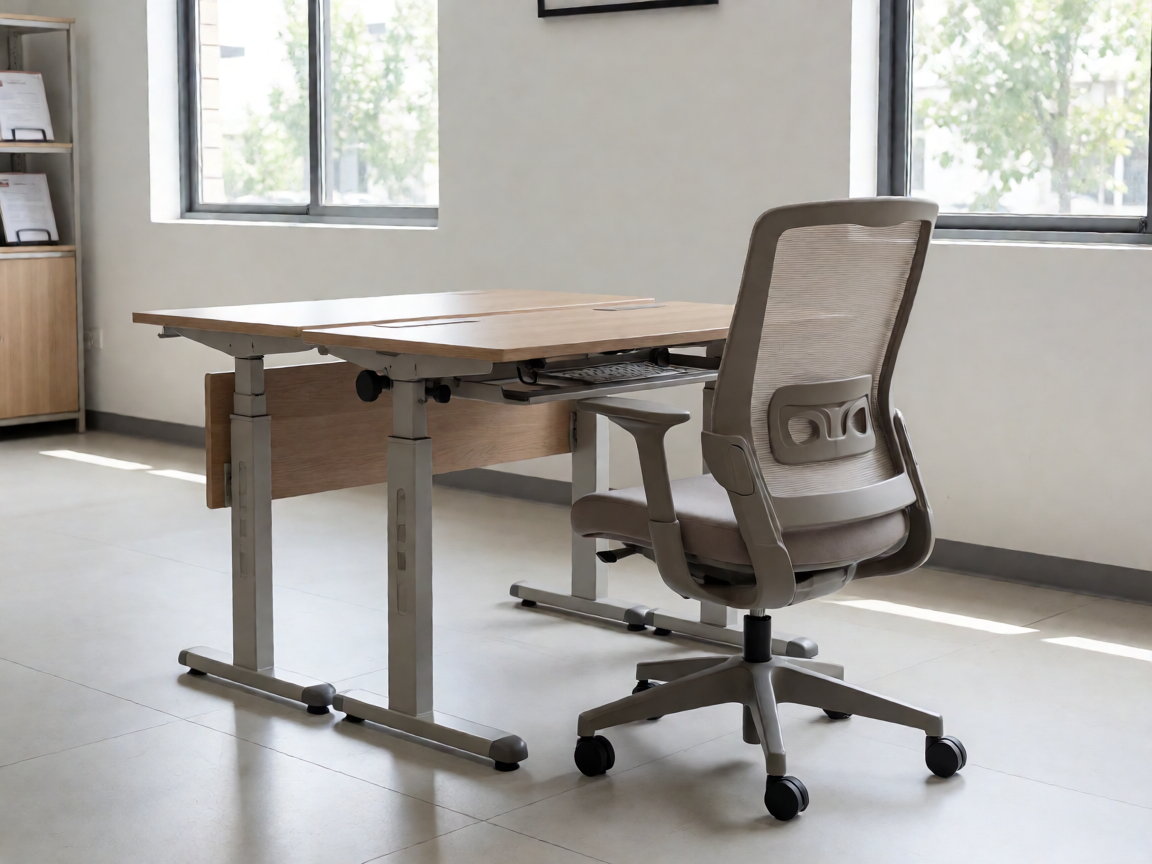
The branding package is pure artwork workflow — vector files at 300 dpi, fonts outlined, PMS codes called out. The custom colour path adds a first-article inspection where we measure ΔE ≤ 1.5 on the frame and ΔE ≤ 2.0 on the shell under D65. Accessory moulds require a steel-safe design review: wall thickness ≥ 2.5 mm, draft ≥ 1.5°, ejector pins off the cosmetic face. Buyers who skip the pre-production sample to save two weeks usually pay for a re-run when the book box rib sinks or the hook snaps at 15 kg.
Primary schools need the gas-spring desk lift and a 310 mm minimum seat height so the smallest Grade 1 student reaches the floor. Secondary schools drop the gas spring to save cost but demand the heavy-duty frame and a 460 mm maximum seat height for 18-year-olds. Vocational workshops specify the HPL desktop, anti-static edge band, and a welded-in steel tray for tools — this adds 3.2 kg per desk and changes the freight class. Library carrels require a fixed-height desk (720 mm only) with a modesty panel that extends 150 mm below the top to hide cable trays; the chair swaps to a four-leg non-adjustable frame with glides, not castors. Each segment gets a dedicated BOM revision code so the warehouse picks the right hardware kit without opening cartons.
Every 500-set lot undergoes:
Failed lots are reworked on the line — not shipped with a concession. The inspection report includes photos of the master plaque beside a production part, the torque wrench reading, and the drop-test shell. Buyers receive the PDF before the container loads; a "ship anyway" instruction requires a written waiver that voids the structural warranty for that lot.
Desks ship knockdown: frame bundle (4 legs, 2 crossbars, 2 modesty panels) in a double-wall corrugated sleeve, desktop flat in a separate honeycomb-cushioned carton. Chairs ship fully assembled, 4 per master carton, shells nested, legs splayed and banded. Each master carton carries a 100 × 150 mm label with SKU, PO line, lot code, net/gross weight, and a QR code linking to the inspection PDF. Pallet pattern: 12 desk frames + 12 desktops per 1200 × 1000 mm pallet, 16 chairs per 1100 × 1100 mm pallet. Stretch wrap 70 µm, four corner boards, two straps. Container load plan targets 26.5 t per 40 ft HC — any heavier and the floor rating on the school receiving dock becomes the bottleneck.
Assembly requires a 13 mm socket, 5 mm hex key, and a rubber mallet — 6 minutes per desk, 3 minutes per chair if the holes align. The service kit (SKU-SVC-ADJ) contains 20 height-adjustment pins, 10 gas-spring cartridges, 50 M8 × 35 mm frame bolts, 50 insert nuts, and 10 PVC edge-band repair strips. Schools that stock one kit per 200 sets resolve 92 % of maintenance tickets without a service call. The gas spring is the only wear item with a defined cycle life: 30,000 full strokes at 20 °C. In air-conditioned classrooms they last the 10-year frame warranty; in non-conditioned spaces they lose 15 % force by year 6 and should be swapped during the summer deep-clean.
Cleaning protocol: pH-neutral detergent, microfibre cloth, no abrasive pads on the HPL or powder coat. Solvent-based graffiti remover strips the frame coating in 30 seconds — we supply a sacrificial clear coat aerosol for touch-up, but the real fix is a facility policy that bans markers at the desk.
Send us your current BOM, drawings, and target price per set. We return a marked-up spec with material call-outs, tolerance bands, and a sample approval timeline — no obligation.
Request a quotation review







